
Somali piracy risk is returning as Red Sea shipping routes face rising pressure. The issue is no longer isolated piracy, but a wider maritime risk system linking the Gulf, Red Sea and Horn of Africa.
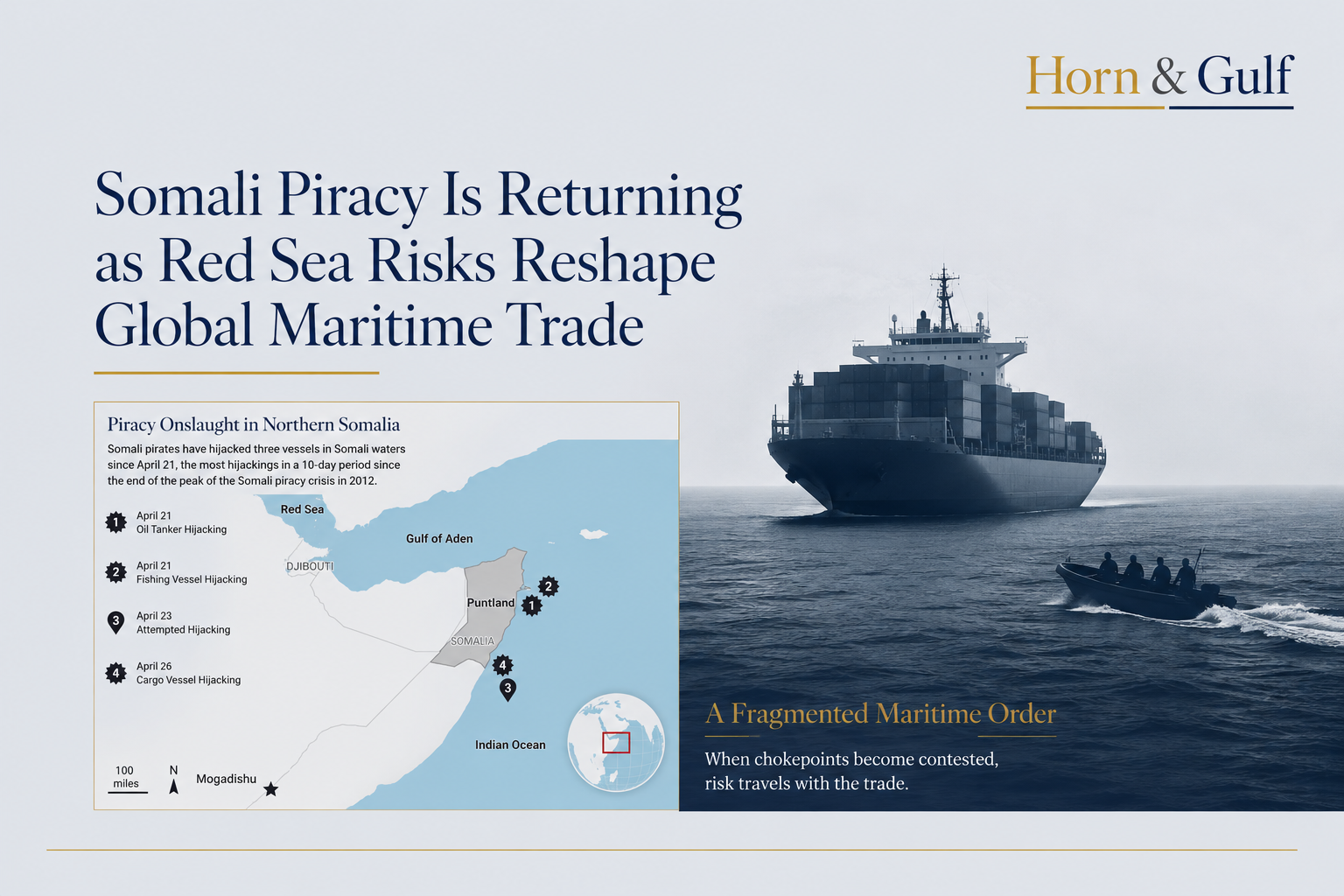
For more than a decade, Somali piracy was treated as a solved problem. Naval patrols expanded, private maritime security firms multiplied, and the shipping industry adjusted its behavior. The Gulf of Aden slowly moved out of the global headlines.
Now it is quietly returning. Not with the scale or visibility of 2008–2012, but as part of something structurally larger: the fragmentation of the maritime security system stretching from the Gulf to the Horn of Africa.
That distinction matters. Because what is happening off the Somali coast today is not simply the return of pirates. It is the return of maritime pressure into spaces that had temporarily stabilized under a different geopolitical order.
The Gulf Crisis Is Exporting Risk Toward the Horn of Africa
The recent escalation around the Strait of Hormuz and the continued instability in the Red Sea have begun to reshape shipping behavior across the wider region.
Tankers and container vessels are now operating inside a layered risk environment:
- Hormuz carries escalation risk
- The Red Sea carries missile and drone exposure
- Bab al-Mandab remains militarized
- Suez transit reliability has weakened
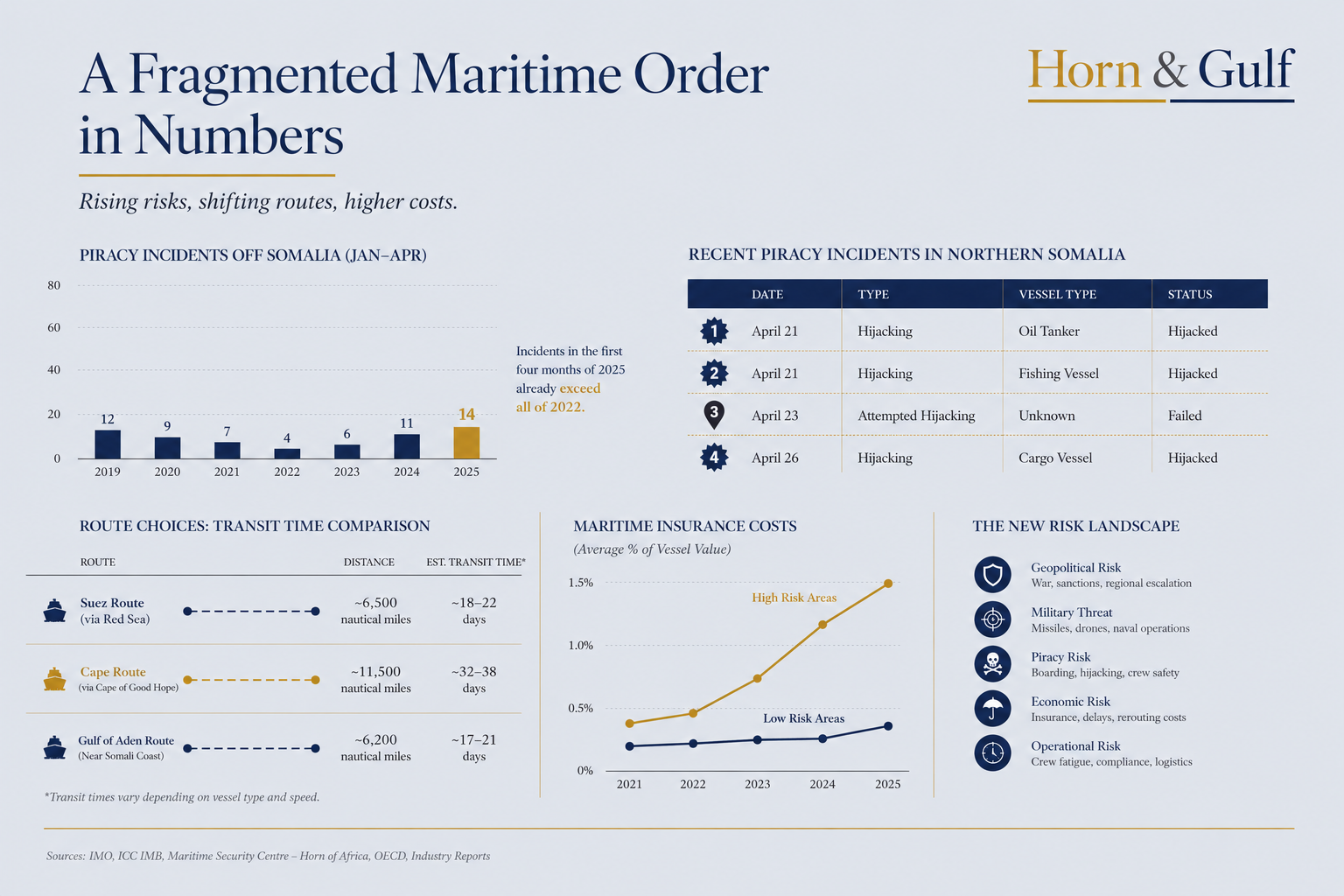
- Insurance costs continue to rise
Under these conditions, maritime traffic does not disappear. It adapts.
Some vessels reroute entirely around the Cape of Good Hope. Others continue operating through Gulf and Red Sea corridors but alter speed, route geometry, convoy behavior, and security protocols. In practice, this means more unpredictable traffic patterns moving through the western Indian Ocean and the Gulf of Aden.
This is where Somalia re-enters the picture.
Piracy historically thrives not only where states are weak, but where commercial shipping becomes vulnerable, overstretched, or insufficiently protected. The current maritime environment is beginning to recreate exactly those conditions.
Naval Attention Is Moving North
The maritime security architecture that suppressed piracy during the previous decade depended on sustained naval density.
American, European, Gulf and Asian naval assets maintained persistent patrol patterns across the Gulf of Aden. Commercial vessels moved through relatively predictable security corridors. The deterrence effect mattered as much as direct intervention.
Today, much of that attention is shifting northward. The primary strategic focus has become:
- Hormuz tanker protection
- Iranian escalation management
- Houthi missile interception
- Red Sea escort operations
- Energy infrastructure defense
This does not mean naval forces have abandoned the Horn of Africa. But it does mean the maritime system is becoming overstretched. And overstretched systems create openings.
Somali piracy does not require total security collapse to return. It only requires reduced predictability, fragmented patrol patterns, and commercial traffic adjusting faster than security coordination can follow.
Red Sea Disruption Is Quietly Changing Shipping Behavior
One of the least discussed consequences of the Red Sea crisis is behavioral rather than military. Shipping companies are increasingly optimizing for survivability instead of efficiency.
That changes route selection in subtle ways. Some operators avoid high-profile military corridors. Others seek flexible routing patterns outside heavily monitored lanes. Certain vessels shorten exposure time by altering coastal distance or transit timing.
These adjustments may reduce one category of risk while increasing another. A route perceived as safer from geopolitical escalation may become more exposed to opportunistic piracy activity. The result is a maritime system where threat environments overlap rather than replace one another.
This is why the old distinction between “war zone” and “piracy zone” is becoming less useful. The Gulf, Red Sea, and Horn of Africa are now functioning as a single connected maritime stress system.
Insurance Markets Are Already Pricing the Shift
The clearest signal often appears before headlines catch up: in insurance pricing.
Shipping markets are no longer dealing with a single premium structure. Operators are now calculating layered exposure across multiple risk categories simultaneously:
- war-risk premiums
- drone and missile exposure
- piracy risk
- crew security costs
- rerouting fuel expenses
- delivery delay liabilities
This changes the logic of maritime trade. The core question for shipping firms is no longer: “Which route is shortest?” It is becoming: “Which risk regime is more manageable?” That is a very different world.
A missile threat may be politically dangerous but operationally predictable. Piracy, by contrast, introduces irregularity and uncertainty. One raises geopolitical exposure; the other complicates operational planning and insurance modeling. Shipping companies are now balancing these risks against each other rather than avoiding them entirely.
The Horn of Africa Is Becoming a Pressure Geography
The Horn of Africa is no longer a peripheral theater in the global maritime system. It is becoming a pressure zone created by disruptions elsewhere.
When Hormuz becomes unstable, traffic pressure shifts westward. When the Red Sea becomes militarized, alternative routing patterns emerge.
When naval resources concentrate around energy corridors, peripheral security gaps widen. Somalia sits directly inside that chain reaction.
This is why the current piracy discussion should not be reduced to criminality alone. The issue is structural. Maritime insecurity is spreading outward from the Gulf system into the Horn of Africa through trade flows, insurance logic, naval redistribution, and corridor fragmentation.
The geography did not suddenly change. The system around the geography did.
A Fragmented Maritime Order
The broader implication is larger than piracy itself.
For years, globalization depended on the assumption that maritime trade routes would remain broadly secure, linear, and manageable. That assumption is weakening.
Instead, the region is moving toward a fragmented maritime order where:
- chokepoints compete with bypass corridors
- security becomes layered rather than centralized
- risk is continuously repriced
- and commercial logistics increasingly resemble geopolitical navigation
The return of Somali piracy is one symptom of that transition. Not the cause.
Final Reading
Somali piracy is returning not because the world has gone back to 2008, but because the maritime system that suppressed piracy is being stretched across too many simultaneous crises.
The Gulf remains tense. The Red Sea remains unstable. Hormuz remains vulnerable. And the Horn of Africa is once again absorbing the pressure generated between them. The result is not a single shipping crisis.
It is the slow emergence of a fragmented maritime order where risk no longer sits in one location — but moves across the system itself.