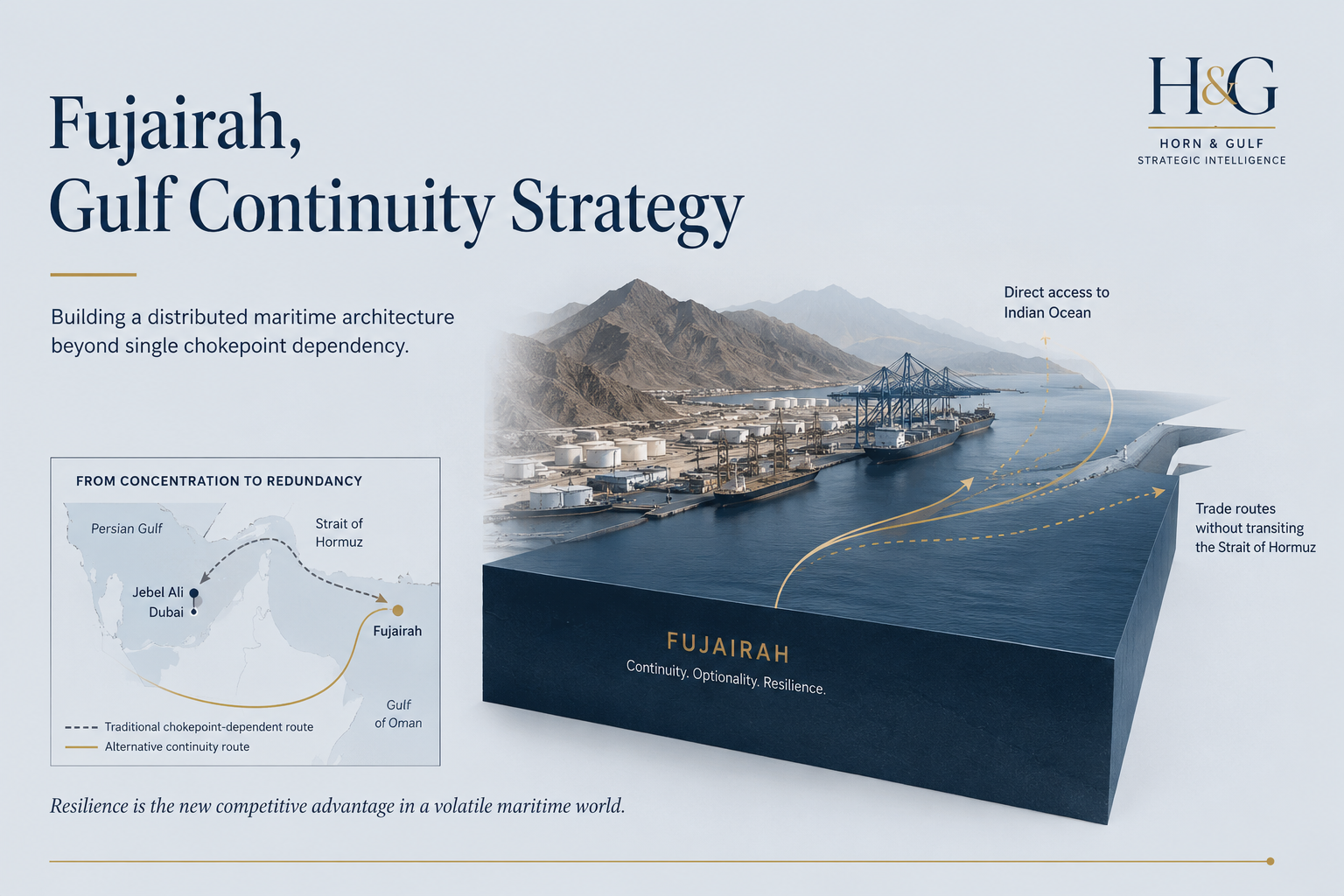
The Fujairah continuity strategy is becoming increasingly important to the UAE’s long-term maritime and energy architecture. As regional volatility continues to affect the Strait of Hormuz and Red Sea corridors, eastern Gulf infrastructure is gaining strategic value as part of a broader continuity and resilience framework.
Rather than replacing Hormuz, Fujairah appears designed to reduce excessive dependency on concentrated chokepoint systems while strengthening operational flexibility during disruption.
The Signal Beneath the Cargo Numbers
The recent acceleration around Fujairah has largely been presented as a logistics story: more containers, more storage, more vessels and higher throughput.
That reading is technically correct — but strategically incomplete.
What appears to be unfolding on the UAE’s eastern coastline is not simply the growth of another Gulf port. It increasingly resembles the construction of a broader maritime continuity framework designed to reduce operational vulnerability within concentrated Gulf trade systems.
Fujairah matters because of where it sits.
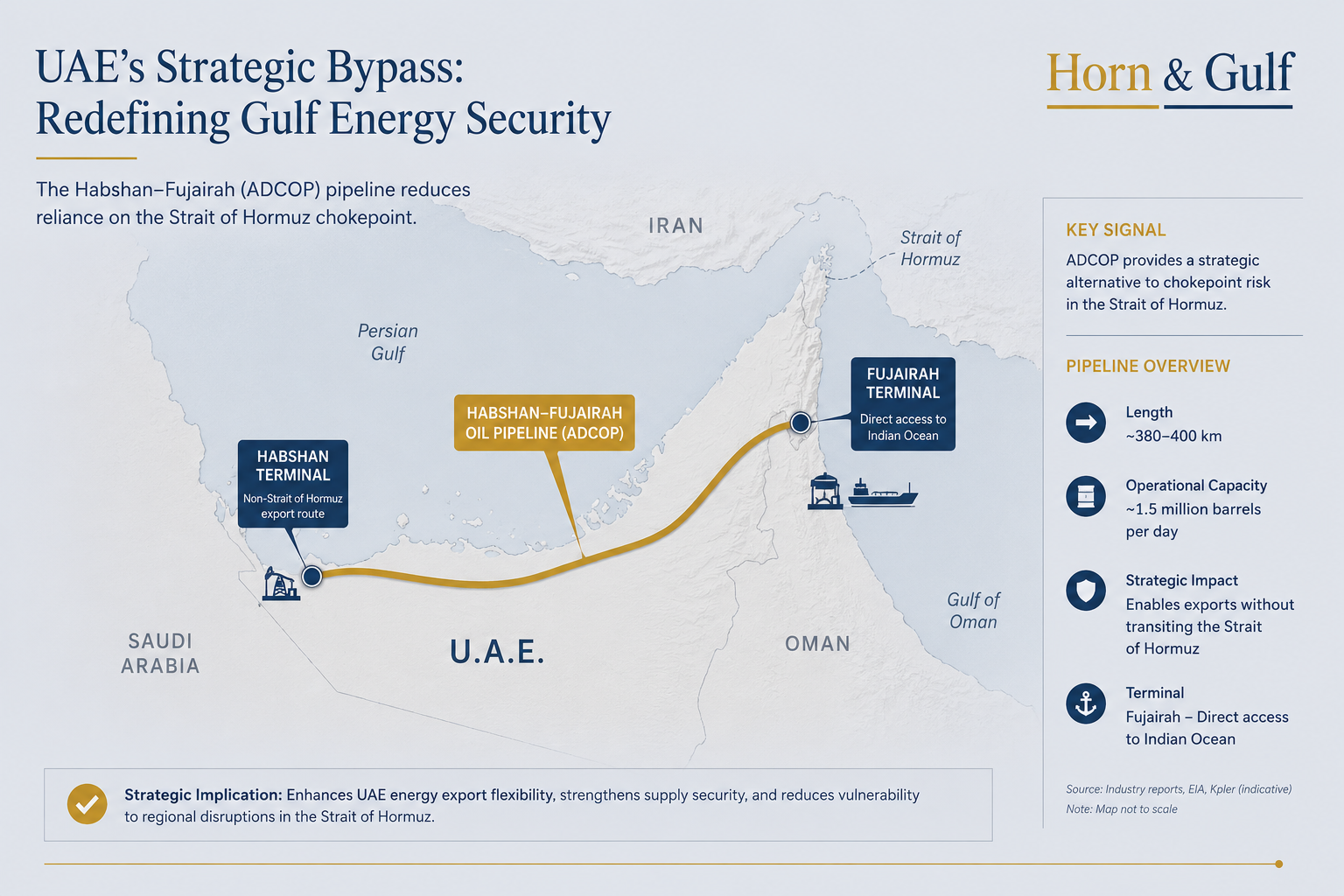
Unlike much of the Gulf’s energy and trade infrastructure, Fujairah opens directly onto the Gulf of Oman and the Indian Ocean without requiring passage through the Strait of Hormuz. In practical terms, this gives the port growing strategic importance as a continuity and rerouting node during periods of regional disruption.
That distinction is becoming increasingly important to Gulf geopolitical and maritime planning.
For years, regional trade architecture was built around concentration:
- concentrated export routes,
- concentrated port infrastructure,
- concentrated maritime insurance assumptions,
- and concentrated dependency on uninterrupted passage through Hormuz.
The underlying logic prioritized efficiency over redundancy.
That balance now appears to be evolving.
From Chokepoint Dependency to Corridor Redundancy
The deeper structural shift taking place across the Gulf is not the disappearance of Hormuz, but the gradual reduction of excessive dependency on a single maritime chokepoint. This distinction matters.
Hormuz remains indispensable to global energy markets. A substantial share of global oil and LNG flows still passes through the Strait, and no existing bypass infrastructure can fully replace its strategic role. Any suggestion that Fujairah alone could replace Hormuz would therefore be analytically overstated.
But replacement does not appear to be the objective. Resilience does. The UAE increasingly appears focused on building a distributed continuity strategy involving:
- multiple maritime gateways,
- diversified logistics corridors,
- bypass pipeline systems,
- expanded storage geography,
- and operational flexibility during periods of disruption.
Under this framework, Fujairah is not intended to eliminate chokepoint risk. Rather, it helps reduce the economic and operational concentration risks associated with chokepoint dependency. That shift may gradually influence how markets behave.
As alternative routing and storage capacity expands, shipping calculations, insurance models, strategic reserve planning and investor perceptions may increasingly adapt around continuity considerations rather than pure efficiency.
The importance of this transition is often underestimated because geopolitical power is still frequently discussed primarily through military frameworks.
Yet increasingly, one of the defining variables may be the ability to preserve continuity during disruption.
The Hidden Layer Is Insurance, Not Shipping
Most discussions around Fujairah focus on cargo volumes, storage capacity or bunkering operations. The more important story may lie in maritime risk management.
Global shipping systems are influenced not only by trade flows, but also by insurance pricing, rerouting assumptions, operational continuity calculations and geopolitical risk assessment. In that environment, ports positioned outside vulnerable chokepoints can gain additional strategic value during periods of instability.
This means Fujairah’s importance may rise not only when trade expands —
but also when geopolitical uncertainty increases. That is a significant structural shift.
Historically, instability in the Gulf was viewed primarily as a threat to regional economic systems. Increasingly, however, parts of the region appear focused on strengthening their role as providers of continuity and resilience infrastructure.
This is where Fujairah becomes more than a commercial port. It increasingly functions as strategic continuity infrastructure within regional maritime systems.
The implications are subtle but important:
- insurers may reassess exposure models,
- shipping firms may diversify routing calculations,
- strategic storage infrastructure may gain higher value,
- and capital may increasingly favor systems capable of maintaining operational continuity during periods of volatility.
In this context, the UAE increasingly appears focused on reinforcing its role as a stable continuity hub within regional trade and energy systems.
The Geography of Gulf Power Is Quietly Expanding Eastward
For decades, the Gulf’s economic gravity leaned heavily toward the enclosed geography of the Gulf basin itself. The rise of Fujairah suggests a gradual eastern expansion of strategic maritime focus.
This does not diminish Dubai, Jebel Ali or the traditional Gulf maritime core. Rather, it expands the strategic geography outward toward the Indian Ocean system.
That evolution matters because the future of Gulf geopolitical positioning is becoming increasingly connected to:
- Indian Ocean trade architecture,
- Red Sea corridor competition,
- East African maritime connectivity,
- energy rerouting systems,
- and wider Asian supply-chain integration.
In this environment, eastern-facing infrastructure gains strategic value beyond simple commercial metrics.
Fujairah, Khor Fakkan and adjacent logistics systems increasingly function as strategic buffers supporting continuity between Gulf infrastructure and global trade flows.
The Gulf is no longer operating solely as an enclosed energy basin. It is increasingly evolving into a broader networked corridor system.
The Underpriced Dimension: State Capacity
One of the least discussed aspects of Fujairah’s rise is what it may signal about state capacity and long-term infrastructure planning.
Large-scale continuity infrastructure requires:
- long-term planning,
- coordinated logistics integration,
- maritime governance,
- financial depth,
- energy strategy alignment,
- and institutional continuity.
These systems are typically developed over long periods rather than during moments of crisis. That may ultimately be one of the most important signals emerging from Fujairah.
The UAE appears increasingly focused not only on economic expansion, but also on infrastructure resilience under conditions of recurring regional volatility.
This reflects a broader shift visible across parts of the Gulf from growth optimization toward resilience optimization.
The distinction is significant. Growth-oriented systems prioritize efficiency during stable conditions.
Resilience-oriented systems prioritize continuity during periods of disruption. Increasingly, major Gulf infrastructure investments appear designed around the second logic.
The Red Sea, Hormuz and the Emerging Maritime Logic
The implications extend beyond the UAE itself. As instability periodically affects both the Red Sea corridor and the Hormuz system, global shipping networks are being forced to reassess assumptions that governed maritime trade for decades.
The earlier model depended heavily on concentrated efficiency:
- shortest routes,
- lowest costs,
- minimal redundancy.
The emerging model increasingly emphasizes:
- route flexibility,
- strategic storage,
- insurance resilience,
- operational optionality,
- and continuity assurance.
That transition may increase costs in certain areas. But structurally, it may also create a new hierarchy of strategic value within maritime systems.
Ports, corridors and logistics networks capable of functioning reliably during periods of instability may command increasing geopolitical and financial importance.
This is why Fujairah should not be viewed merely as a local infrastructure story. It appears increasingly connected to a broader repricing of maritime resilience and continuity.
Final Reading
Fujairah is no longer simply “a port outside Hormuz.”
It is becoming part of a wider Gulf transition away from concentrated maritime dependency toward distributed continuity architecture.
The significance of this shift lies not only in cargo volumes or storage expansion, but in the strategic logic underpinning the infrastructure itself.
The strategic value of continuity infrastructure may increasingly rival traditional chokepoint control in importance.
And within that evolving system, Fujairah is no longer peripheral infrastructure.
It is gradually becoming part of the Gulf’s core continuity architecture within the wider Indian Ocean and regional maritime system.