For over two centuries, the dominant political question was simple: “Which nation do you belong to?”
In the 21st century, a new question is emerging: “Where are you safe, valued, and able to build a future?” This shift is not theoretical. It is lived. And nowhere is it more visible today than in the UAE.
1. From Identity to Performance
Classical nation-states were built on:
• ethnicity
• language
• religion
• shared historical narratives
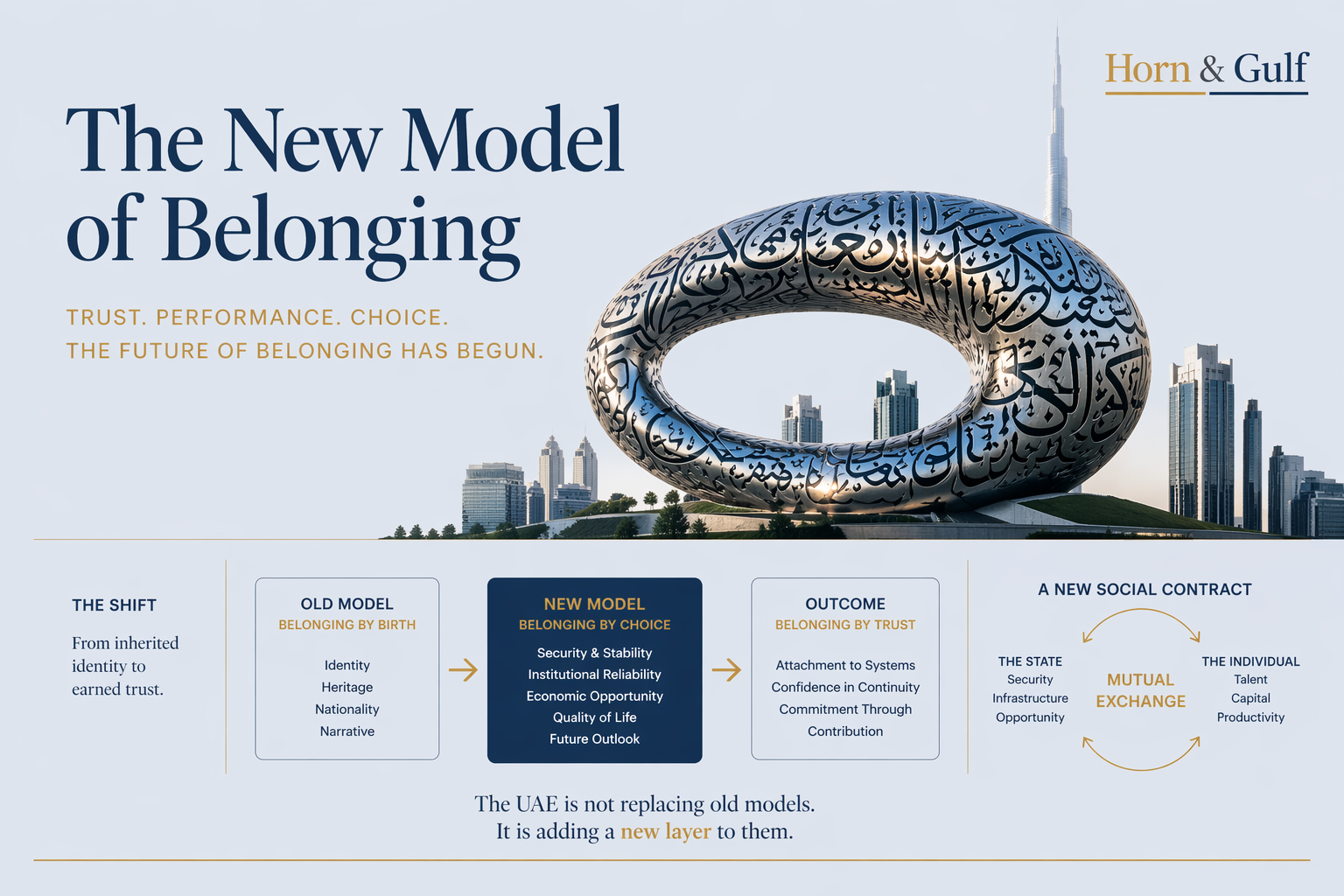
But modern global citizens—highly mobile, economically active, and digitally connected—are increasingly making decisions based on:
• security and stability
• institutional reliability
• economic opportunity
• quality of life
• future outlook
The UAE has positioned itself not as a nation you inherit, but as a system you choose.
2. The Rise of “Voluntary Belonging”
During recent regional tensions, something remarkable happened: Millions of expatriates—people without passports, voting rights, or formal political inclusion— chose to stay. Not because they had to. But because they trusted the system.
This is a new form of legitimacy: Not enforced loyalty, but earned trust under pressure. When leadership signals that “everyone who contributes belongs”, and backs it with real security, continuity, and governance capacity, something deeper forms:
A sense of belonging without formal citizenship.
3. Stability as the New Ideology
The 20th century was dominated by grand ideologies:
• nationalism
• socialism
• religious political movements
But today, for a growing segment of the global population: Stability itself has become the most powerful ideology.
In a world marked by volatility, conflict, and uncertainty,
countries that can deliver:
• predictability
• safety
• economic continuity
are no longer just states. They are places where people can plan their lives.
4. The Silent Transformation of Loyalty
What we are witnessing is subtle but significant:
People are beginning to form attachments not only to flags,
but to systems.
• Cities over countries
• Systems over narratives
• Outcomes over ideology
The UAE has understood this earlier than most.
5. A New Social Contract
The emerging model is not based on historical identity, but on mutual exchange:
• The state provides security, infrastructure, opportunity
• The individual contributes talent, capital, and productivity
And in between: A new form of belonging emerges— not legal, not symbolic, but real.
Final Thought
We are not witnessing the end of nations. But we are witnessing a change in what belonging means. The UAE is not replacing old models. It is adding a new layer to them.
A layer where:
• trust replaces ideology
• performance replaces narrative
• belonging becomes a choice, not just something inherited
The world may not fully see it yet. But those living it already know: The future of belonging has quietly begun.