Houthi Red Sea transit fees are increasingly becoming an institutional risk rather than simply a wartime security concern. Iran’s recent experience at the Strait of Hormuz suggests that the critical question is no longer whether a non-state actor seeks to tax maritime transit, but how close it is to establishing the administrative institutions that make those fees durable.
Most Red Sea risk coverage still treats a Houthi toll on Bab el-Mandeb as a conditional threat. Analysts write that the Houthis could impose fees, might formalize a toll mechanism, or are considering charging for passage. That framing is out of date. The real question is no longer whether the Houthis intend to tax the strait — Iran’s own parliament has already put a public number on it. The real question is how many institutional steps separate that intention from a standing authority like the one Iran built at Hormuz. Measured against Tehran’s own timeline, the answer is fewer steps than most shipping and insurance markets appear to have priced.
Iran’s Sequence, in Four Steps
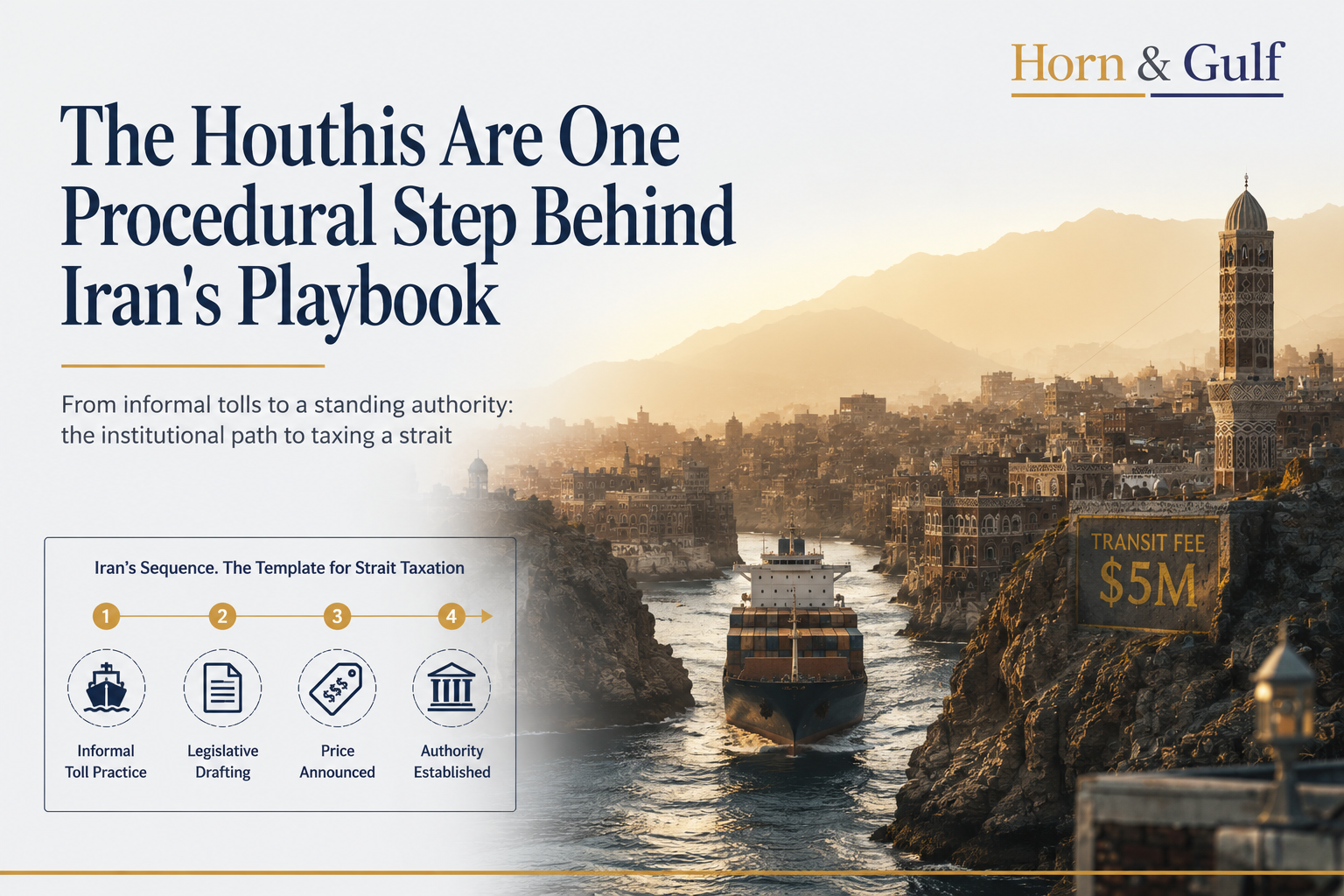
The Persian Gulf Strait Authority did not appear fully formed. It followed a sequence worth stating plainly, because that sequence is now the template for every other strait-adjacent armed actor. First came years of informal, unacknowledged toll-like practice. Vessels navigating IRGC-controlled waters faced de facto costs of passage, with no formal collection mechanism behind them. Second, as the 2026 war escalated, Iranian state media reported in late March that parliament’s Civil Affairs Committee had drafted legislation to authorize fee collection formally. An official quoted the move as “completely natural.”
Third, individual toll figures began circulating in shipping and trade press. Reports put per-vessel charges as high as $2 million. Fourth, on May 5, Iran founded the PGSA itself: a named authority with a registration process, an official contact channel, a published route map, and, weeks later, its own cryptocurrency-based insurance product. Each step converted an informal practice into an increasingly formal institution. The final step made the toll durable enough to survive a ceasefire. An authority does not need to collect revenue to persist — it only needs to keep registering ships.
Where the Houthis Currently Stand
Set against that sequence, the Houthis have moved further than most coverage acknowledges. They have not yet taken the final step. Documentation already exists for the informal stage: a UN Security Council panel of experts alleged in 2024 that Houthi-linked networks collected roughly $180 million a month in undeclared safe-passage fees during the group’s Red Sea campaign. The Houthis denied the claim, but it matches the pattern of tolerated, unacknowledged extraction that preceded Iran’s own formalization.
The leadership-discussion stage arrived in April 2026. The UK-based maritime intelligence firm Obsidian International told an industry conference it could state “with utmost confidence” that senior Houthi leadership had discussed formal Red Sea transit-fee mechanisms. The firm characterized Iranian involvement in those discussions as near-certain, at a senior level. The price-setting stage followed within weeks. In May, Iranian parliamentarian Ali Khezrian announced that Houthi forces had completed preparations to close Bab el-Mandeb. He said commercial vessels would face a choice: pay a $5 million transit fee, or reroute around the strait at an estimated cost of $30 million.
One step has not yet appeared: a named authority. No Houthi equivalent exists yet for the PGSA’s registration portal, its official transit-permit contact, its published route map, or its dedicated insurance product. Iran took roughly six to eight weeks to move from legislative drafting to a fully operational authority. On that compressed timeline, the Houthis currently sit where Iran stood in April — leadership consensus and a public price, but no bureaucracy yet built to collect it.
The Trigger Point Markets Should Actually Be Watching
This comparison identifies a specific, observable trigger for formalization. That trigger is more useful than attack frequency, which is a noisy and lagging indicator. Iran’s institutional shift did not track cleanly with military escalation; the PGSA was founded during a period when attack rates on shipping had already begun to fluctuate. The signal that mattered was administrative: a named body appeared, with a registration process attached to it.
The equivalent marker for Bab el-Mandeb would be a Houthi-announced authority, whatever name it takes, with a formal permitting channel. That announcement — not the next missile test, not the next ceasefire extension — would convert Bab el-Mandeb’s risk profile from episodic disruption to structural taxation. The PGSA’s founding date did exactly this for how markets model Hormuz risk.
What This Means for Those Pricing the Corridor
War-risk underwriters and marine insurers should build the administrative trigger into pricing models now, ahead of the event rather than reactive to it. Premiums that move only in response to attacks will systematically lag a toll authority’s actual founding. Hormuz war-risk pricing made this exact mistake, lagging the PGSA’s institutional entrenchment during this summer’s toll-free negotiating window.
Logistics operators are already weighing a return to the Red Sea route. Container lines including Maersk and CMA CGM have begun testing renewed transits, citing reduced attack frequency. The institutional trajectory argues for treating that data as necessary but not sufficient. A ceasefire in attacks and a ceasefire in institution-building are different variables. The second has kept moving even during periods when the first looked favorable.
For Gulf and Horn of Africa fiscal planners, a formalized Houthi toll authority would raise more than a security problem. It would compete directly with two of the region’s largest legitimate revenue sources tied to the same corridor: the Suez Canal Authority’s transit revenue, and Djibouti’s transshipment and port-lease income. Any traffic, insurance structuring, or fee payment that shifts toward a Houthi-run authority comes mechanically at the expense of the formal revenue base Egypt and Djibouti both depend on.
Creditors and development finance institutions underwriting Red Sea corridor infrastructure should shift their planning assumption. Most redundancy financing has been built around physical disruption risk. The more relevant risk now is institutionalized parallel taxation, which needs different mitigations — legal structuring around sanctions exposure for any entity that might inadvertently engage a future authority, not just insurance and rerouting capacity.
Iran needed roughly two months to move from a parliamentary draft to a functioning toll authority. The Houthis have already cleared the first three steps of the same sequence. They are missing only the institutional shell. Whether that shell appears is now a narrower, more answerable question than whether the Houthis want to tax the strait. It is the question the region’s insurers, operators and financiers should be tracking — and, on current evidence, are not.