
When reading the Gulf, the most common analytical mistake is not underestimating risk — but misreading its scale. In recent commentary, a recurring pattern has emerged: short-term disruption is rapidly translated into long-term structural collapse. The problem is not the data itself, but the speed and certainty with which conclusions are drawn from it.
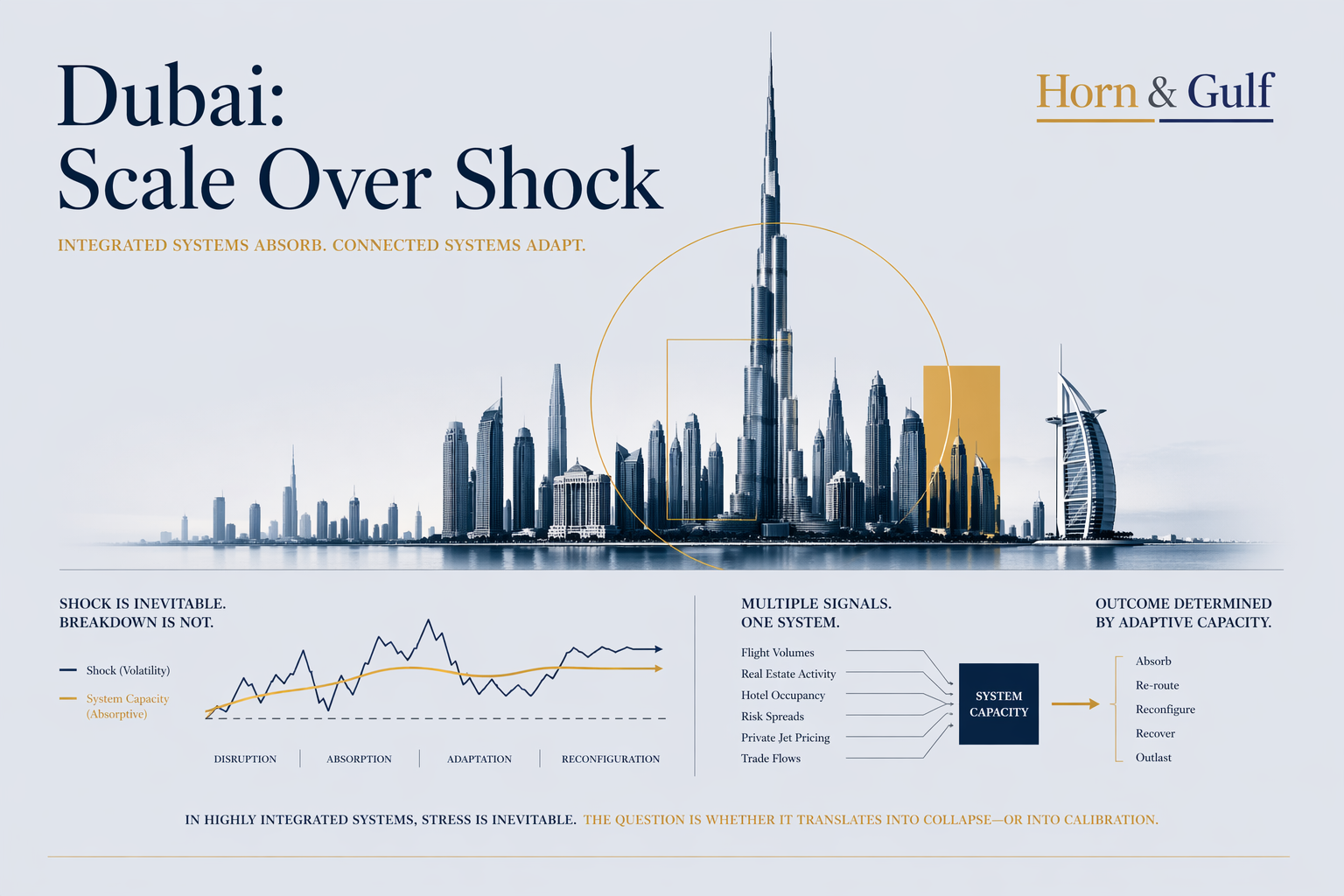
The first error is simple: confusing shock with breakdown.
In a high-tension environment, flight disruptions, rising insurance costs, shifts in investor behaviour and temporary contractions in key sectors are not anomalies — they are expected responses. What requires scrutiny is not their occurrence, but the tendency to treat them as definitive evidence of systemic failure.
The correct question is not whether a shock occurred. It is whether the underlying model has fractured. These are not the same.
Dubai’s structure is built on continuous flow, operational agility, financial flexibility and rapid reconfiguration. This does not make it immune to disruption. But it does mean that disruption alone is not sufficient proof of structural erosion. In systems designed around connectivity, initial volatility is often the first phase of adjustment — not the end state.
The second issue is more methodological: deriving absolute conclusions from proxy indicators. Night-time light intensity, flight volumes, hotel occupancy, private jet pricing, risk spreads or traffic rerouting patterns can all offer useful signals. But they remain signals — not direct measures of systemic collapse.
Each of these indicators is shaped by multiple overlapping variables: temporary closures, security protocols, insurance recalibration, routing adjustments, behavioural hesitation, and timing effects. Interpreting them in isolation, and then extrapolating them into definitive claims about capital flight, systemic breakdown or the end of “safe haven” status, collapses analytical distance.
There is a significant gap between movement in a proxy variable and a structural conclusion. That gap must be respected. A third pattern is more subtle: Analysing Dubai not as a system, but as a symbol.
In some readings, the city becomes a proxy for broader discomfort with models built on mobility, low taxation, expatriate labour and global capital flows. Concepts such as “platform city” or “space of flows” are invoked not as analytical tools, but as implicit critiques.
These frameworks are valid — but their existence does not, in itself, constitute evidence of fragility.
Dubai’s model has, for two decades, demonstrated an ability to absorb regional volatility precisely because of these characteristics. High mobility, modular infrastructure and networked integration do not only generate exposure — they also generate adaptability.
Connectivity can be a vulnerability. But it is also a form of resilience.
The same infrastructure that amplifies disruption can accelerate recovery and re-routing. Any serious analysis must hold both sides of that equation simultaneously. The fourth issue lies in scale:turning sectoral disruption into civilizational judgement.
Tourism may contract.
Real estate transactions may slow.
Air traffic may shift to alternative corridors.
Risk premiums may rise.
All of these developments are meaningful. But none, in isolation, is sufficient to declare the collapse of a city’s role within the global system.
In the Gulf context, “safe haven” has never meant the absence of risk. It has meant the relative capacity to manage, absorb and outlast it — through institutional control, financial infrastructure, logistical continuity and regulatory predictability.
When that distinction is lost, analysis drifts from interpretation into narrative construction. What matters, ultimately, is not only the presence of disruption — but the capacity of governance and systems to process it.
A port being targeted is not equivalent to a port system failing.
Airspace disruption is not equivalent to the end of hub logic.
Volatility in flows is not synonymous with structural exit.
Temporary departures are not evidence of permanent dislocation.
In highly integrated systems, stress is inevitable.
The question is whether that stress translates into collapse — or into recalibration.
A more grounded analytical approach would slow down the conclusions.
What is unfolding across the Gulf is not the sudden unraveling of a model, but a stress test of a highly connected system under geopolitical pressure. There are costs, disruptions and exposed vulnerabilities. But there is also institutional response, logistical adaptation and systemic reconfiguration.
Serious analysis requires holding both realities at once.
Understanding Dubai — and the wider Gulf — demands neither uncritical admiration nor premature collapse narratives.
It requires scale, restraint and structural clarity.
Because in some cases, a system absorbs shock without breaking.
In others, indicators move while the underlying architecture holds.
And often, the greatest analytical error is to mistake disturbance for decline.