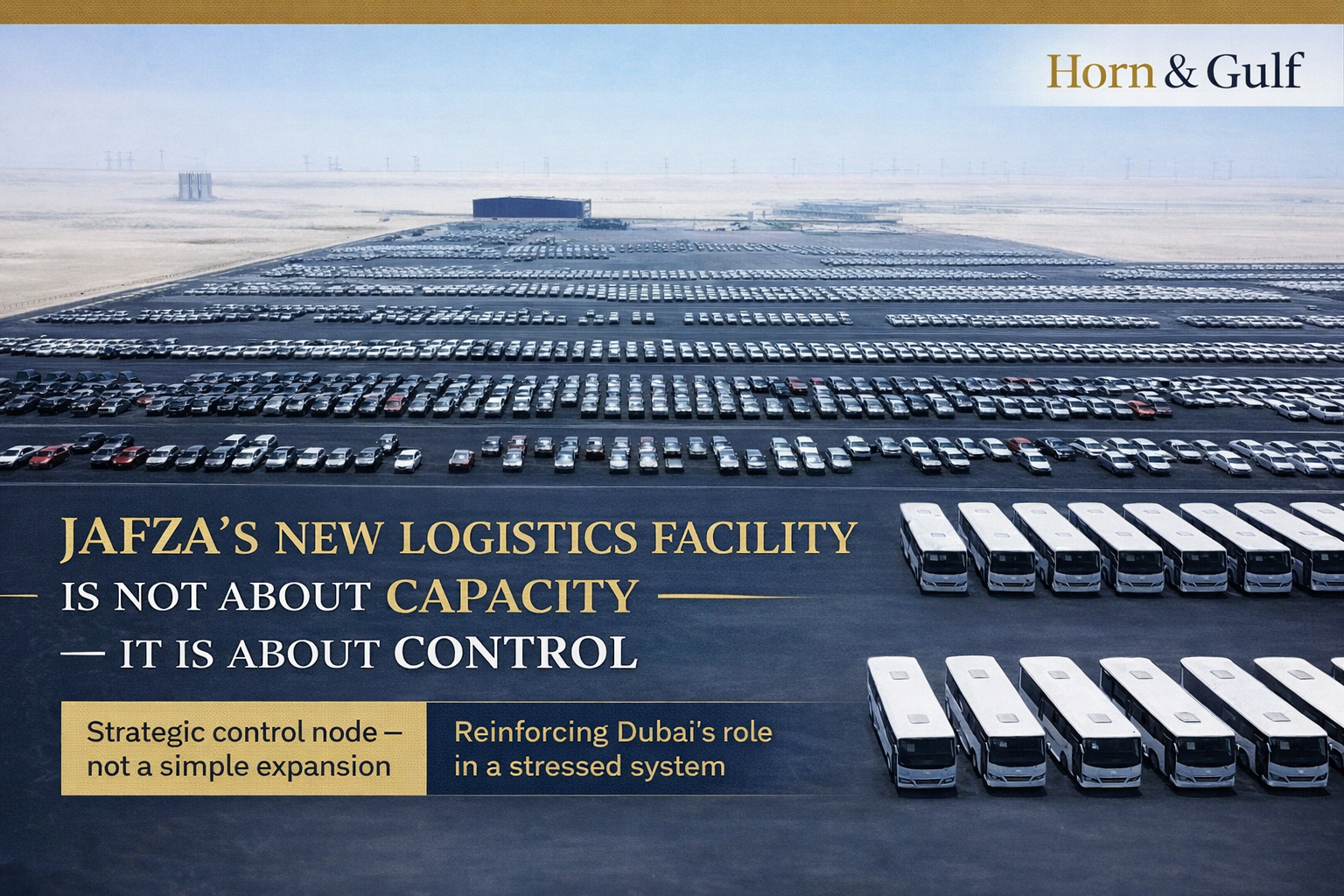
At first glance, the newly announced vehicle logistics center in JAFZA looks like a standard expansion: one million square feet, capacity for 6,500 vehicles, operations starting in May 2026.
But this is not a capacity story. It is a systems story. Dubai is not investing in storage. It is reinforcing its role as a redistribution layer within a stressed global logistics network. Vehicles in this context are not end products — they are mobile inventory, destined for re-export across Africa, Central Asia and beyond.
The significance lies in where this facility sits: JAFZA. This is not just a free zone. It is one of the most integrated logistics nodes in the world — connected to Jebel Ali Port, air cargo networks, customs systems and trade finance infrastructure. Adding a vehicle logistics hub here does not expand the system linearly. It deepens it vertically.
In practical terms, this means greater control over flow: not just moving goods, but sorting, holding, reallocating and redirecting them depending on market conditions. Timing is equally important. With ongoing instability in the Red Sea and rising uncertainty across key maritime corridors, global supply chains are no longer defined by efficiency alone, but by adaptability. This facility is a response to that reality.
It allows Dubai to absorb volatility rather than react to it — to function as a buffer when routes are disrupted and as a redistribution hub when flows need to be recalibrated. The analytical mistake is to read this as growth. It is not.It is system reinforcement.
And in periods of uncertainty, the actor that matters most is not the one producing goods, but the one ensuring they keep moving.