
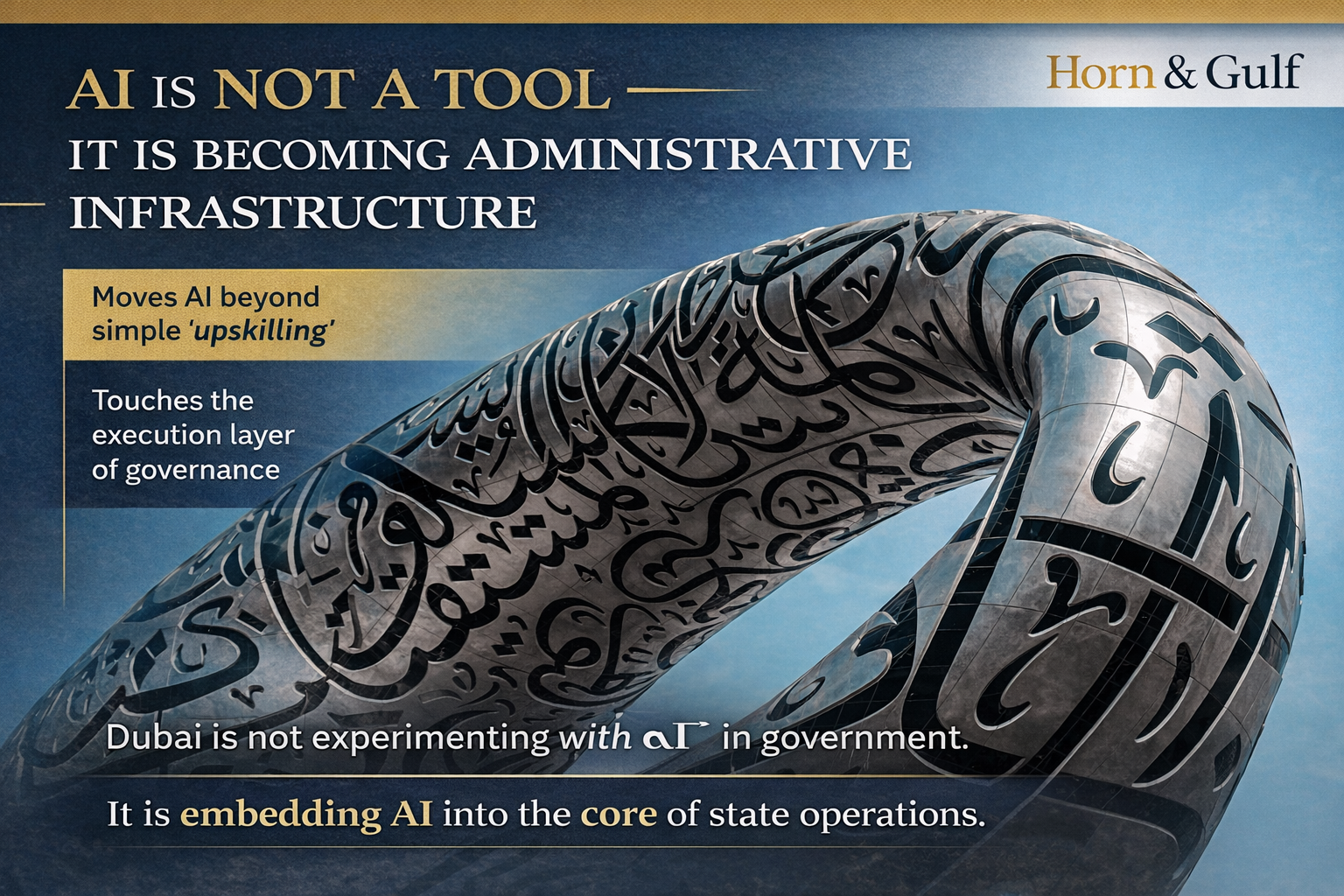
For most observers, Digital Dubai’s announcement of an AI workforce program looks like a familiar story: government upskilling, future readiness, talent development. But that reading misses the signal This is not about training.
It is about restructuring how the state operates.
What This Program Actually Changes
Training 50,000 government employees in AI is not a marginal upgrade. It touches the execution layer of governance — where policy becomes action. In most countries, AI remains: Experimental, Outsourced or siloed within tech teams.
Dubai is doing something structurally different. It is embedding AI into: Decision workflows, Administrative processes, Service delivery systems. This is not digitization. It is operational re-architecture.
From Human Bureaucracy to Hybrid Systems
Traditional governance relies on human bottlenecks: Slow approvals, Fragmented data, Institutional inertia. AI changes this — but only if it is system-wide, not selective. What Dubai is attempting is a shift from: Human-dependent bureaucracy to Hybrid decision systems (human + AI).
And scale matters.
50,000 employees means this is not a pilot. It is institutional penetration.
Why This Matters in a Crisis Environment
In periods of regional instability, the advantage is not just capital or infrastructure. It is decision speed and coordination. A system that can: Process information faster, Align departments in real time, Reduce friction in execution …becomes structurally more resilient.
This is the same pattern we saw in logistics (JAFZA): Control is not built through capacity alone. It is built through coordination layers. AI is that layer — but applied to governance.
A Pattern: Dubai Builds Systems Before They Are Needed
This is not the first time Dubai has moved ahead of visible necessity. During COVID: Borders closed globally, Mobility collapsed. Yet Dubai reopened earlier than most. Not because risk disappeared — but because its system allowed faster recalibration. The current AI push follows the same logic: Build capability before stress peaks, Not after.
What Most Analysis Misses
The common mistake is to interpret this as: Innovation branding, Future-of-work narrative, Or tech ambition. But the underlying shift is more fundamental. This is about: who controls decision-making speed, how information translates into action and where institutional efficiency compounds over time.
The Signal
Dubai is not adopting AI. It is integrating AI into the core logic of governance. And in a region where volatility is structural, systems that adapt faster do not just survive. They redefine the playing field.
Conclusion
The AI Workforce Transformation Program is not about skills. It is about state capability. Just as logistics infrastructure reshapes trade flows, administrative infrastructure reshapes power. And increasingly, that infrastructure is no longer physical. It is algorithmic.