
The international conference on Sudan held in Berlin looked, at first glance, like a familiar story:
pledges of aid, calls for ceasefire, and whispers of tension behind closed doors. But that reading is incomplete.
What unfolded in Berlin was not a diplomatic failure. It was something deeper: A visible manifestation of Europe’s inability to align with the emerging power structure across the Red Sea–Horn of Africa system.
The Misread: “The Conference Failed”
The media instinct is predictable: “Talks collapsed,” “no agreement,” “rising tensions.” But Berlin was never about outcomes. It was about structure. Because this conference: did not bring the actors who can stop the war, and failed to align even those who influence it. This is not an outcome failure. This is an alignment failure.
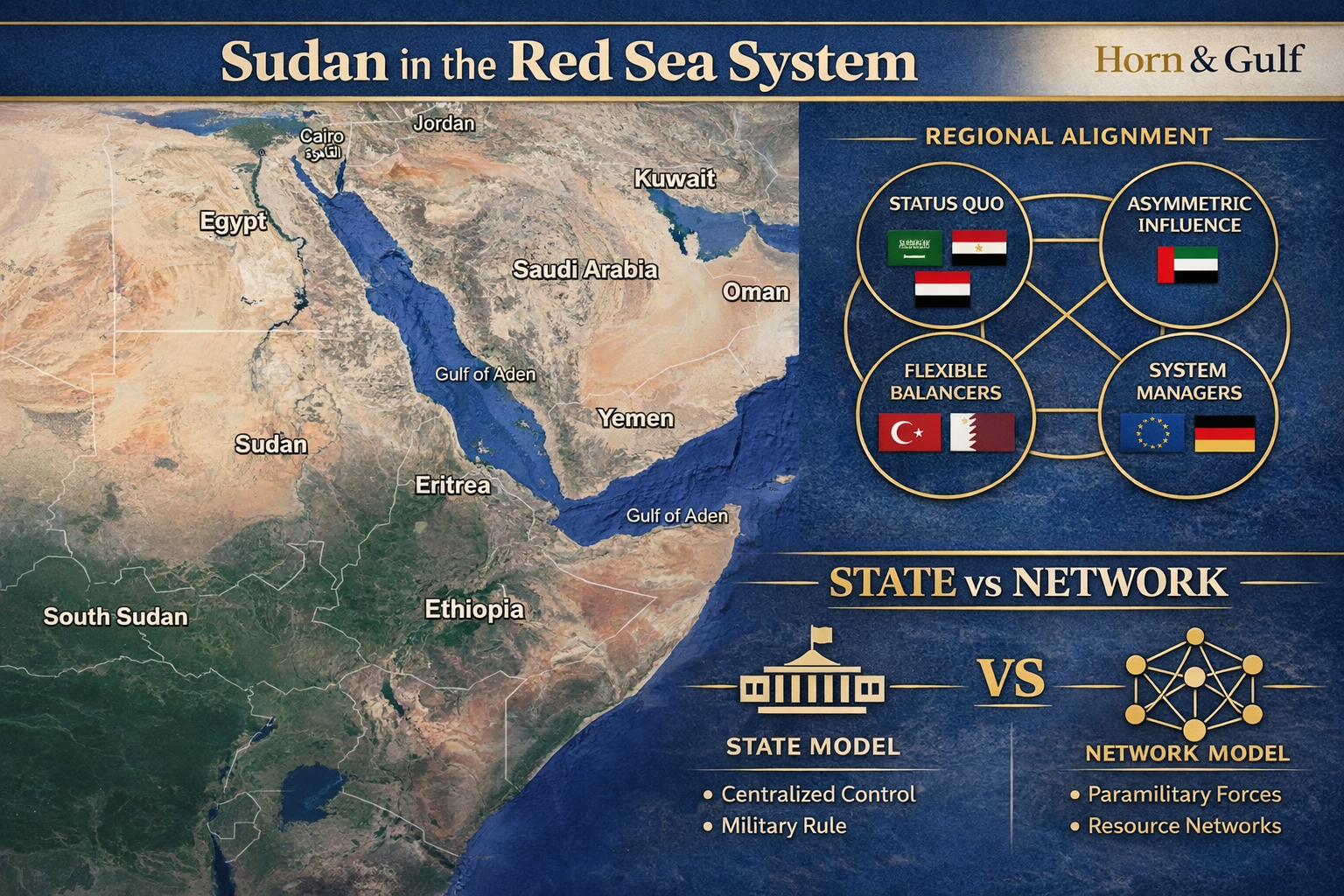
A System That No Longer Aligns: Four Power Blocks
Sudan is no longer a binary civil war. Berlin made that clear. The system is now composed of four distinct blocs:
1. Status Quo Stabilizers
- Saudi Arabia
- Egypt
Their priority is straightforward: Prevent state collapse and preserve centralized authority. Control, order, hierarchy.
2. Asymmetric Influence Players
- United Arab Emirates
A different logic applies here:
Influence is not built through the state, but through networks. For this model, Sudan is not a crisis. It is a field of opportunity bring stability and sustainable economic structer to the region.
3. Flexible Balancers
- Qatar
- Turkey
These actors do not fix positions. They create them. Diplomacy, flexibility, opportunistic positioning.
4. System Managers (Operating Outside the System)
- Germany
- European Union
The architects of Berlin. But with a structural limitation: They are attempting to manage a system they are not embedded in.
The Core Friction: Who Gets to Shape Sudan?
The real debate in Berlin was not about Sudan. It was about authority. Who has the right to shape the future of a state in collapse? The national government? Regional powers? Economic networks? International norms? There is no consensus. And Berlin exposed that clearly.
The Design Flaw: Wrong Tool, Wrong Table
The Berlin conference was structurally constrained from the start. Because: The actors fighting the war were not in the room. And the actors in the room were not aligned. The implications are predictable: Ceasefire calls remain symbolic. Aid becomes the only deliverable. The logic of the conflict remains untouched. Berlin did not fail. It functioned exactly as it was designed to.
A Deeper Reading: Sudan Is Not a Country — It Is a Node
In an H&G framework, Sudan is not analyzed in isolation. It is: A critical node within the Red Sea operating system. This system connects:
- Bab Al-Mandeb
- Gulf of Aden
- Horn of Africa
- Gulf capital flows
Sudan is not just geography. It is a connector.
The Real Conflict: State vs Network
The war in Sudan is not just military. At its core, it is structural: A confrontation between state-based authority and network-based power. The army represents the state model, The opposing forces represent networked, resource-driven structures. Regional actors are not neutral. They are investing in different models. Which is why the conflict: persists, fragments,resists resolution.
Europe’s Strategic Illusion
Berlin reflects a deeper assumption: That crises can be managed through conferences. But the system shaping Sudan: is not table-based, is not diplomacy-driven, It is network-driven. Built through: finance, logistics, security linkages
What This Means
For the region:
Sudan is not an exception. It is the new baseline.
For the Gulf:
Competition is no longer ideological. It is operational.
For Europe:
Influence is diminishing. Because it operates outside the system it seeks to shape.
Conclusion
Nothing “collapsed” in Berlin. Something more important was revealed: Sudan is not failing. The system around it is being renegotiated.