Dubai real estate pricing shift is no longer driven only by cyclical demand or speculative momentum. The deeper structural change is the gradual repricing of the market around capital protection, infrastructure quality, global connectivity and institutional resilience.
As regional volatility continues to influence investor behavior across the Gulf and Red Sea system, Dubai increasingly operates as a layered pricing environment rather than a single unified property market.
Most investors still talk about Dubai real estate as if it were one market. It isn’t. And that misunderstanding is becoming more expensive.
Because what we are seeing today is not a downturn. It is a repricing—driven by a new global equilibrium where safety, continuity, and system reliability are no longer assumed. They are priced.
Three Markets — One Misinterpretation
Dubai has always operated as three parallel property markets. But in a high-growth cycle, that distinction gets blurred. Capital flows everywhere, and performance looks uniform. That phase is over. Now the separation is visible again—and it matters.
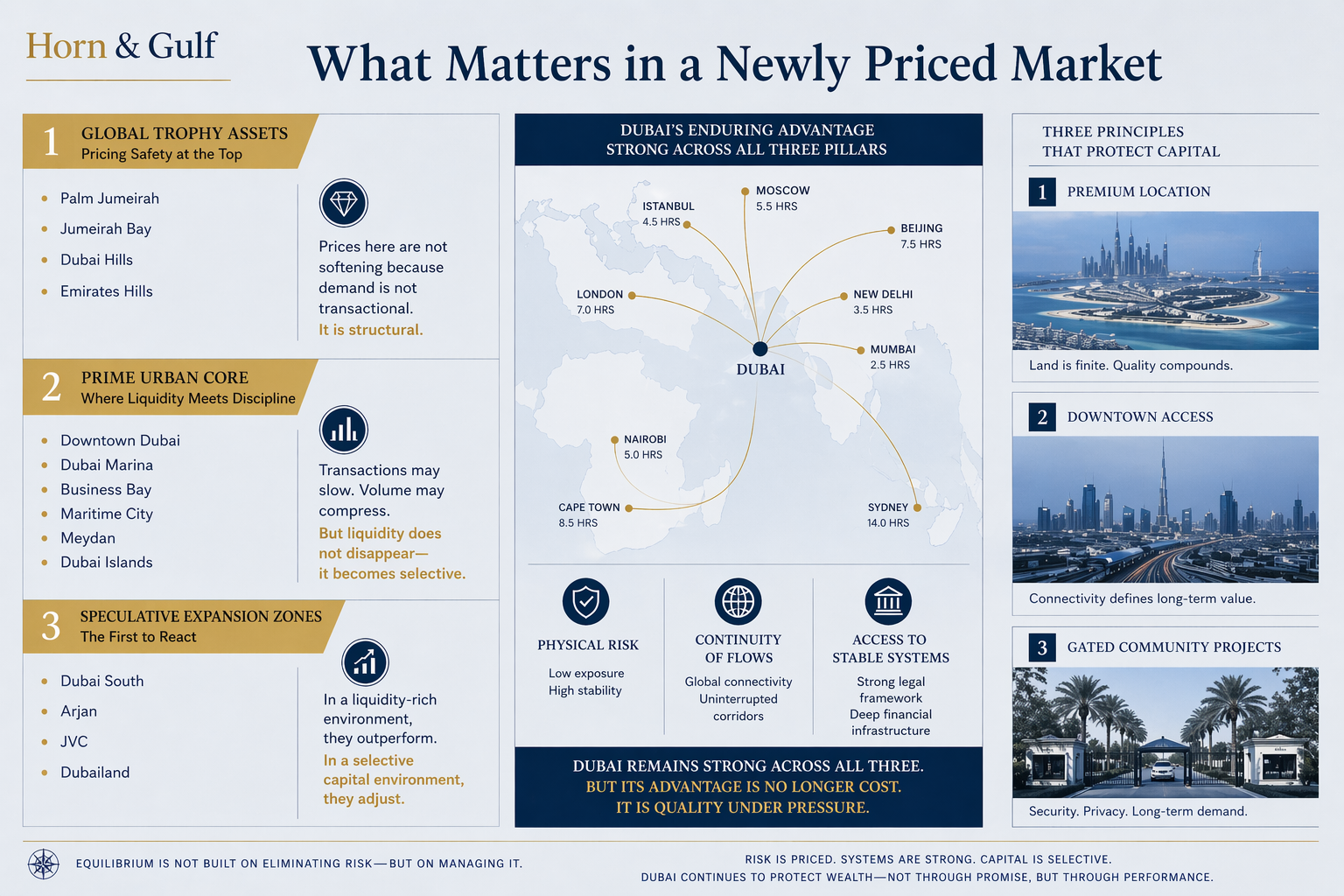
1. Global Trophy Assets — Pricing Safety at the Top
Palm Jumeirah
Palm Jebel Ali
Jumeirah Bay
Dubai Hills
Emirates Hills
This segment does not follow local cycles. It follows global wealth. Ultra-high-net-worth buyers are not here to speculate. They are reallocating capital into jurisdictional safety, lifestyle security, and long-term asset preservation.
In the old cycle, these assets were “premium.” In the new cycle, they are strategic allocations. They sit at the intersection of three forces:
- Physical safety
- Legal/system stability
- Global mobility
Prices here are not softening because demand is not transactional. It is structural.
2. Prime Urban Core — Where Liquidity Meets Discipline
Downtown Dubai
Dubai Marina
Business Bay
Dubai Maritime City
Meydan
Dubai Islands
This is the most important layer of the market. Not because it grows the fastest—but because it holds under pressure.
Demand here is diversified:
- International investors
- Entrepreneurs relocating capital and operations
- Long-term residents building life stability
These areas form the execution layer of Dubai’s real estate system. And in the current environment, execution matters more than narrative. Transactions may slow. Volume may compress. But liquidity does not disappear—it becomes selective. This is where the new pricing model is most visible:
- Buyers underwrite risk more carefully
- Developers with weak positioning lose momentum
- Tier 1 developers maintain pricing power
Because in a world where stability has a price, credibility becomes a currency.
3. Speculative Expansion Zones — The First to React
Dubai South
Arjan
JVC
Dubailand
These markets always move first—on the way up and on the way down. They benefit from momentum. But they are also exposed to supply. In a liquidity-rich environment, they outperform. In a selective capital environment, they adjust. This is not a failure of the market. It is the system doing what it is designed to do—repricing risk in real time.
The Shift: From Growth to Pricing Risk
The earlier phase of Dubai’s cycle was defined by acceleration. Capital inflows were strong.
Liquidity was abundant. Risk was present—but often ignored. That environment no longer exists. We are now in a different equilibrium:
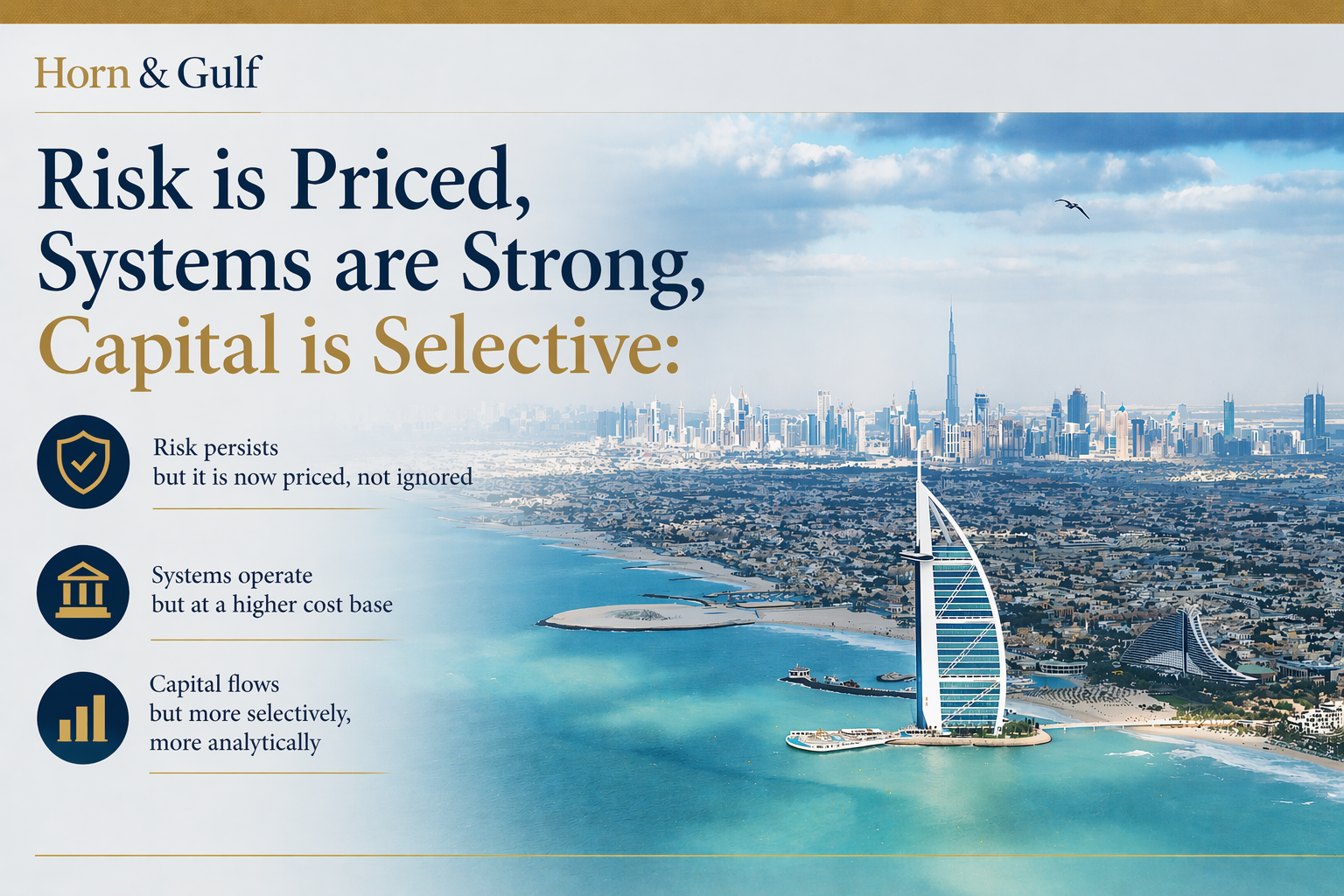
- Risk persists → but it is now priced, not ignored
- Systems operate → but at a higher cost base
- Capital flows → but more selectively, more analytically
The question is no longer whether Dubai is safe. The question is how much that safety costs.
The Three Pillars of the New Pricing Model
Across global markets, capital is now pricing assets based on three underlying variables:
1. Physical Risk
Geopolitical exposure, regional stability, real-world disruption.
2. Continuity of Flows
Ports, logistics, aviation, trade corridors—whether systems keep moving under stress.
3. Access to Stable Systems
Legal infrastructure, banking integration, currency stability, governance.
Dubai remains strong across all three. But its advantage is no longer cost. It is performance under pressure.
Why Prices Hold Where It Matters
This is where most investors get it wrong. They expect a uniform correction. But pricing is no longer uniform—because risk is no longer ignored.
Prime locations—especially:
- Waterfront assets
- Gated communities
- Areas with strong connectivity to Downtown and DIFC
—continue to attract capital not because they are cheap, but because they are defensible. And this is where Tier 1 developers separate themselves.
In a selective market:
- Weak balance sheets get exposed
- Overleveraged projects slow down
- Incentives increase at the margins
But Tier 1 developers operating in prime locations do not need to discount aggressively. Because they are not selling units. They are selling certainty in an uncertain system.
The System Passed the Test — The Speed Adjusted
Dubai has just gone through another stress test. Not hypothetical. Real. Regional tensions. Trade uncertainty. Capital repositioning.
The outcome was not collapse. It was calibration.
- Transaction volumes slowed
- Decision cycles extended
- Capital became more disciplined
But the system did not break. Ports continued to operate. Financial flows remained intact. Real estate demand did not reverse—it filtered. This is what a mature market looks like. Not constant growth. But controlled resilience.
Signal Over Noise
Dubai real estate is not falling. It is sorting. And the sorting is happening along one axis: Who can hold value when risk is no longer ignored? The answer is increasingly clear:
- Global trophy assets
- Prime urban core locations
- Tier 1 developers with real credibility
Everything else will continue to move. But not at the same speed. And not with the same certainty.
The Real Question
The question was never: Will Dubai real estate hold? The system already answered that.
The real question is: Where is safety being priced—and who can afford it?