
For the better part of a decade, financial centres competed on digitisation. Platforms improved, interfaces became faster, compliance moved online, and transactions accelerated. “Digital” became the baseline language of finance.
But what is now emerging out of Dubai—through the evolution of Dubai International Financial Centre (DIFC) —is something fundamentally different. This is no longer about digitising finance. It is about rebuilding it—natively—around intelligence.
A Strategy That Did Not Start Today
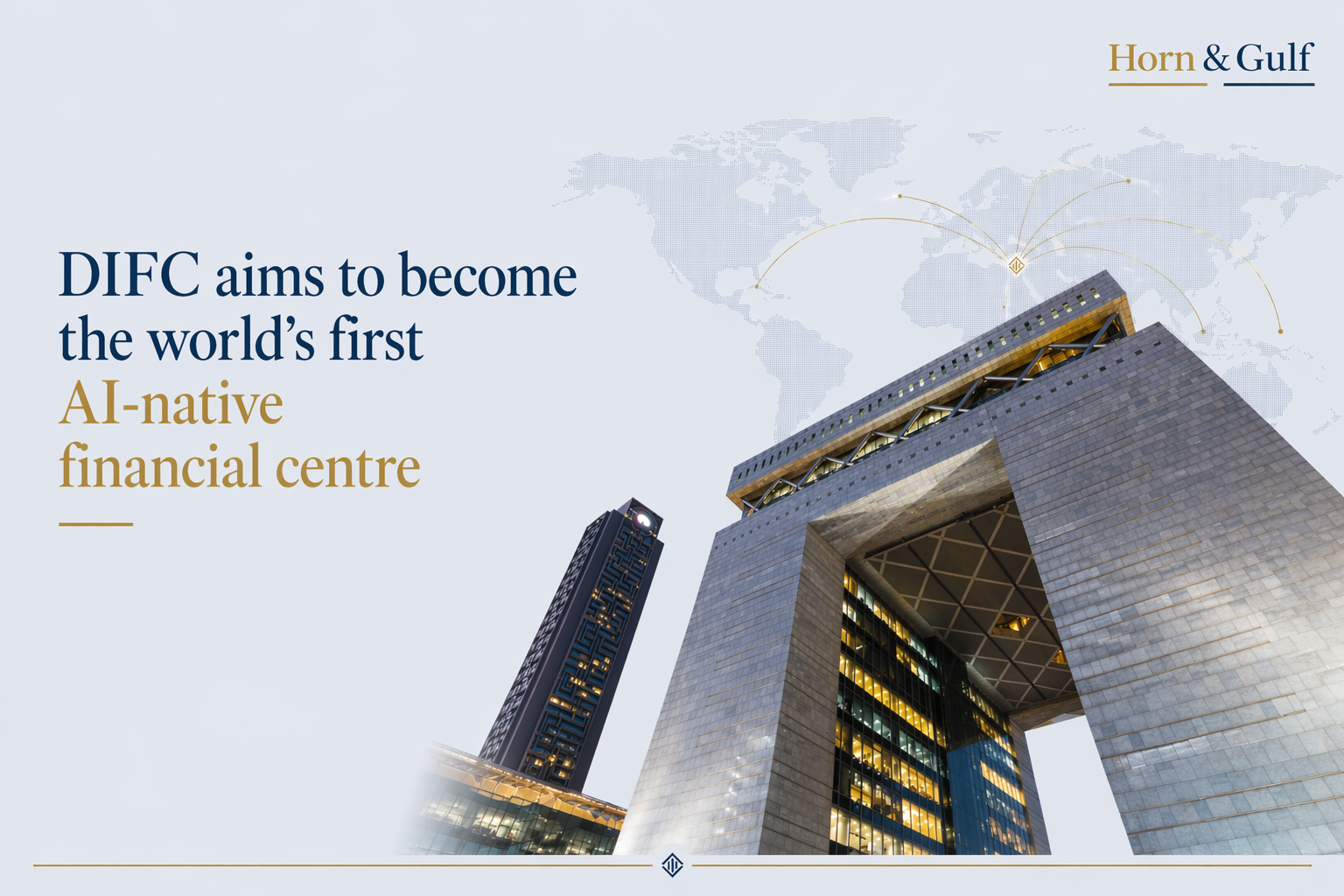
The announcement that DIFC aims to become the world’s first AI-native financial centre is not a sudden pivot. It is the visible endpoint of a strategy that has been compounding for several years.
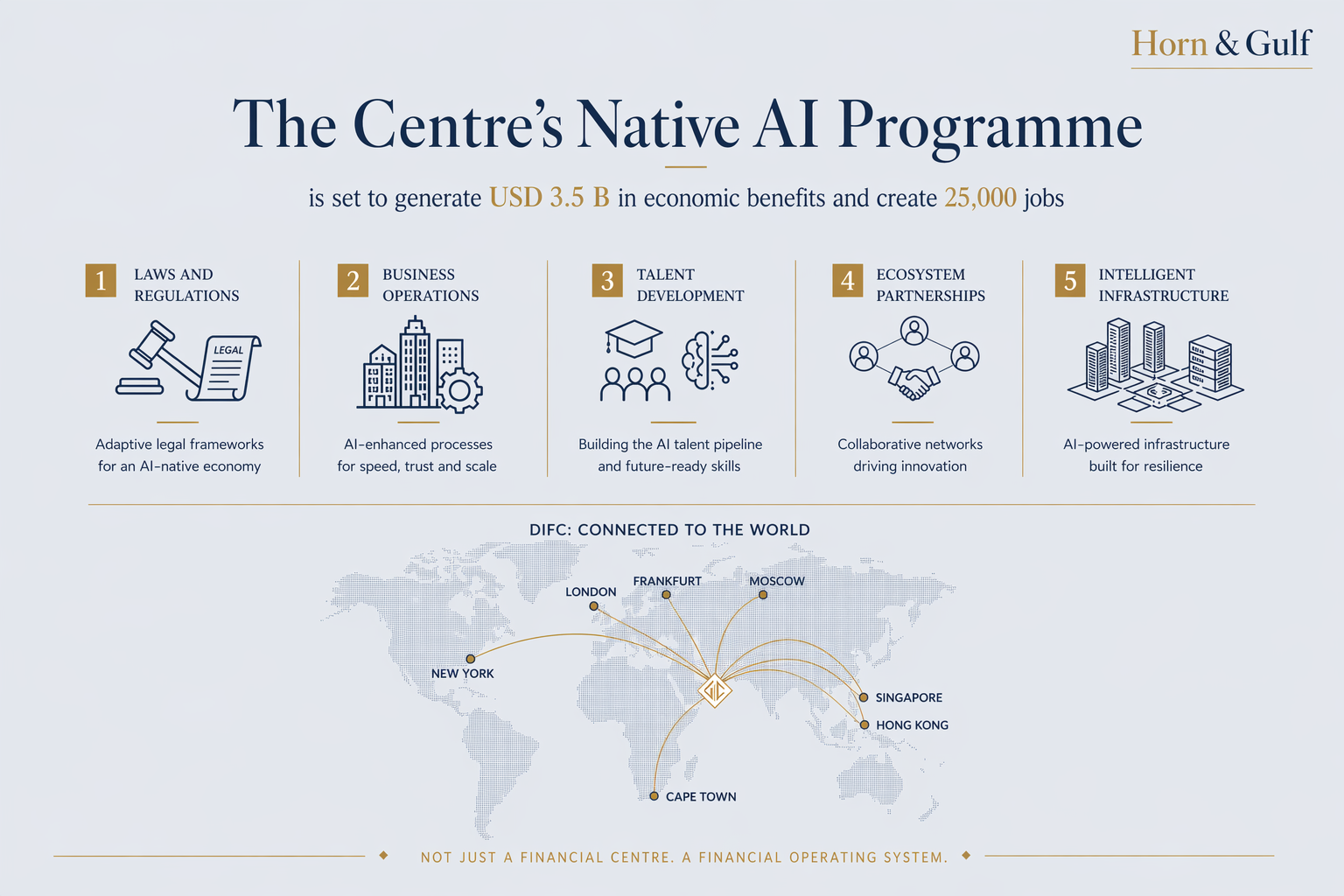
Around 2023, the foundations were laid with the launch of the AI and Web3 ecosystem within DIFC. The objective was not simply to attract startups, but to begin clustering capital, talent, and regulatory flexibility in one place. The creation of the AI & Web3 Campus signaled an early understanding: the next financial edge would not come from scale alone, but from computational capability embedded within the system.
Through 2024 and 2025, this ecosystem expanded. Events, capital pools, and regulatory sandboxes began to converge. AI was no longer treated as an adjacent sector—it was being tested inside finance itself. Compliance tools, risk models, and data infrastructure began shifting from static frameworks to adaptive ones.
By 2026, the transition becomes explicit. AI is no longer a layer. It is becoming the system.
Cost of Stability
There is a misconception that technological advancement reduces cost. In financial systems, the opposite is often true. Stability is becoming more expensive. Building an AI-native financial environment requires deep investment—compute infrastructure, data pipelines, regulatory redesign, and highly specialised talent. These are not marginal upgrades. They are structural costs.
But what is being purchased is not efficiency in the traditional sense. It is resilience. In previous cycles, financial centres absorbed shocks through human intervention—policy adjustments, regulatory pauses, liquidity injections. These responses were often delayed, reactive, and unevenly applied.
An AI-native system changes the nature of response. Risk is detected earlier. Compliance is enforced continuously. Decision-making compresses in time. The system does not wait to react. It adjusts in motion. The result is not a cheaper system. It is a more controlled one.
And control, in volatile environments, carries a premium.
Selective Capital
As systems become more intelligent, capital becomes more selective. This is not a behavioral shift driven by sentiment. It is a structural shift driven by visibility. In an AI-native financial centre, information asymmetry begins to collapse. Risk is not hidden—it is modelled, scored, and continuously updated. Transactions are no longer judged solely by narrative, but by data integrity and systemic fit.
This changes the nature of capital flows. Liquidity does not disappear. It fragments. Capital moves more slowly into poorly understood risk and more aggressively into environments where risk is measurable, priced, and managed in real time.
The era of indiscriminate inflows gives way to analytical allocation. Money does not leave the system. It chooses more carefully where to stay.
Crisis Buffer
The true test of any financial centre is not its performance in stability, but its behavior under stress. Recent years—pandemic shocks, geopolitical tensions, supply chain disruptions—have exposed a simple truth: systems that rely on manual coordination break under pressure.
DIFC’s transformation points toward a different model. A financial centre that embeds intelligence at the core becomes, by definition, a crisis buffer. In moments of disruption, three things matter: speed, clarity, and trust.
AI-native infrastructure enhances all three. Decisions accelerate because systems process data continuously. Clarity improves because risk is quantified, not assumed. Trust strengthens because enforcement is consistent, not discretionary.
This does not eliminate crises. It changes how they are absorbed. Instead of freezing, the system rebalances. Instead of uncertainty spreading, it is contained. The financial centre becomes not a passive safe haven, but an active stabiliser.
From Digital to Native
The shift from digital finance to AI-native finance is subtle in language but profound in implication Digital systems replicate existing processes in faster formats. Native systems redefine the processes themselves.
In a digital financial centre, technology supports operations. In an AI-native financial centre, technology becomes the operating logic. This is where DIFC is positioning itself. Not as the most advanced platform. But as a different category altogether.
The New Definition of Control
What ultimately emerges from this transition is a redefinition of control. In the past, control in finance was regulatory—rules, jurisdictions, compliance frameworks. Today, it is increasingly computational.
Control is exercised through data, algorithms, and embedded decision systems. It is continuous, not periodic. Invisible, but pervasive. And this is the deeper signal behind DIFC’s announcement. Dubai is not simply investing in AI. It is restructuring finance around it.
Conclusion
Finance is not becoming faster. It is becoming native to intelligence. Risk is no longer something to be avoided. It is something to be modelled. Stability is no longer assumed. It is engineered. And capital is no longer reactive. It is selective. In this emerging system, the question is no longer which financial centre is largest.
The question is which one understands how to operate under constant uncertainty. DIFC is making a clear bet. That the future of finance will not belong to those who digitised first— but to those who redesigned the system itself.