Hormuz Strait disruption impact is no longer a short-term shock. It is actively reshaping Gulf trade routes, logistics systems and capital flows. As maritime chokepoints fail, supply chains are shifting toward inland corridors and multi-route resilience structures.
Hormuz Disruption and Global Trade Flows: Why the Closure Is a Signal, Not the Crisis
The closure of the Strait of Hormuz is not the crisis itself. It is a signal. For decades, global trade relied on a fragile assumption: that a narrow maritime passage could carry a disproportionate share of energy and goods without interruption. Hormuz was the most critical of these routes.
When it stopped functioning, the question was not whether flows would halt. It was where they would reappear, and through which systems. Trade systems rarely collapse. They shift. What matters is not the disruption, but the direction of that shift.
Saudi Logistics Infrastructure and Supply Chain Resilience: A System Built for Rerouting
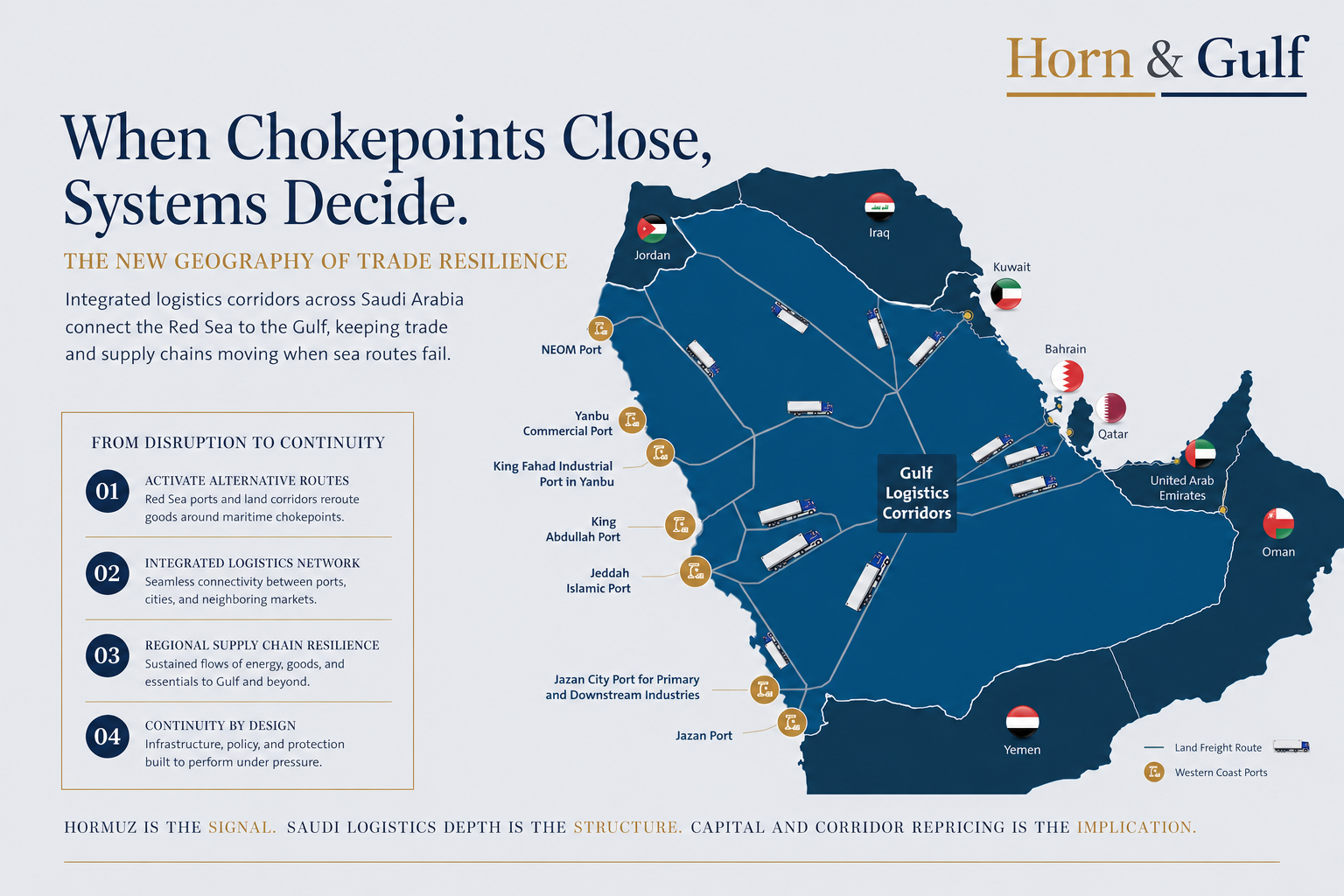
Saudi Arabia’s role in this moment is often described in political terms. That misses the point. What matters is structure. The Kingdom operates across two coastlines, with multiple ports, inland corridors, and energy transfer capacity linking east to west. This creates something more valuable than redundancy: optionality.
When Hormuz closed, the system did not need to improvise. It adjusted. Oil flows moved through the East–West pipeline toward the Red Sea. From there, shipments continued through alternative maritime routes or via connections through Egypt into the Mediterranean.
The key is not the existence of an alternative route. It is the ability to choose between routes depending on conditions. That flexibility is what keeps systems functioning under pressure.
Red Sea Ports and Gulf Land Corridors: How Trade Routes Shift from Sea to Land
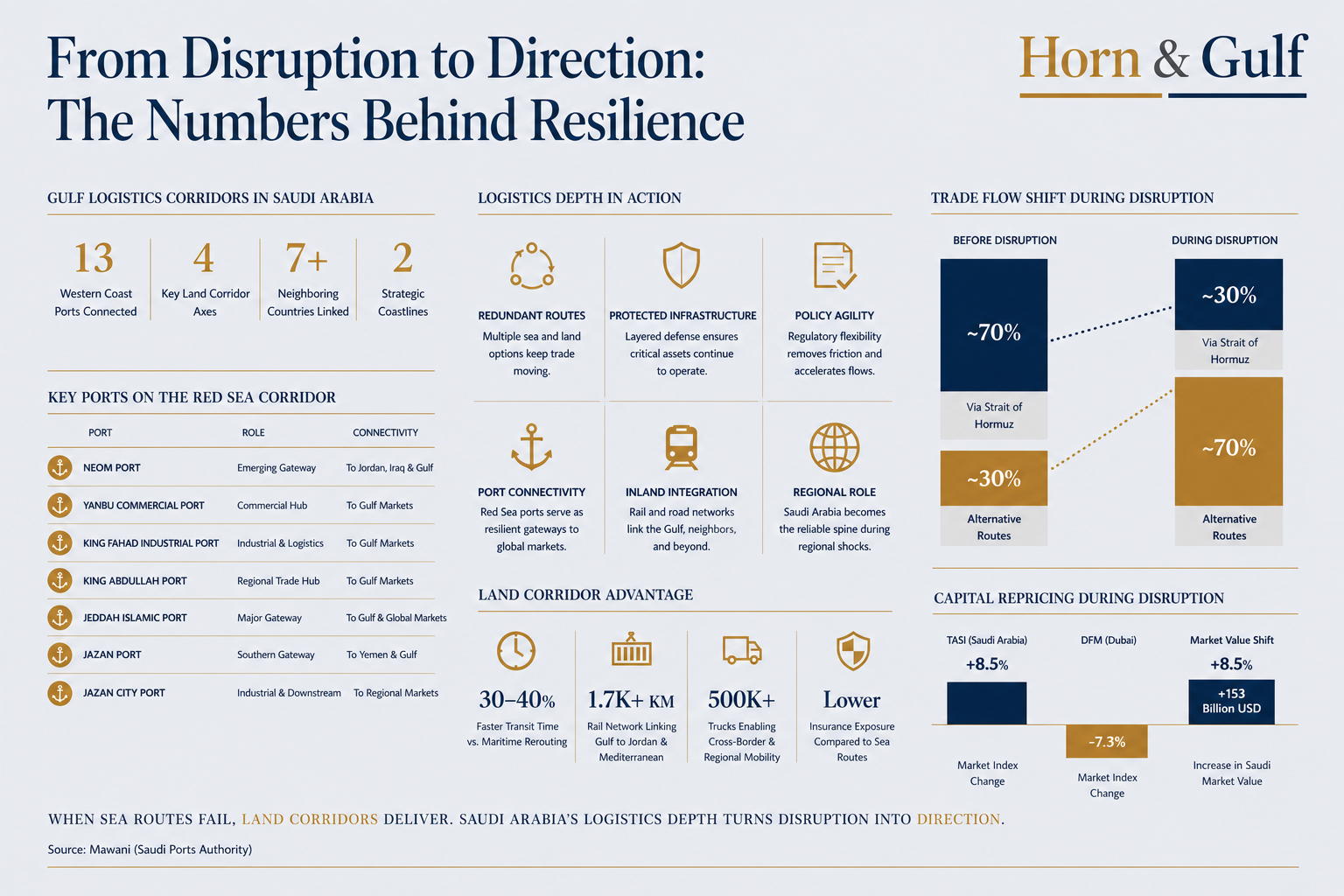
As maritime movement through Hormuz became constrained, the balance of logistics shifted. Saudi ports on the Red Sea—such as Jeddah, Yanbu, and Jazan—absorbed incoming flows. From these points, goods moved inland and re-entered Gulf markets through land transport.
This was not an emergency workaround. It was a functioning alternative. The system effectively reversed direction:
- Imports arrived via the Red Sea
- Distribution moved across inland corridors
- Final delivery reached Gulf markets by land
What could not pass through the sea was redirected across territory. This shift highlights a broader principle: trade routes do not disappear. They reorganize.
Infrastructure Protection and Economic Continuity: Why Defense Capacity Matters for Trade
Supply chains depend on more than routes. They depend on reliability. Over the past decade, Saudi Arabia has operated under persistent regional security pressure. This has led to the development of layered defense systems designed to protect critical infrastructure.
In practice, this means ports, pipelines, and logistics hubs continue to function even under stress. Markets respond less to capability than to performance. Infrastructure that continues to operate during disruption becomes the default channel for flows.
Policy Response and Supply Chain Efficiency: Reducing Friction During Disruption
Physical infrastructure alone is not sufficient. It must be matched by policy speed. During the disruption, Saudi authorities introduced measures to ease movement:
- Reduced storage costs
- Faster customs handling
- Greater flexibility in transport operations
These adjustments did not create new capacity. They allowed existing capacity to move faster. In crisis conditions, time becomes as important as volume.
Capital Flows and Gulf Market Shifts: How Investment Reprices Operational Stability
Financial markets do not respond to narratives. They respond to continuity. When disruption affects a critical route like Hormuz, capital does not necessarily leave the region. Instead, it reallocates within it.
The key question for investors is simple: Which systems can still operate? This leads to a gradual repricing:
- Logistics hubs gain relative importance
- Trade corridors are reassessed
- Risk exposure is recalculated
- Capital shifts toward operationally stable environments
This is not a sudden move. It is a structural adjustment.
From Chokepoints to Multi-Corridor Systems: The Shift in Global Trade Architecture
The Hormuz disruption highlights a broader transformation. Traditional trade systems were built around efficiency, often relying on single high-capacity routes. This model performs well in stable conditions but becomes fragile under stress.
A different model is emerging:
- Multiple exit points
- Integration of sea and land transport
- Flexible routing based on conditions
This is not simply diversification. It is a redefinition of resilience.
Conclusion: Trade Continuity and Regional Power Shift in the Gulf
The closure of Hormuz did not stop the system. It revealed how it adapts. Saudi Arabia’s logistics depth did not emerge in response to the crisis. It was already in place.
What changed was visibility. In moments of disruption, control shifts toward those who can maintain continuity. Flows follow function. And over time, capital follows flows.