
Red Sea security dynamics are no longer confined to maritime threats. They are being reshaped by power shifts across the Horn of Africa, redefining control, logistics routes and global trade stability. From Eritrea’s strategic repositioning to Djibouti’s military infrastructure, Berbera’s logistics expansion and Sudan’s fragmentation, the Red Sea is evolving into a multi-layered system of control.
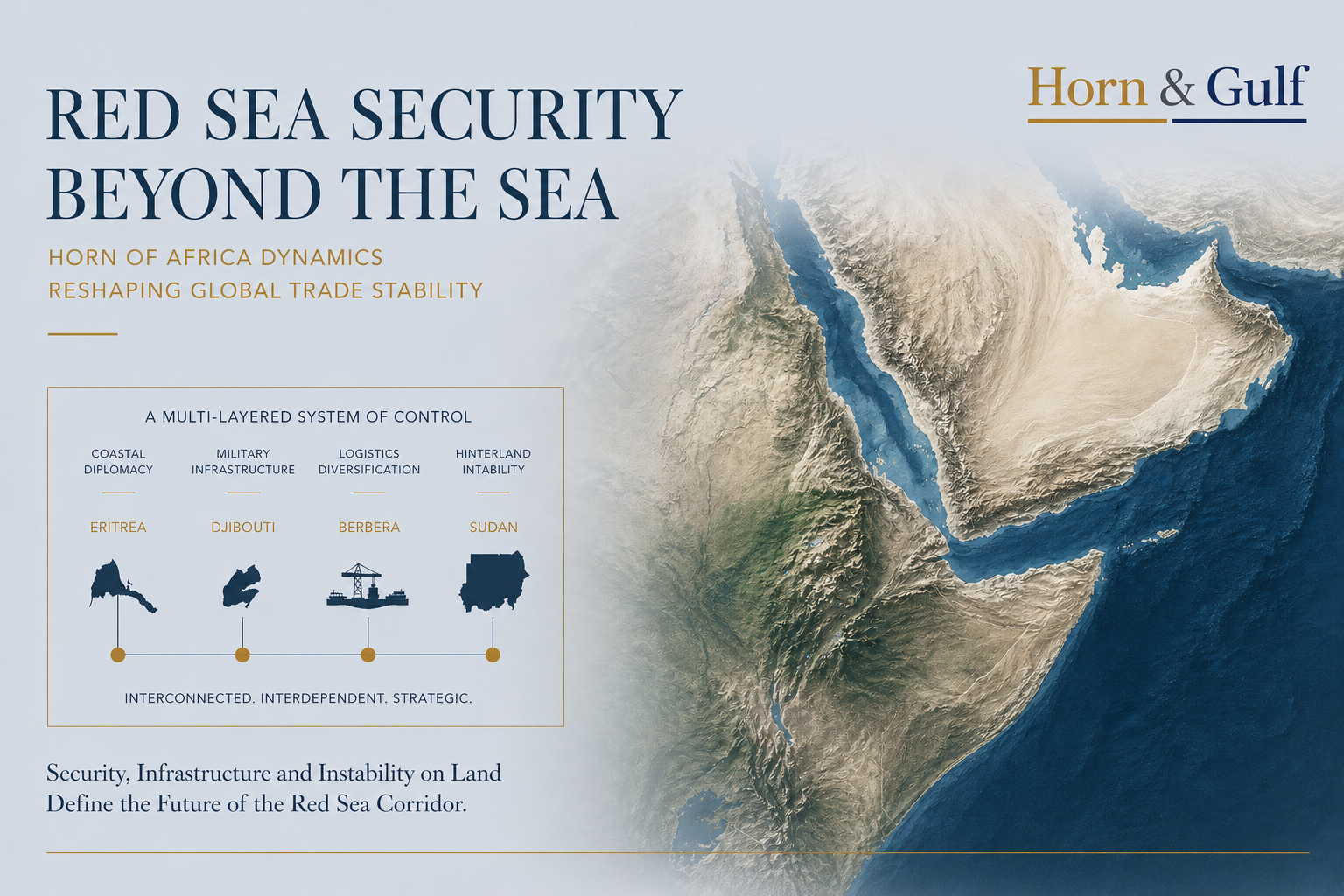
The Red Sea is no longer defined by what happens at sea. Its stability is increasingly shaped on land — across Eritrea, Djibouti, Somaliland and Sudan — where political alignments, military infrastructure and fragmented conflicts are quietly redrawing the map of maritime security.
What appears as a shipping risk is, in reality, a structural transformation of control.
US–Eritrea Reset: Strategic Realignment in the Red Sea Corridor
Recent signals around a potential recalibration between United States and Eritrea suggest a shift that goes beyond bilateral diplomacy. Eritrea sits along one of the most sensitive stretches of the Red Sea coastline, directly facing critical maritime lanes feeding into Bab al-Mandab.
For years, Eritrea remained diplomatically isolated. That isolation is now being reconsidered through a narrower lens: maritime security and access. This is not about normalization. It is about positioning.
If Washington succeeds in re-engaging Asmara, even partially, it introduces a new variable into a coastline historically shaped by Gulf influence and regional rivalries. It also complicates existing alignments involving GCC countries and other actors who have treated the Horn as an extension of their strategic depth.
The implication is subtle but significant: Red Sea security is no longer anchored solely in naval presence — it is negotiated through coastal states.
Djibouti’s Base Economy: Military Infrastructure as a Revenue Model
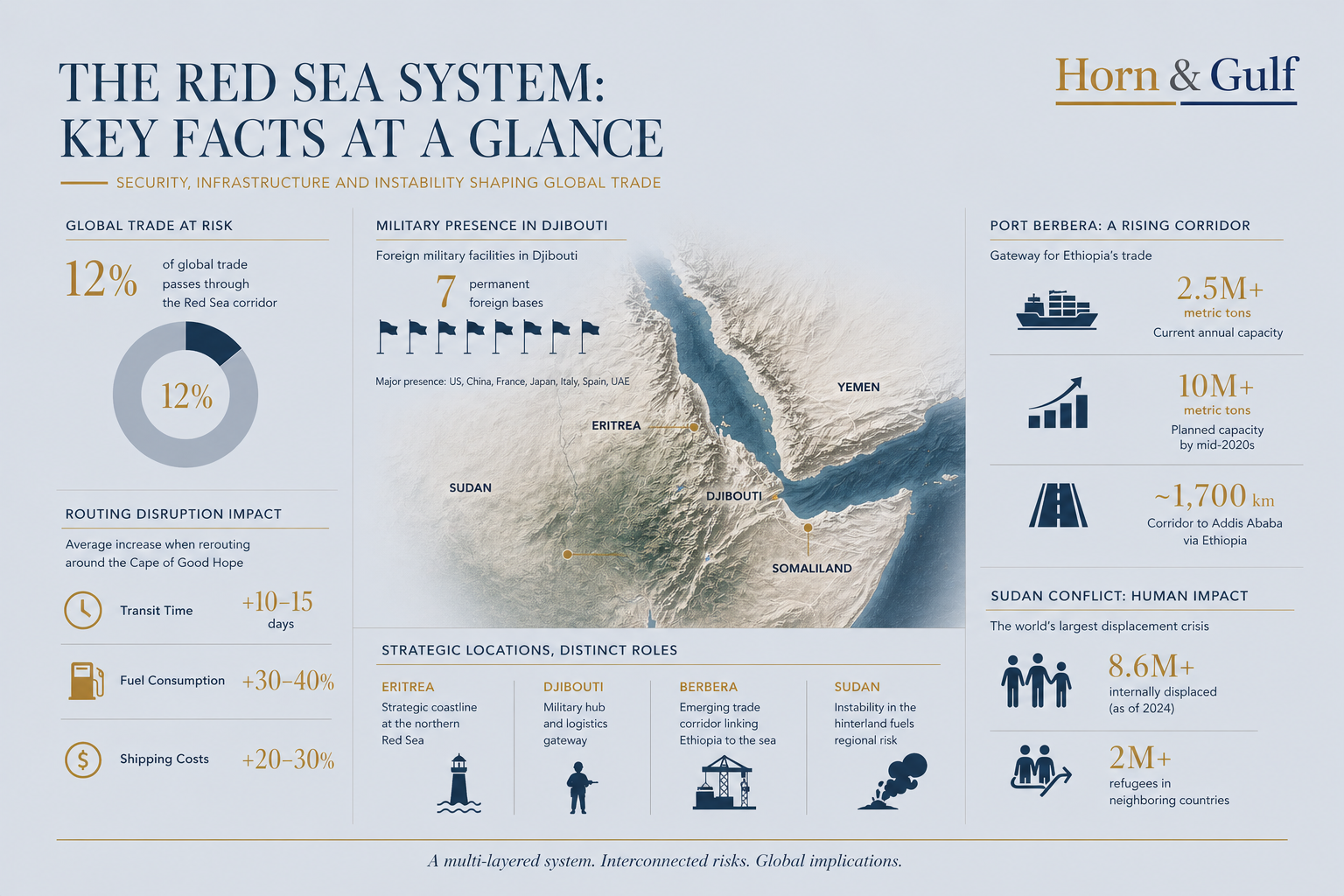
Few places illustrate the economics of security better than Djibouti. Positioned at the southern gateway of the Red Sea, Djibouti has transformed geography into income. Multiple global powers — from the US to China — maintain military facilities within a tightly compressed territory. The result is a unique model: sovereignty monetized through access.
Djibouti does not control trade flows directly. It controls proximity to them. This distinction matters. As global shipping companies reroute vessels or reassess risk exposure, the value of forward-positioned military infrastructure rises. Djibouti becomes less a passive host and more an active node in a layered security architecture.
But this model carries fragility. Dependence on external actors means that any shift in global posture — escalation, withdrawal, or competition — reverberates immediately within its borders. In a system increasingly defined by volatility, Djibouti’s strength is also its vulnerability.
Berbera Corridor: Somaliland’s Emerging Role in Regional Logistics
Further east, the development of the Berbera port corridor in Somaliland signals a different kind of transformation. Unlike Djibouti, which monetizes military presence, Berbera is building relevance through logistics.
Backed by Gulf investment — particularly from the United Arab Emirates — the port and its inland connections are designed to serve landlocked Ethiopia. This creates a new axis: Gulf capital, African demand, and strategic geography converging into a functional trade corridor.
The significance is not immediate volume. It is optionality.
As Red Sea routes face intermittent disruption, alternative entry and exit points gain strategic weight. Berbera does not replace established hubs. It complements them, offering redundancy in a system that increasingly values resilience over efficiency. In this sense, Somaliland — long seen as peripheral — becomes structurally relevant.
Sudan War: The Hidden Rear Layer of Red Sea Instability
While ports and bases shape the coastline, the war in Sudan defines the rear. What began as an internal conflict has evolved into a fragmented battlefield with regional implications. Control over Port Sudan, shifting alliances, and external involvement have turned the country into a pressure point behind the Red Sea system.
Sudan does not sit on the main chokepoint. It destabilizes the environment around it. This distinction is critical. Maritime security is often framed through narrow passages — Bab al-Mandab, Hormuz — but these passages do not exist in isolation. They depend on hinterlands that are increasingly contested.
As long as Sudan remains fragmented, the western shore of the Red Sea will continue to generate uncertainty — not through direct attacks on shipping, but through the erosion of state control.
From Shipping Route to Control System: The Structural Shift
Taken together, these developments point to a deeper transformation. The Red Sea is no longer just a corridor for global trade. It is becoming a control system shaped by overlapping layers:
- Coastal diplomacy (Eritrea)
- Military infrastructure (Djibouti)
- Logistics diversification (Berbera)
- Hinterland instability (Sudan)
Each layer operates independently. But their interaction defines the system. For Gulf states, this creates a strategic imperative. Securing Hormuz is no longer sufficient. Stability must be extended westward — across the Horn of Africa and into the Red Sea basin.
For global trade, the implication is equally clear: Disruption will not always come from direct attacks. It will emerge from the slow reconfiguration of control across land and sea. In that sense, the Red Sea is no longer a route to be protected.
It is a system to be managed.