
Hormuz Strait flow control is no longer a temporary disruption. It is reshaping the Gulf energy system by shifting pricing from supply security to route access and risk.
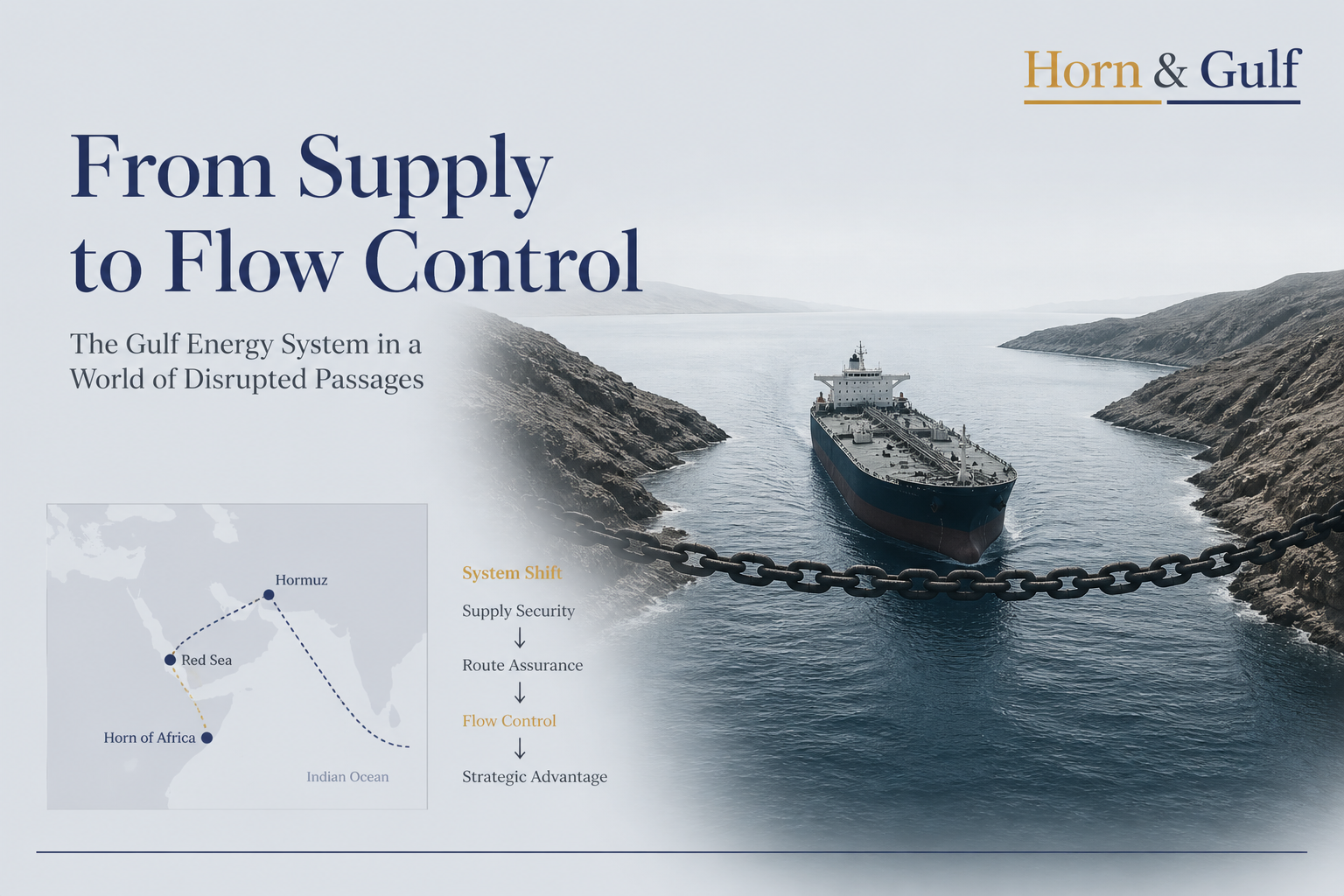
The Oil-for-Security System Has Not Ended — It Has Stopped Functioning
For decades, the relationship between the United States and the Gulf rested on a simple exchange. Oil moved out of the region. Security flowed in. The arrangement did not require perfection; it required reliability. As long as tankers moved and threats were contained, the system held.
That system has now ceased to function.
The closure of the Strait of Hormuz is not just another geopolitical shock. It exposes a deeper failure: the inability to guarantee the movement of energy out of the Gulf. Oil is still being produced. Demand has not disappeared. What has broken is the assumption that supply can reach the market.
This is the point where the conventional reading—“security has failed”—falls short. What we are witnessing is not the end of an agreement, but the breakdown of the mechanism that made the agreement credible.
Hormuz Is Not Blocked — It Has Become Unusable
There is a tendency to describe the current situation in military terms. Mines, missiles, naval presence. But the actual shutdown of Hormuz has not come through a single decisive act. It has come through hesitation.
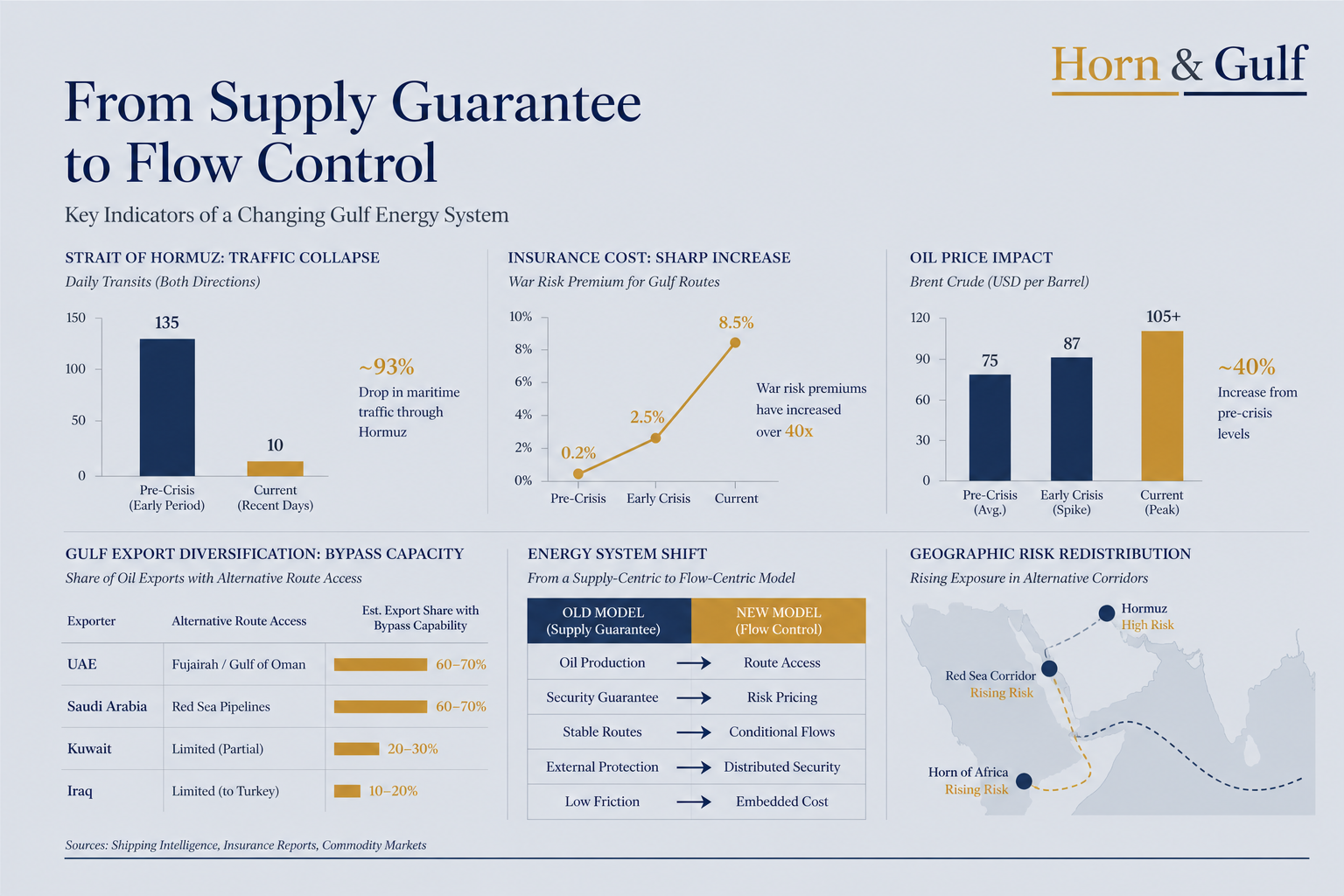
Insurance rates have surged or withdrawn entirely. Shipping companies have stepped back. Risk has shifted from theoretical to immediate. Traffic has not been forcibly stopped; it has thinned to the point of irrelevance.
In practical terms, the Strait has not been closed. It has become commercially non-viable.
This distinction matters. A blocked chokepoint can be reopened. A market that no longer functions is harder to restore. Confidence, once broken, does not return on command.
Energy Is No Longer Priced by Supply — It Is Priced by Passage
The older system priced oil in terms of production and demand. Volumes mattered. Spare capacity mattered. The physical barrel was the central unit of calculation. That is no longer sufficient.
Today, the critical variable is not how much oil exists, but how much of it can move. The price of energy increasingly reflects access—who can ship, under what conditions, and at what level of risk.
This introduces a different kind of logic. Insurance desks become as important as oil fields. Shipping routes carry as much weight as production quotas. Security is no longer an external guarantee; it is embedded in the cost structure of every shipment. The result is a shift from a supply system to a flow system.
The Gulf Is No Longer a Single Energy Bloc — It Is Dividing by Exit Routes
The breakdown of Hormuz does not affect all Gulf producers equally. The region is no longer a unified export platform.
Some states remain tied to the Strait, with limited alternatives. Others have partial or significant bypass options. Pipelines to the Red Sea, export capacity on the Gulf of Oman, and overland corridors are no longer secondary assets. They are strategic differentiators.
What emerges is a new hierarchy. Not based on reserves, but on flexibility. The ability to redirect flows becomes more valuable than the ability to increase output.
In this environment, geography is no longer static. It is operational.
Security Has Not Disappeared — It Has Moved into the System
The argument that the United States has failed to provide security captures only part of the reality. Security has not vanished. It has changed form.
Instead of being delivered primarily through naval dominance, it is now distributed across multiple layers: insurance underwriting, route diversification, infrastructure resilience, and political alignment. No single actor controls it fully. No single guarantee restores it entirely.
This fragmentation alters the nature of risk. It becomes continuous rather than episodic. Managed rather than eliminated.
For Gulf states, this means that reliance on a single external security provider is no longer sufficient. The system they operate in now requires internal adaptation as much as external protection.
The Crisis Does Not Stop at Hormuz — It Extends into the Red Sea and the Horn
One of the most overlooked aspects of the current situation is its geographic spillover. Pressure on Hormuz does not remain contained within the Gulf. It redirects attention, traffic, and vulnerability elsewhere.
The Red Sea becomes more critical. Alternative corridors gain importance. At the same time, older fault lines re-emerge. The waters off the Horn of Africa, long associated with piracy and weak enforcement, begin to matter again.
This is not a coincidence. When one route becomes constrained, others inherit both volume and risk. The system is not collapsing in one place. It is shifting across multiple nodes.
What Has Broken Is Not an Alliance — It Is a Pricing Logic
It is tempting to frame the current moment as the end of a geopolitical bargain. The United States no longer guarantees security. The Gulf can no longer rely on external protection. The alliance weakens. But this framing misses the deeper change.
What has broken is the assumption that energy markets can function independently of route risk. For years, that risk was present but underpriced. Today, it is explicit.
The Gulf is no longer operating within a system where security is assumed and supply is the variable. It is operating within a system where movement is uncertain and access determines value.
The Gulf Is No Longer Protected — It Is Priced
The region has not lost its importance. If anything, its centrality has increased. But the terms have changed. Oil is no longer sufficient on its own. Production does not guarantee influence. Security cannot be outsourced in the same way. Every shipment now carries embedded questions: Can it move? Under what conditions? At what cost?
In this environment, the Gulf is not simply exporting energy. It is navigating a system where every flow is conditional. And that condition is what the market now prices.