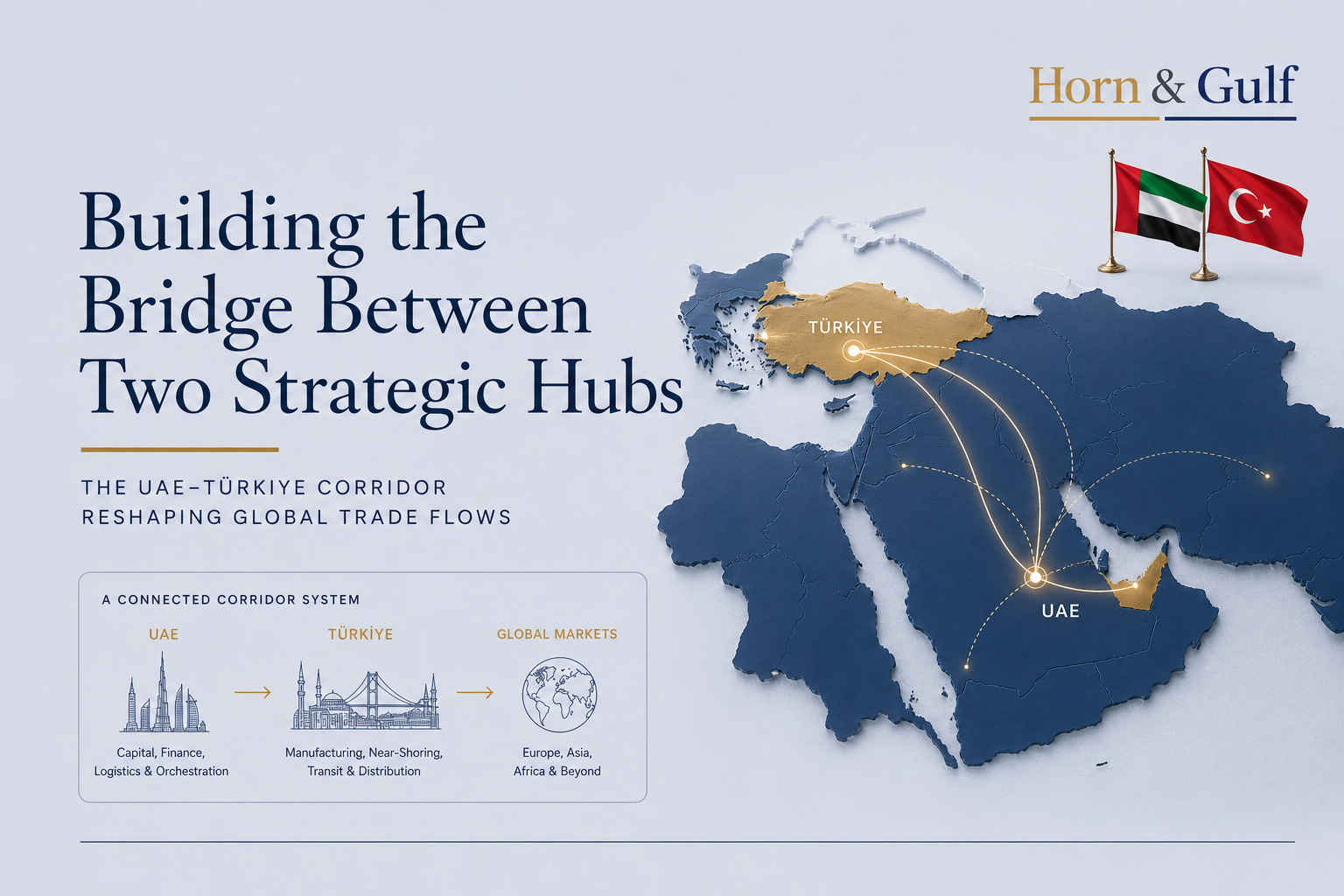
UAE–Türkiye trade corridor is no longer just a bilateral agreement. It is reshaping global trade routes by creating a multi-layered system connecting Europe, Africa and Asia through new logistics and production networks.
Why the UAE–Türkiye CEPA Is More Than a Trade Agreement
The UAE–Türkiye Comprehensive Economic Partnership Agreement (CEPA) is often framed as a trade deal designed to increase bilateral volume. That framing is incomplete. The agreement is not simply about expanding commerce between two economies; it is about restructuring how trade flows across regions that are increasingly defined by fragmentation, risk, and rerouting.
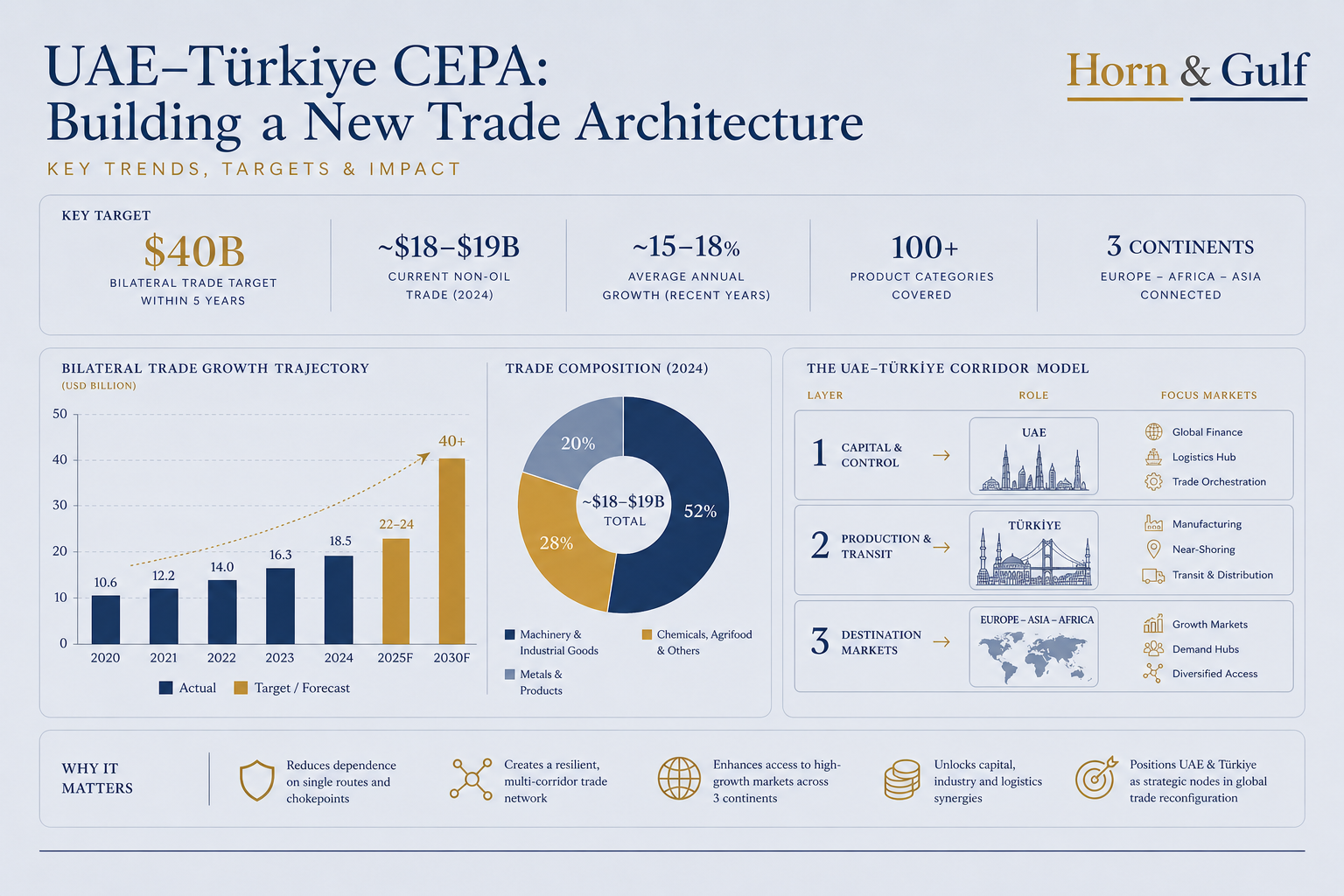
The headline figure—targeting $40 billion in bilateral trade within five years—captures attention. But the deeper signal lies elsewhere. The UAE is not building trade relationships; it is building a system of corridors. Türkiye is not just a partner in this system; it is becoming a structural node within it.
From Bilateral Trade to Global Trade Corridor Strategy
This shift becomes visible only when the agreement is placed within the UAE’s broader economic trajectory. Over the past few years, Abu Dhabi and Dubai have moved decisively beyond a hydrocarbon-centered model. Non-oil trade now dominates the economic structure, and a growing network of CEPAs connects the UAE to Asia, Africa, and Europe.
These agreements are not isolated deals. They form a distributed architecture of access, where each bilateral link feeds into a larger network of flows.
Within that architecture, Türkiye occupies a unique position. It combines industrial depth with geographic reach. It connects Europe to the Middle East, Central Asia, and the Mediterranean basin.
For a Gulf economy seeking to move beyond port-based intermediation, this combination is essential. The UAE does not need another market. It needs an extension of its logistical and economic reach into production and distribution layers that it does not control domestically.
How the UAE–Türkiye Corridor Reshapes Supply Chains
This is where the nature of the CEPA changes. It is no longer a tariff-reduction mechanism. It becomes a corridor agreement.
The emerging system can be read as a three-layer structure:
- UAE → capital, finance, logistics orchestration
- Türkiye → manufacturing, near-shoring, transit
- Global markets → Europe, Central Asia, Africa
This layered structure is not theoretical. It responds directly to the pressures shaping global trade in 2026. Maritime routes are increasingly exposed to geopolitical risk. The Red Sea corridor has become unstable. The Strait of Hormuz, while still open, functions under persistent strategic tension.
In such an environment, resilience is no longer about securing a single route. It is about distributing risk across multiple corridors.
Risk, Rerouting, and the New Trade Geography of 2026
The UAE’s CEPA strategy is designed precisely for this. By building bilateral agreements across geographies, it creates optionality. Trade can be redirected, reassembled, and rerouted depending on conditions.
Türkiye, in this context, offers something that few partners can:
a bridge that sits outside the Gulf’s immediate risk envelope while remaining deeply connected to its economic system.
This transforms the UAE’s role in the global economy. It is no longer merely a transit hub where goods pass through.
It becomes a control layer where flows are structured, redirected, and priced. The distinction matters. A hub depends on volume. A control layer shapes volume.
Türkiye’s Strategic Role in the New Trade Architecture
For Türkiye, the implications are equally significant.
The agreement reinforces its position as a manufacturing and transit axis at a time when global supply chains are being reconfigured. It provides access to Gulf capital, integrates production with logistics networks centered in the UAE, and opens pathways into African markets where both countries are expanding their presence.
This is not simply trade expansion. It is system integration.
The Horn of Africa Connection: Extending the Corridor South
This convergence becomes particularly visible when viewed through the Horn of Africa. The UAE has spent the past decade building a network of port and logistics positions across the Red Sea and East Africa. Türkiye, meanwhile, has expanded its economic and political footprint in the same region.
The CEPA does not directly address this geography, but it connects the systems that operate within it. What emerges is not a single corridor but a triangle:
- Gulf capital and coordination
- Anatolian production
- African consumption
This triangular system reduces dependence on any single chokepoint while increasing the density of connections across regions.
From Trade Blocs to Modular Trade Networks
In this sense, the UAE–Türkiye CEPA reflects a broader shift in how trade is organized. Large, rigid trade blocs are giving way to flexible, modular agreements. These agreements are faster to negotiate, easier to adapt, and better suited to a world where risk is unevenly distributed.
Instead of building one large system, states are assembling networks of smaller, interoperable systems.
Conclusion: Trade Routes Are No Longer Fixed — They Are Designed
The result is a new map of global trade—less hierarchical, more networked, and increasingly shaped by those who can orchestrate flows rather than simply host them. The UAE is positioning itself at the center of that orchestration.
Türkiye is becoming one of its most critical extensions.
The agreement, therefore, should not be read as a bilateral milestone. It is part of a larger process in which trade routes are no longer fixed lines on a map. They are dynamic systems, constantly reconfigured in response to risk, opportunity, and strategic intent.
The UAE–Türkiye CEPA is one of the clearest expressions of that transformation.