
Dubai air traffic recovery is not just an aviation story. It reveals how DXB moved from a sharp March disruption to a rapid May rebound once airspace access returned.
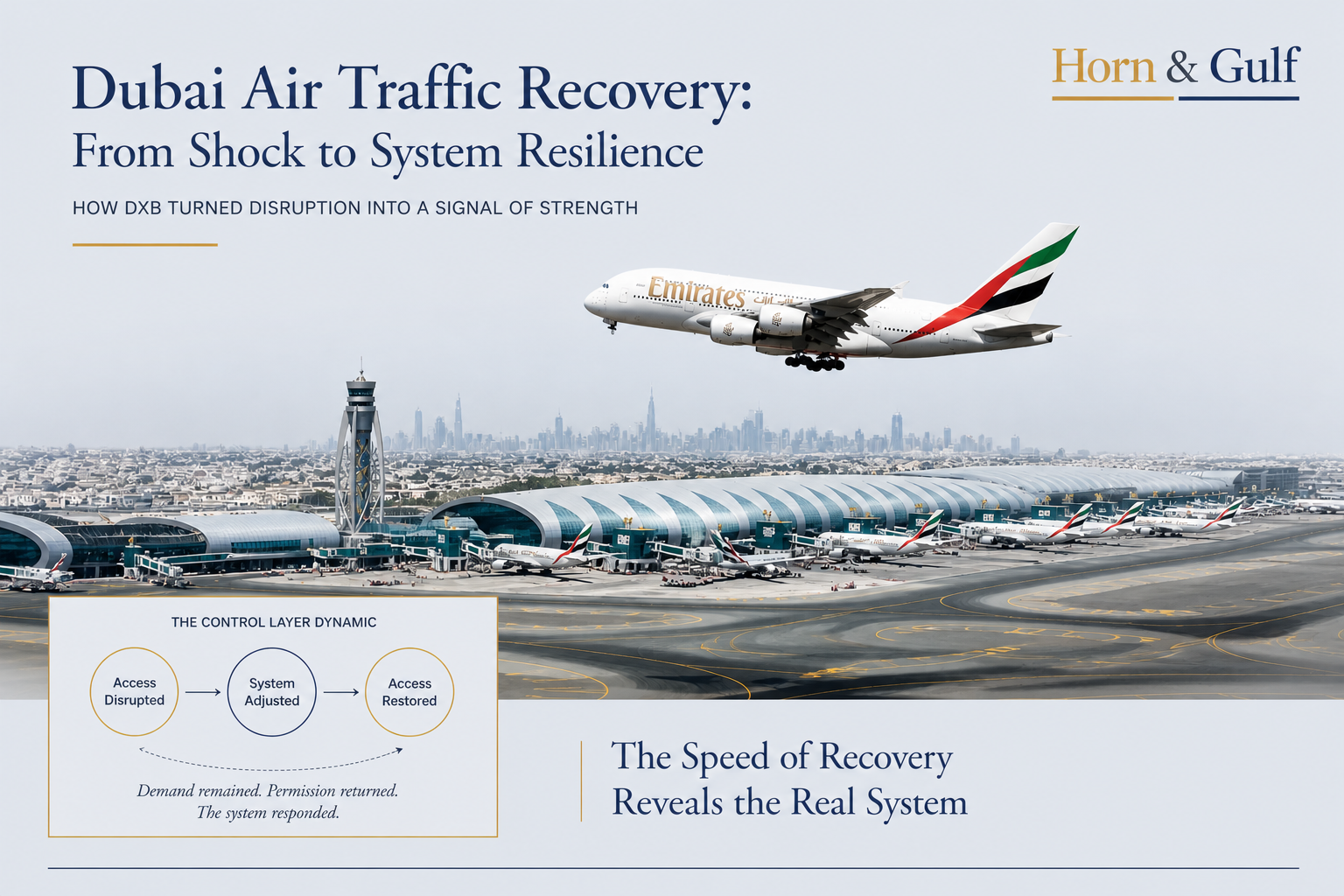
The Shock Was Not About Demand — It Was About Access
In March, Dubai International Airport registered a dramatic collapse in passenger traffic. The drop—around 66% in a single month—appeared, at first glance, to signal a breakdown in travel demand across the region. It did not.
Flights did not disappear because people stopped moving. They disappeared because the system that allows movement—airspace access, routing permissions, and risk clearance—was abruptly constrained. The Iran-linked regional escalation did not weaken demand; it temporarily disrupted the ability to process it. Dubai did not lose passengers. It lost access.
Aviation Is No Longer Infrastructure — It Is a Control Layer
What unfolded in March was not an aviation crisis in the traditional sense. It was a control-layer event.
Airspace, often treated as neutral infrastructure, behaved instead like a geopolitical filter. Routes were closed or restricted, insurance costs adjusted in real time, and airlines recalibrated exposure within hours. The sky, much like maritime chokepoints, became conditional. This is no longer a system defined by capacity alone. It is a system defined by permission.
Dubai sits at the center of this architecture. As the world’s busiest international hub, its traffic is not primarily local—it is transit. That distinction matters. When access is disrupted, the impact is not linear. It is amplified.
The Speed of Recovery Reveals the Real System
By early May, the narrative shifted. UAE authorities lifted the temporary air traffic restrictions introduced during the escalation. Flights resumed, routes reopened, and operational capacity began scaling back toward pre-shock levels. The recovery was not gradual—it was immediate.
This speed is the real story. A conventional airport recovers slowly, waiting for demand to rebuild. Dubai did not need to wait. The demand was already there. Once airspace permissions returned, traffic followed almost instantly.
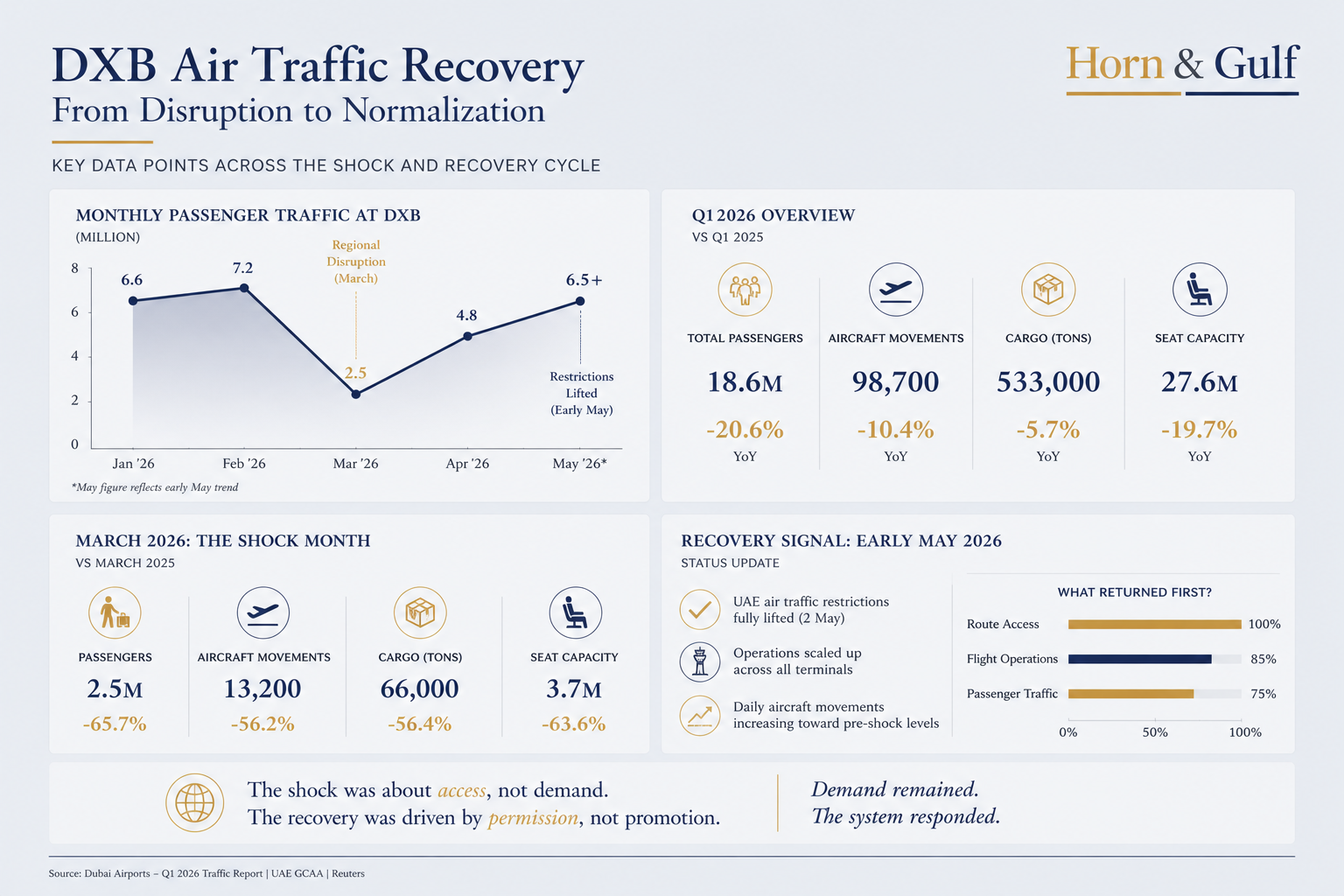
The system did not need rebuilding. It needed reopening.
Resilience Is Not Stability — It Is Reconfiguration
It would be a mistake to interpret this recovery as a simple return to normal. The shock has already altered the structure beneath the surface. Airlines have adjusted routing assumptions. Risk models have been recalibrated. Insurance pricing has shifted. The system is now more sensitive, more reactive, and more aware of its own exposure.
In other words, the system did not just recover. It learned. Dubai’s role in this system has also been clarified. It is not merely a hub that facilitates movement. It is a node that concentrates global flows—of passengers, cargo, and capital—into a single routing engine. When that engine pauses, the effects cascade far beyond aviation.
From Collapse Narrative to System Test
The March numbers told a story of collapse. The May recovery tells a different one. This was not a demand shock.
It was a temporary interruption of a highly optimized global system.
And the response was not fragility. It was speed. Dubai did not break under pressure. It paused, recalibrated, and resumed. The difference is structural. A fragile system absorbs shocks slowly and recovers even more slowly. A resilient system processes shocks quickly and restores function almost immediately.
Dubai belongs to the second category.
What This Means Going Forward
The implication is clear. Air traffic is no longer just about movement. It is about access, risk, and control. Future disruptions—whether geopolitical or operational—will not necessarily reduce demand. They will restrict the system’s ability to process it. And when access is restored, recovery will not be gradual. It will be immediate.
This is the new logic of global mobility.