
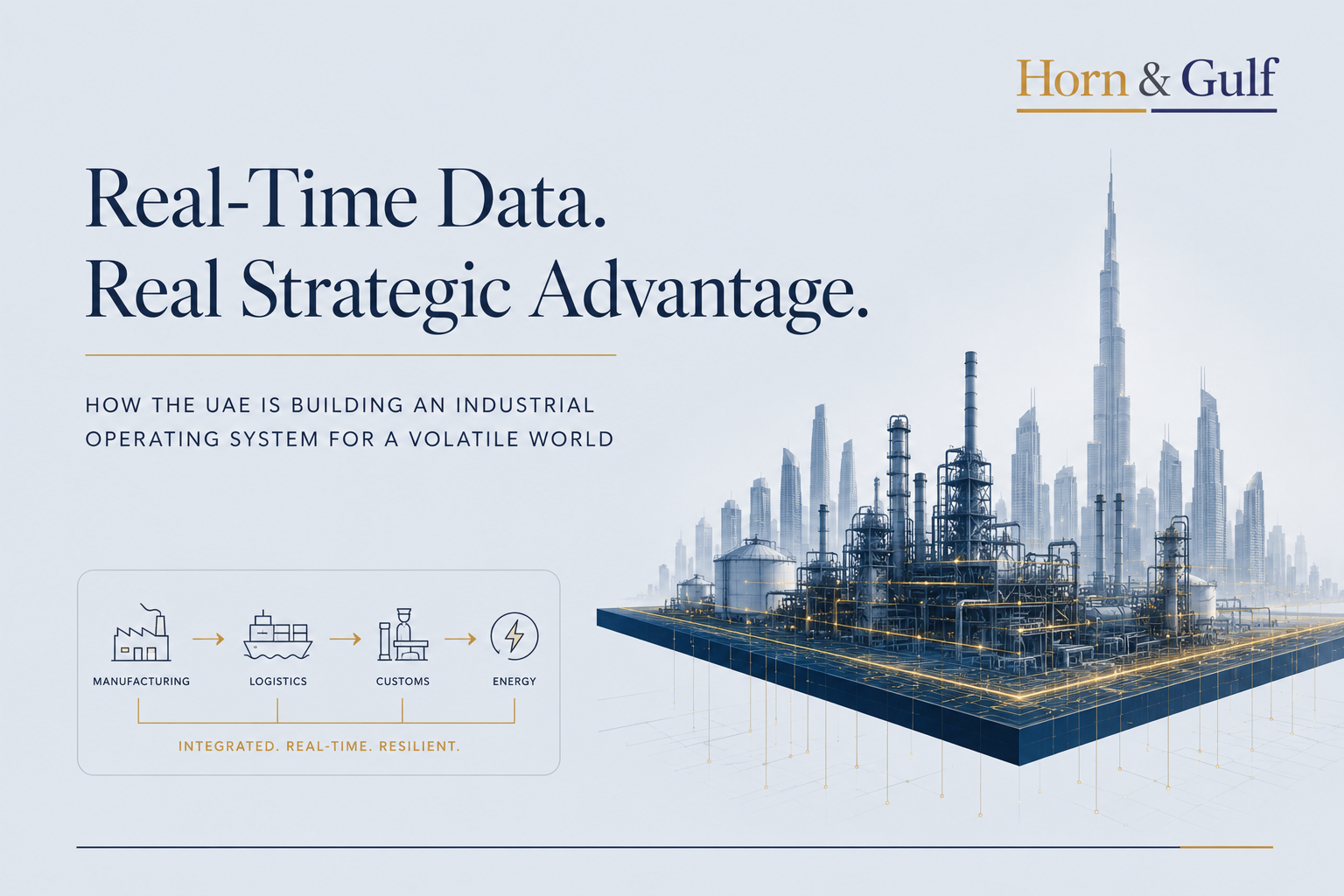
UAE industrial data strategy is becoming a central pillar of the country’s long-term economic resilience model. By integrating manufacturing, logistics, customs and energy into a real-time operational system, the UAE is positioning data visibility as a strategic national advantage in an increasingly volatile global environment.
The Signal Is Not the Committee. The Signal Is the System.
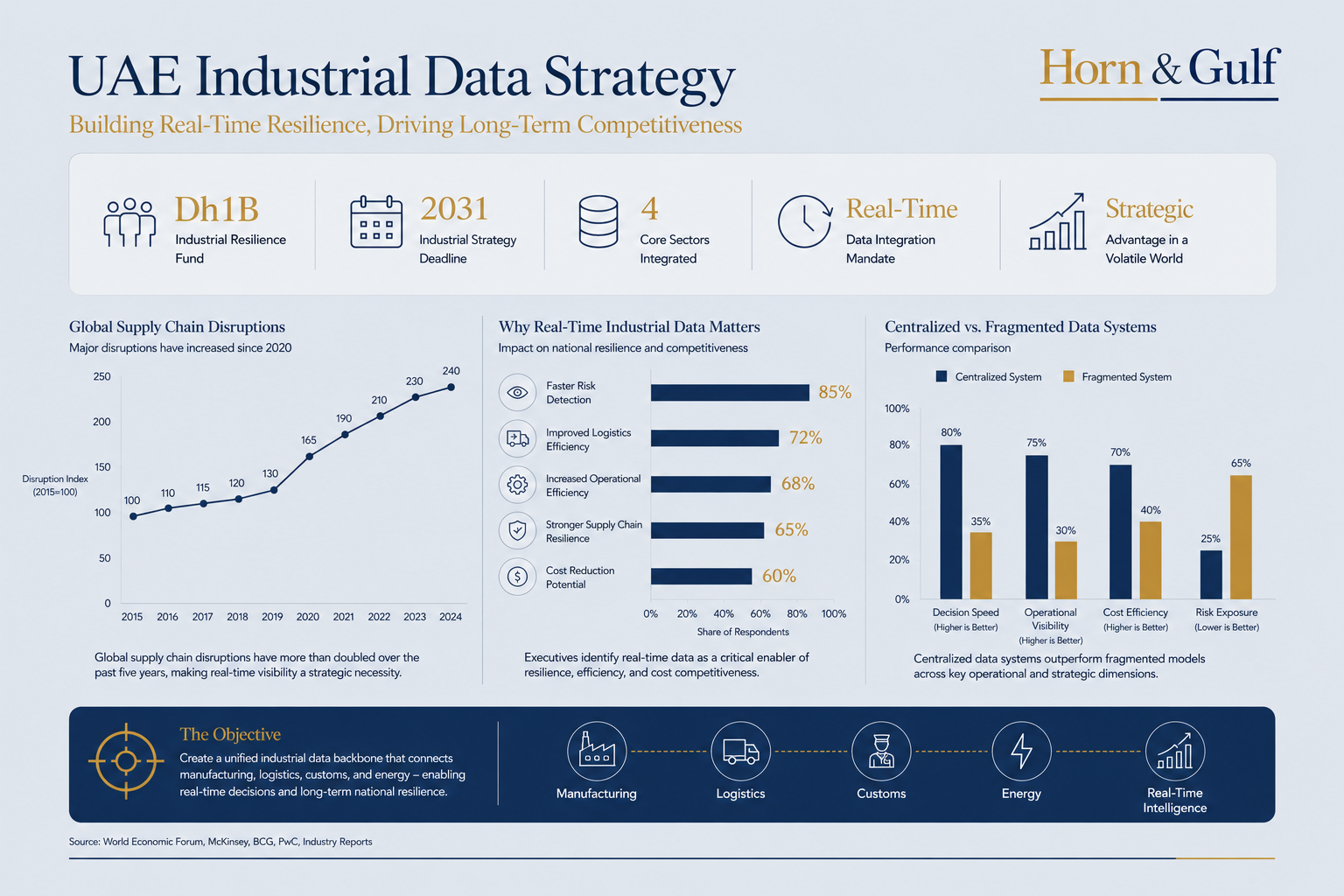
The UAE’s approval of a National Industrial Data Committee is easy to read as another institutional announcement. It is not. The more important signal is the architecture around it: a Dh1 billion industrial resilience fund, a national mandate to integrate real-time data across manufacturing, logistics, customs and energy, and a 2031 industrial strategy that gives the whole structure a deadline.
In practical terms, the UAE is not merely creating another government body. It is attempting to build a national industrial operating layer. That distinction matters. A committee can coordinate policy. A data backbone can coordinate the economy.
From Infrastructure State to Coordination State
For two decades, the UAE built the physical foundations of competitiveness: ports, airports, free zones, logistics corridors, digital government platforms, energy assets and smart-city infrastructure. That model turned the country into one of the world’s most efficient trade and services hubs. The new phase is different.
The UAE is now moving from physical infrastructure to decision infrastructure. The goal is no longer only to move goods, capital and people faster. The goal is to see the system in real time, identify stress before it becomes disruption, and coordinate industrial activity across agencies and sectors.
Manufacturing, logistics, customs and energy are not separate files in this model. They are parts of one operational map. That is the real meaning of industrial data integration.
Why This Matters After Red Sea, Hormuz and Supply Chain Shocks
The timing is important. The Gulf is operating in a world where disruption is no longer occasional. Red Sea attacks, Hormuz risk pricing, energy volatility, shipping rerouting, insurance premium spikes and supply chain fragmentation have all shown the same lesson: crisis now moves faster than traditional bureaucracy.
If disruption is real-time, governance also has to become real-time.
This is where the UAE’s move becomes strategically significant. A live industrial data layer can help the state understand where pressure is building: energy consumption, port movement, customs flows, factory output, logistics delays, import dependency and sector-level bottlenecks.
That does not eliminate risk. But it changes the state’s reaction time.
The UAE Model: Build Fast, Refine While Moving
The comparison with the EU and the UK is central to the argument. Europe generally moves through consultation, legal frameworks, institutional balancing and regulatory sequencing. That model is rigorous, but slow.
The UAE model is different: central mandate, Cabinet-level direction, institutional alignment and fast execution.
This has advantages. Expo 2020 was delivered. Etihad Rail was built. Digital government systems moved faster than in many older industrial economies. The UAE’s track record suggests that once a national priority is defined, implementation usually follows.
But the model also carries risk. Centralisation can create speed, but it can also create dependency. A national industrial data backbone improves visibility, but it also raises questions around cybersecurity, operator trust, data ownership, interoperability and private-sector confidence.
The state can mandate the data layer. It cannot automatically fix the plant floor.
The Hard Part Is Not the Cabinet Decision
The hardest part will be technical and operational.
Factories use different systems. Logistics operators hold fragmented data. Customs platforms, energy systems and manufacturing floors do not naturally speak the same language. Many industrial operators still depend on legacy software, manual reporting or isolated ERP systems.
To make this work, the UAE will need more than a committee. It will need standards, connectors, incentives, cybersecurity rules, data-sharing protocols, industrial software partners and trusted governance mechanisms.
That is where the real execution test begins.
A national data strategy succeeds only when the smallest factory, the logistics warehouse, the customs gate and the energy dashboard can all feed reliable information into the same operating picture.
The Bigger Signal: Data as Strategic Infrastructure
The deeper reading is that the UAE now sees data as infrastructure. Not as a technology accessory. Not as a dashboard. Not as a corporate efficiency tool.
Data is becoming part of national resilience.
Ports were infrastructure. Airports were infrastructure. Free zones were infrastructure. Energy grids were infrastructure. Now the UAE is adding another layer: the ability to read its industrial economy in motion. That is a major strategic shift.
The country is positioning itself not only as a trade hub, but as a regional coordination hub. In a fragmented world, the winner is not only the country with assets. It is the country that can see, price, route and manage those assets faster than others.
Final Reading: The Gulf Is Becoming a Live Operating System
The UAE’s financial centres are moving toward AI-native finance. Its logistics system is tied to global maritime flows. Its free zones are designed around capital mobility. Its industrial policy is increasingly linked to resilience, food security, energy security and supply chain control.
The National Industrial Data Committee sits inside this larger architecture. It is another sign that the Gulf is no longer simply building assets. It is building control layers.
In the old model, competitiveness came from location, capital and infrastructure. In the new model, competitiveness comes from coordination speed. That is what this announcement signals.
The UAE is not only preparing for growth. It is preparing to manage volatility as part of growth. And in the present regional environment, that may be the more important advantage.