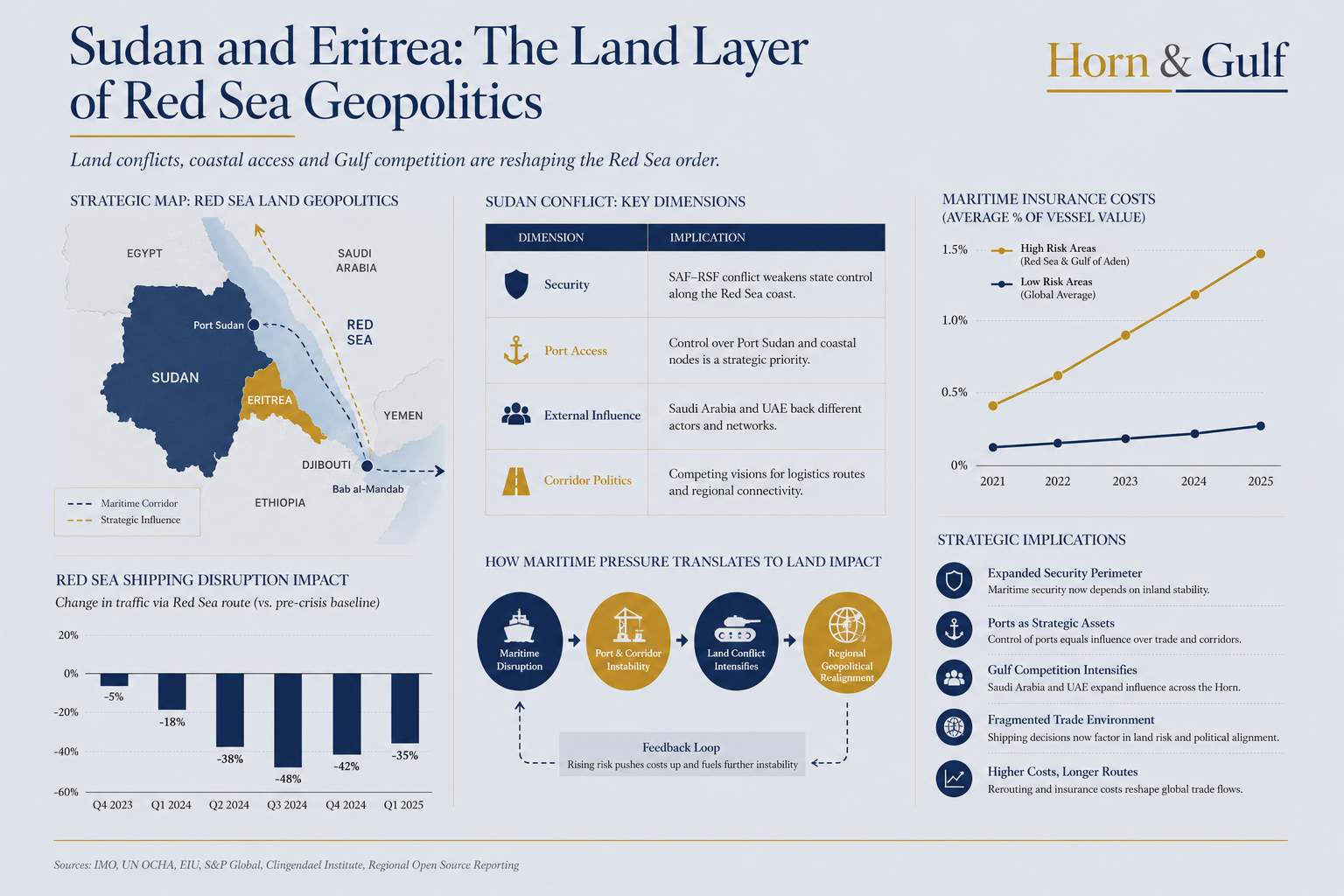
Red Sea geopolitics is no longer limited to shipping lanes and naval patrols. Sudan’s conflict and Eritrea’s strategic position are reshaping maritime security, Gulf influence and regional risk across the Horn of Africa.
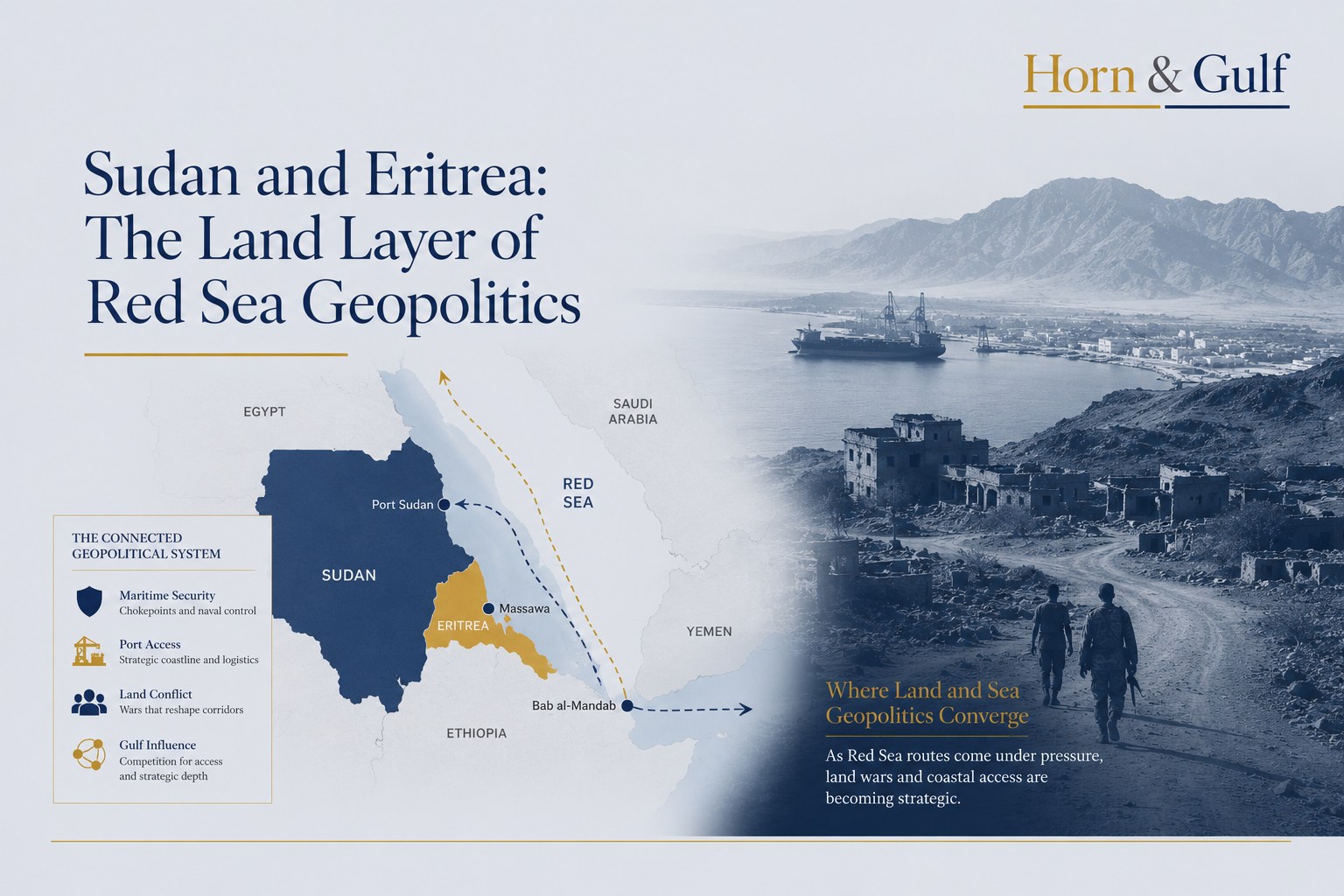
For years, the Red Sea was treated primarily as a maritime corridor — a narrow but manageable artery connecting Europe, the Gulf and Asia through the Suez Canal system. Security discussions focused on shipping lanes, naval patrols and chokepoint stability.
That framework is beginning to break down. The Red Sea is no longer only influencing maritime trade. It is starting to reshape the political geography around it.
Sudan’s civil war, Eritrea’s renewed strategic relevance, and the widening competition between Gulf powers across the Horn of Africa are no longer separate regional stories. They are increasingly connected pieces of a broader restructuring taking place between the Gulf, the Red Sea and East Africa.
This is not simply a maritime crisis spilling onto land. It is the emergence of a geopolitical system where land wars, ports, logistics corridors and naval security are becoming inseparable.
The Red Sea Is Moving Inland
The old model was relatively straightforward. A secure maritime route depended on:
- open sea lanes
- stable chokepoints
- naval deterrence
- predictable shipping patterns
But maritime trade does not function in isolation. Ports require functioning states. Supply chains require political stability. Energy corridors depend on territorial control far beyond the coastline itself.
As pressure rises across Hormuz and the Red Sea, the importance of coastal political order increases with it. This is why Sudan matters far beyond Sudan.
The country sits along one of the most strategically sensitive coastlines in the wider Red Sea system. As instability deepens there, the consequences extend into maritime insurance, shipping calculations, Gulf logistics planning and regional power projection.
The sea is now pulling inland politics into its own security orbit.
Sudan Is Becoming a Red Sea Power Struggle
The war inside Sudan is often described through the lens of internal military rivalry between the Sudanese Armed Forces and the Rapid Support Forces. That remains true, but it is no longer sufficient.
The conflict is also evolving into a contest over:
- access to strategic ports
- political alignment along the Red Sea
- logistics influence
- and regional corridor positioning
Port Sudan has become increasingly important not only because it functions as a wartime capital, but because Red Sea access itself has become more valuable under regional instability.
As Hormuz faces pressure and Red Sea shipping routes remain vulnerable, western maritime corridors gain strategic weight. Gulf powers understand this clearly.
Saudi Arabia’s long-term investment in Red Sea infrastructure — from Yanbu to Jeddah and NEOM — reflects a strategic shift toward western maritime depth. The UAE, meanwhile, continues to strengthen its network-oriented approach across ports and logistics corridors stretching into the Horn of Africa.
Sudan now sits between these competing strategic geometries. That does not mean Gulf powers are directly controlling the war. But it does mean the war is increasingly shaped by wider maritime calculations surrounding the Red Sea.
Eritrea Is Quietly Returning to Strategic Relevance
Eritrea has long occupied an unusual position in regional geopolitics: isolated, heavily securitized and diplomatically constrained, yet geographically impossible to ignore.
That geography is becoming more important again.
As maritime instability expands, states bordering the Red Sea gain new strategic relevance regardless of economic size or diplomatic profile. Eritrea sits directly near the Bab al-Mandab corridor, one of the world’s most sensitive maritime chokepoints.
In periods of regional stability, Eritrea can remain peripheral. In periods of maritime fragmentation, it becomes strategically valuable.
This is why diplomatic attention toward Eritrea has quietly increased. The issue is no longer simply governance or sanctions policy. It is also about maritime positioning, regional access and strategic depth. The Red Sea crisis is transforming geography into leverage.
Maritime Security No Longer Ends at the Coastline
One of the most important shifts underway is conceptual. For decades, maritime security was treated primarily as a naval issue. Ships, fleets, patrols and chokepoints defined the conversation. Today, maritime security increasingly depends on what happens inland.
A port city under pressure affects trade flows. A fragmented hinterland affects insurance pricing. A regional proxy struggle affects corridor reliability. The result is a much wider security perimeter.
Sudan demonstrates this clearly. The conflict is not interrupting a stable maritime system from the outside. It is becoming part of the system itself.
This is why the Horn of Africa is gradually transforming from a peripheral geography into a strategic pressure zone connected directly to Gulf security calculations.
The Gulf’s Strategic Competition Is Expanding Westward
The pressure surrounding Hormuz is producing another long-term effect: Gulf strategic competition is moving westward toward the Red Sea and the Horn of Africa.
Saudi Arabia’s western coastline is becoming more central to its economic and logistical future. The UAE continues to deepen its maritime-oriented strategy through ports, trade infrastructure and regional access points.
This creates a wider geopolitical arc stretching from:
- the Gulf
- through the Red Sea
- into Sudan, Eritrea, Djibouti and Somaliland
These are no longer separate regional files. They are increasingly connected components of a single strategic system. The more contested maritime trade becomes, the more valuable coastal influence and corridor depth become alongside it.
A New Geography of Risk
The broader implication reaches beyond the region itself. Global trade was built on the assumption that maritime routes would remain relatively predictable, insulated from land conflicts and supported by stable security structures.
That assumption is weakening. Today:
- sea routes influence land wars
- land instability affects shipping calculations
- ports shape geopolitical leverage
- and maritime risk spreads across entire regions rather than remaining confined to chokepoints
This creates a more fragmented geopolitical environment where instability moves through interconnected systems rather than isolated crises.
The Red Sea illustrates this transition more clearly than almost anywhere else.
Final Reading
Sudan and Eritrea are not secondary stories orbiting the Red Sea crisis. They are increasingly becoming part of its core structure. Because the Red Sea is evolving beyond its traditional role as a shipping corridor. It is becoming:
- a strategic pressure system
- an access architecture
- an energy security layer
- and a geopolitical reordering zone linking the Gulf to the Horn of Africa
As pressure intensifies across maritime corridors, instability is no longer stopping at the coastline. It is moving inland with the trade itself.