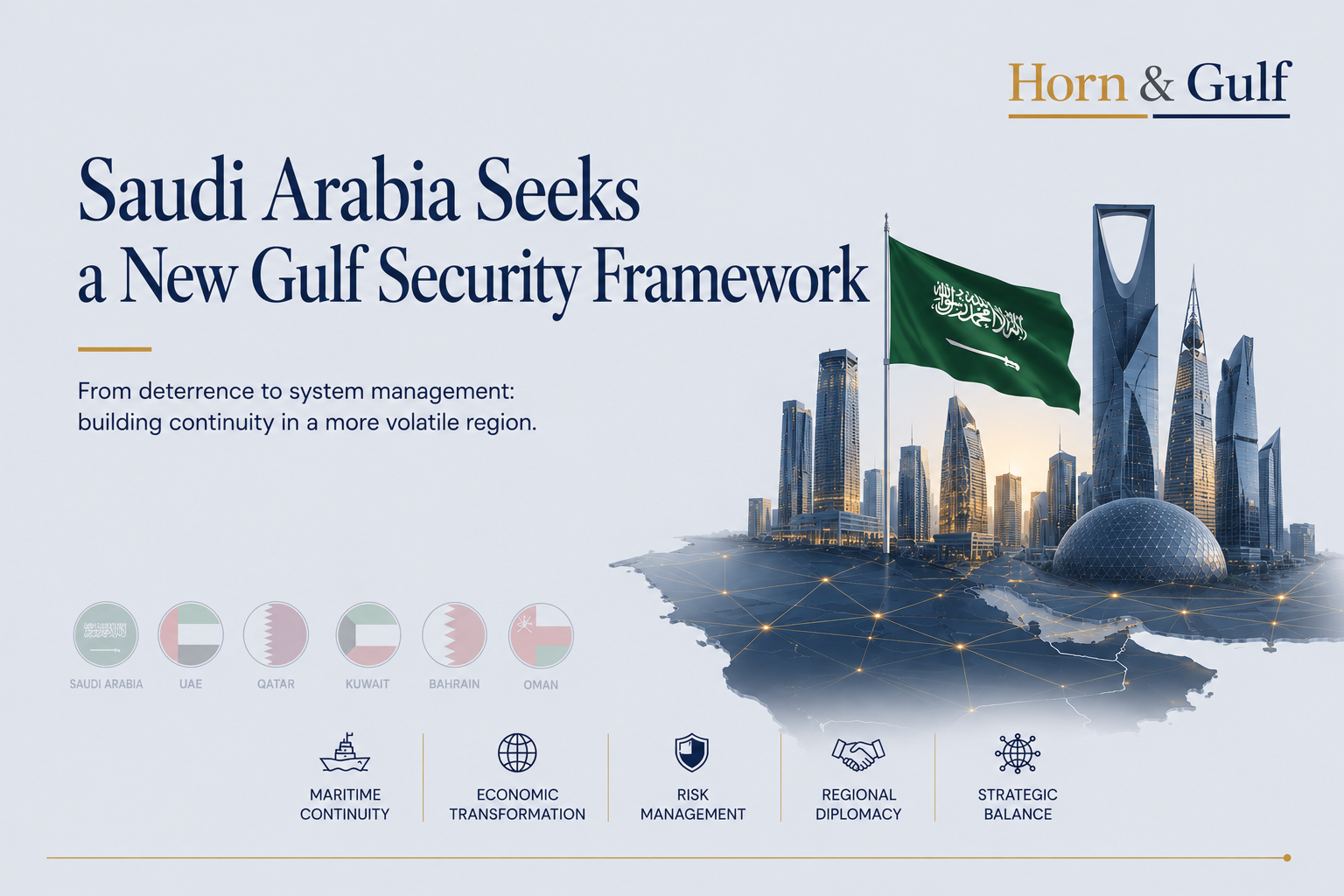
The emerging Gulf security framework is increasingly shaped by continuity management rather than deterrence alone. Saudi Arabia’s current regional posture suggests a broader effort to reduce escalation risks affecting maritime stability, energy flows and long-term economic transformation across the Gulf and Red Sea system.
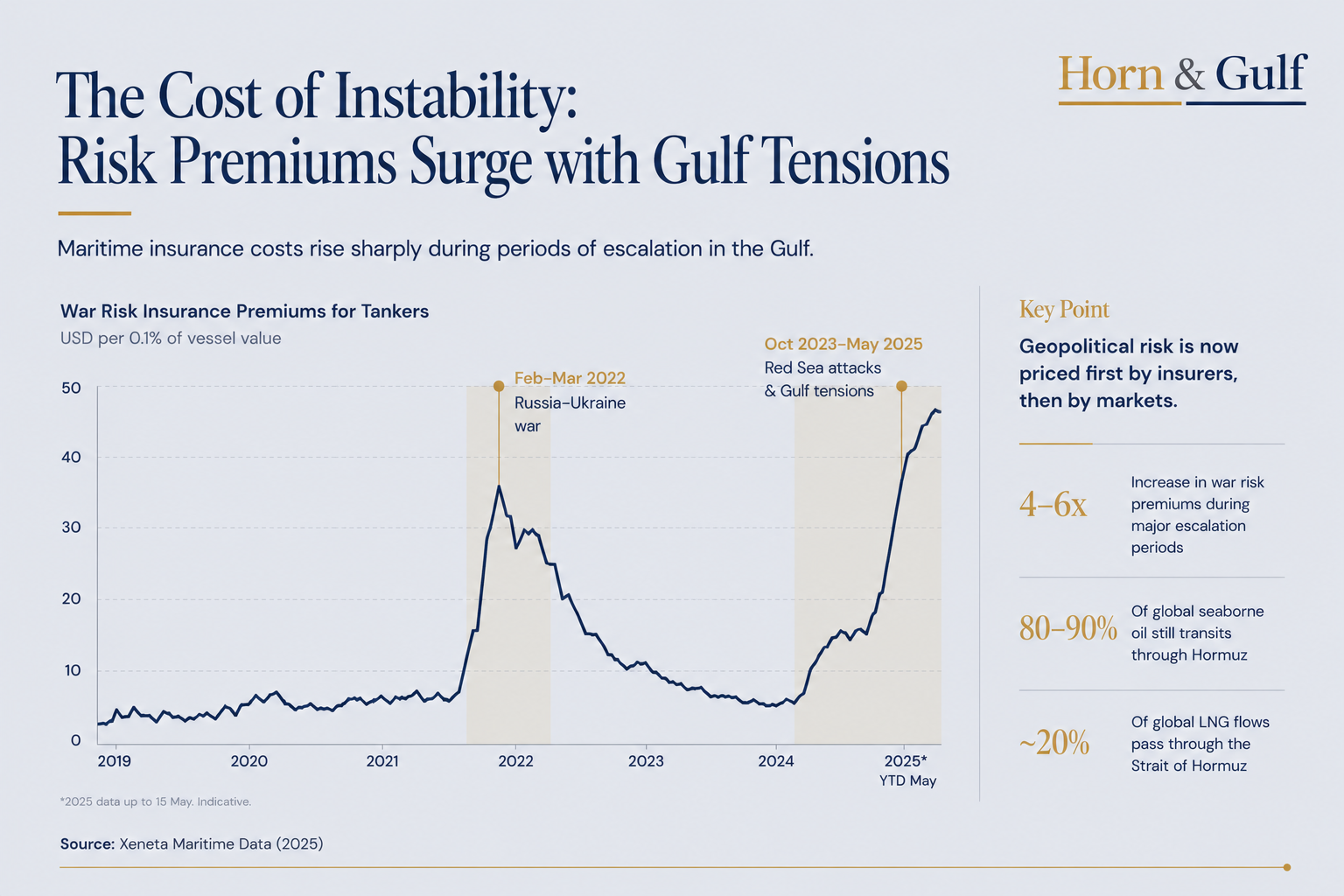
As geopolitical pressure around Hormuz and the Red Sea continues to influence insurance costs, logistics confidence and sovereign investment behavior, regional security is becoming more closely tied to corridor resilience and economic continuity.
The visible signal is diplomatic. The deeper signal is structural.
Across the Gulf, a broader strategic recalibration appears to be taking shape. Regional powers are increasingly exploring mechanisms that can reduce escalation risk while preserving economic continuity, maritime stability and long-term investment confidence. The discussion is no longer limited to military deterrence alone. It increasingly concerns whether the Gulf can sustain economic transformation under conditions of prolonged geopolitical pressure.
This is where Saudi Arabia’s current regional posture becomes particularly significant.
Riyadh’s approach increasingly suggests an emphasis not only on deterrence, but also on preserving regional continuity and reducing the economic and strategic costs of recurring instability. That distinction matters because the region’s exposure today extends beyond traditional military considerations. It also touches maritime continuity, logistics confidence, energy pricing, insurance conditions and investor behavior.
For decades, Gulf stability rested on a relatively straightforward framework: energy exports would continue, maritime corridors would remain functional and external security guarantees would help contain major regional disruptions before they affected the wider economic system.
Today, that framework is facing new forms of pressure.
The Gulf Is Moving Toward Broader System Management
Recent tensions around Hormuz highlighted something larger than a conventional security crisis. They demonstrated how exposed modern Gulf economies can be to disruption at the chokepoint level.
A maritime corridor does not necessarily need to be fully closed to reshape global market behavior. Even elevated uncertainty can influence insurers, shipping operators, energy traders and investors to reassess regional risk.
That repricing dynamic is becoming an increasingly important feature of the Gulf security environment.
This is why Riyadh’s posture should not be interpreted solely through the language of reconciliation or diplomacy. Saudi Arabia’s current positioning suggests an effort to explore whether regional stability can be reinforced through broader political and security understandings that reduce the probability of uncontrolled escalation.
In practical terms, the kingdom appears focused on limiting the number of scenarios in which military deterrence becomes the primary mechanism for preserving regional stability.
This is less about short-term tactical positioning and more about long-term strategic continuity.
Vision 2030 Requires a More Predictable Regional Environment
Many external analyses still separate Gulf security from Gulf economic transformation. Increasingly, the two are interconnected.
Saudi Arabia’s long-term development agenda depends on several forms of continuity:
- predictable logistics
- uninterrupted maritime access
- stable energy exports
- investor confidence
- manageable insurance costs
- regional transport integration
- long-duration infrastructure planning
A persistently unstable regional environment increases the cost and complexity of protecting those pillars.
If maritime corridors repeatedly experience periods of elevated tension, the implications extend beyond security considerations alone. Insurance costs can rise, capital allocation may become more selective and long-term infrastructure planning becomes more difficult to price with confidence.
Under such conditions, even successful diversification strategies require greater resilience and higher continuity management.
This appears to be one of the underappreciated dimensions of Riyadh’s current regional posture.
Saudi Arabia does not necessarily require full strategic alignment with regional rivals. Rather, its broader positioning suggests an interest in reducing the degree to which geopolitical rivalry repeatedly affects economic continuity, maritime stability and investor confidence across the Gulf system.
In this sense, the kingdom’s posture can be read as part of a wider effort to strengthen the political and strategic foundations supporting long-term regional development.
Hormuz and the Red Sea Increasingly Form One Strategic Theatre
Another important dimension is the growing connection between Hormuz and the Red Sea.
From an H&G perspective, these corridors increasingly operate as interconnected pressure systems rather than isolated theatres.
If instability around Hormuz intensifies, Gulf states are likely to accelerate bypass infrastructure, western export routes and logistical diversification. If instability simultaneously affects the Red Sea, however, those alternative corridors become more strategically constrained.
This is why Saudi Arabia’s regional calculations increasingly intersect with broader Red Sea and Bab el-Mandeb stability considerations.
The issue is no longer simply territorial security. It is increasingly about corridor continuity.
And corridor continuity today involves far more than naval presence alone. It also includes:
- insurance confidence
- shipping predictability
- energy continuity
- escalation management
- infrastructure redundancy
- sovereign credibility
- logistics resilience
The Gulf is gradually becoming a geography where access, continuity and confidence must be actively managed across multiple interconnected systems.
The Saudi and Emirati Approaches Reflect Different Strategic Priorities
Saudi Arabia and the UAE appear to be responding to similar structural pressures through somewhat different strategic emphases.
The UAE’s approach has focused strongly on infrastructure resilience, export flexibility and logistical diversification. Fujairah’s expanding role reflects a broader effort to strengthen energy continuity and reduce direct exposure to Hormuz-related disruption.
Saudi Arabia’s approach appears broader at the regional level.
Alongside route diversification, Riyadh’s posture increasingly reflects an interest in reducing the likelihood of repeated escalation cycles affecting the wider Gulf system.
This reflects differences in strategic positioning rather than disagreement.
The UAE operates as a highly networked commercial and logistics hub with strong emphasis on flexibility and infrastructure adaptation. Saudi Arabia, because of its scale, geography and regional centrality, naturally carries a broader stake in long-term systemic stability across the Gulf and Red Sea environment.
In simplified terms:
The UAE is strengthening resilience around critical corridors.
Saudi Arabia appears increasingly focused on reducing the long-term volatility surrounding those corridors.
Both approaches are rational responses to a changing regional landscape.
The Emerging Gulf Security Environment
The earlier regional framework was relatively clear:
external security protection supported energy continuity and regional stability.
The emerging framework is becoming more layered and interconnected.
The next phase of Gulf security will likely be shaped simultaneously by:
- maritime chokepoints
- insurance markets
- sovereign capital flows
- logistics redundancy
- regional diplomacy
- energy rerouting
- infrastructure resilience
- state capacity
- continuity management
Military deterrence will remain essential. But deterrence alone may no longer be sufficient to sustain long-term confidence across the wider economic system.
That is the deeper significance of Saudi Arabia’s current posture.
Riyadh’s positioning increasingly suggests an effort to support a regional environment capable of sustaining economic continuity, investment confidence and strategic stability under conditions of ongoing geopolitical competition.
The central question facing the Gulf is therefore no longer simply whether the region can absorb crises.
It is whether the Gulf can develop a broader security and continuity framework capable of supporting long-term transformation in an era defined by persistent geopolitical pressure.