
Horn of Africa security is becoming increasingly important to Gulf trade continuity and Red Sea stability. As tensions around Bab el-Mandeb, Ethiopia’s maritime ambitions and wider corridor competition intensify, the Horn is evolving from a regional security concern into a structural component of global trade resilience.
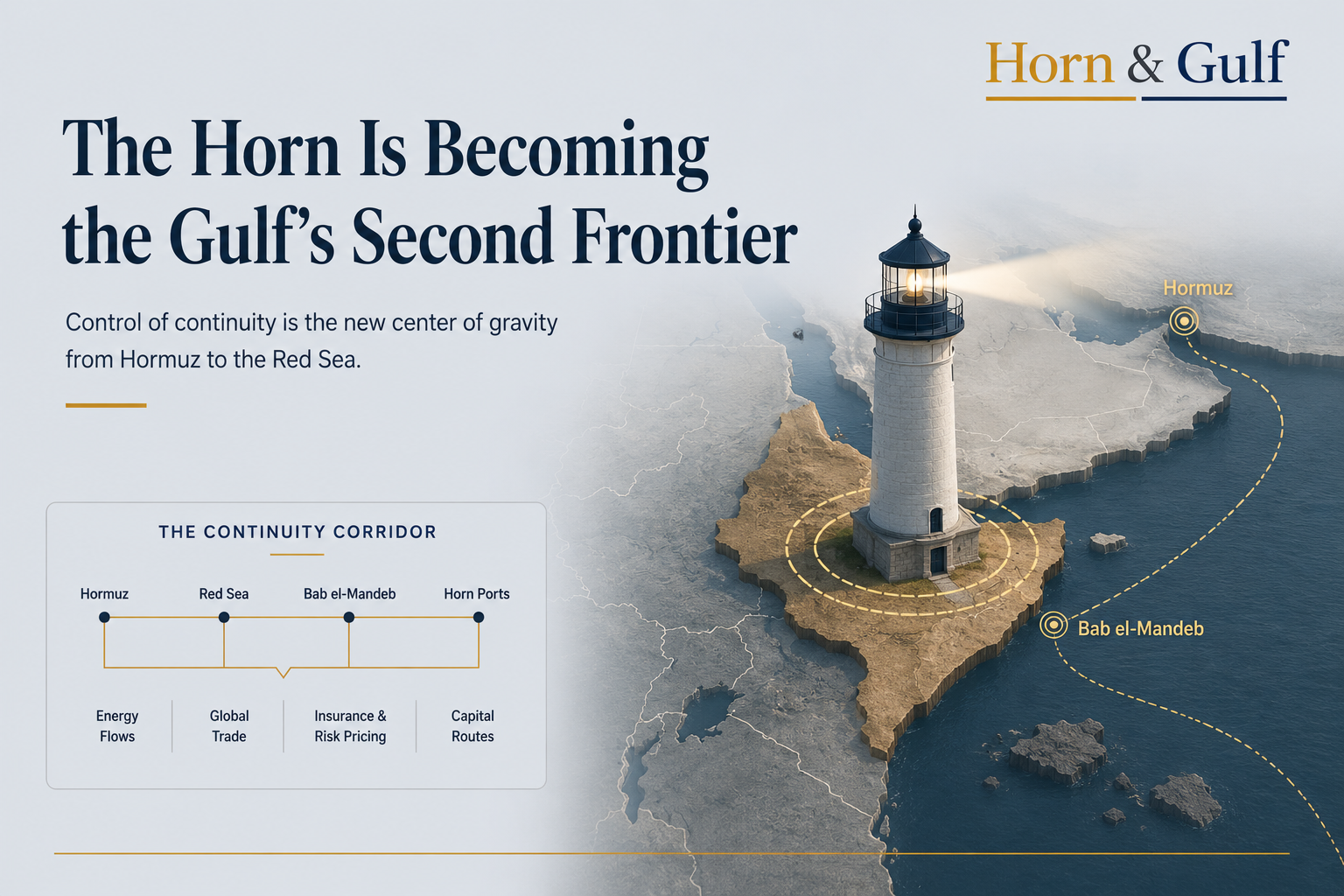
The Horn Is Becoming Part of the Gulf’s Continuity Equation
The Horn of Africa is still largely treated as a secondary theatre in global markets and geopolitical headlines. Attention remains concentrated on Hormuz, Iran, Red Sea shipping disruptions, energy security and great-power rivalry. Yet beneath those immediate pressures, a quieter structural shift is taking shape across the Horn itself.
The region is no longer functioning merely as a fragile periphery of Africa or the Middle East. Increasingly, it is becoming linked to the same strategic system that connects Gulf energy flows, Red Sea transit, Bab el-Mandeb, Suez, logistics infrastructure, insurance pricing and sovereign capital resilience.
That is the emerging signal.
Several regional pressures are beginning to converge on the same corridor: Ethiopia’s search for sustainable maritime access, Eritrea’s security concerns, Sudan’s ongoing conflict and institutional fragmentation, the unresolved Somalia–Somaliland question, and the growing diplomatic, commercial and logistics interest of Gulf and external actors.
Individually, each file can be understood within its own national context. Collectively, however, they increasingly shape a wider maritime-security environment extending from the Gulf into the Red Sea and the Horn of Africa. At the center of this equation is geography.
Ethiopia’s landlocked position is not simply a logistical challenge. Over time, it creates structural pressure on trade access, economic planning and regional connectivity. As one of Africa’s largest economies and populations, Ethiopia’s long-term interest in diversified maritime access is likely to remain a central feature of regional diplomacy.
That reality inevitably intersects with the interests of Eritrea, Somalia, Somaliland, Djibouti, Egypt and Gulf economies linked to Red Sea trade continuity. This is why the Horn matters beyond its immediate geography.
Hormuz and Bab El Mandeb Continuity System
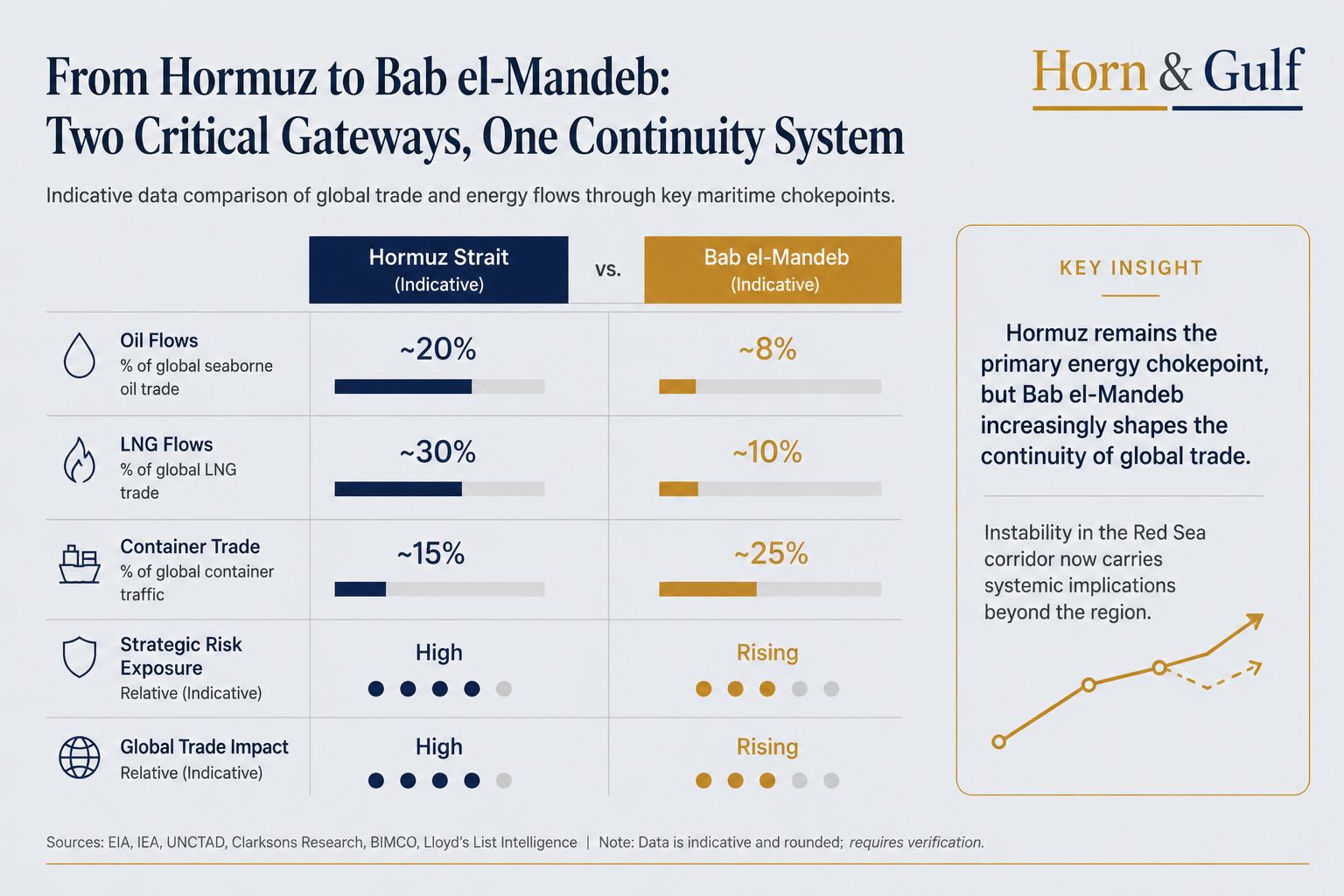
Bab el-Mandeb is not merely another maritime passage. It forms the southern gateway of the Red Sea system and remains one of the critical corridors through which global trade, energy flows and maritime traffic pass. Hormuz continues to dominate the language of Gulf security, but the stability of Bab el-Mandeb increasingly influences how resilient wider regional trade networks can become during periods of geopolitical stress.
This is the underappreciated dimension of the current transition.
The Gulf has spent years building redundancy into its strategic infrastructure through pipelines, logistics diversification, storage capacity, overland trade corridors and alternative export routes. Yet many of those systems ultimately remain connected to the continuity of Red Sea maritime access.
If Red Sea instability intensifies, or if maritime competition and regional alignments across the Horn become more rigid over time, the resilience calculations surrounding Gulf trade continuity may become more complex. The deeper issue is not necessarily whether a single chokepoint faces disruption.
It is whether multiple maritime pressure points begin influencing insurance costs, freight behavior, logistics planning and investor perceptions simultaneously. That is where the Horn increasingly becomes part of a larger Gulf continuity equation.
The Gulf economies are evolving beyond their traditional role as energy exporters. They are also becoming logistics hubs, aviation connectors, capital platforms, insurance centers, data corridors and sovereign investment systems. As a result, long-term strategic planning increasingly depends on the continuity of flows — the ability to sustain the movement of goods, capital, energy and trade during periods of regional volatility.
In that environment, security planning expands beyond tanker protection alone. It increasingly includes corridor resilience, maritime coordination, logistics continuity and infrastructure redundancy. This broader shift changes the strategic meaning of the Horn.
Instability in the region does not remain entirely local. Over time, it can influence freight costs, insurance pricing, delivery schedules, infrastructure competition, investor sentiment and capital allocation patterns across connected trade systems.
The market may not always price these pressures immediately. But the structural relationship is becoming increasingly visible.
The short-term signal is regional tension and diplomatic friction. The medium-term shift is growing competition over corridors, ports and connectivity architecture.
The longer-term implication is a gradual geopolitical repricing of maritime continuity itself. If current trends continue, the Red Sea may increasingly function not only as a trade route, but also as a strategic control layer shaping access, resilience and economic continuity across multiple regions simultaneously.
For Gulf strategic planners, maritime insurers, logistics operators and long-term investors, the Horn of Africa is therefore becoming harder to treat as a distant or isolated theatre. The strategic geography of the wider region is evolving.
Hormuz remains central to Gulf security calculations, but it is no longer the only corridor shaping continuity risk. Bab el-Mandeb and the Horn of Africa are becoming increasingly important components of the same interconnected maritime system linking the Gulf, the Red Sea, East African ports, insurance markets and global trade flows.
The principal risk is not necessarily immediate interstate conflict.
It is the gradual accumulation of fragmentation, pressure and competitive alignment inside a corridor the global economy increasingly depends upon.
That is why the Horn should no longer be viewed solely as a regional security story. It is becoming part of a broader continuity framework shaping Gulf resilience, maritime stability and the future geography of trade itself.