The Hormuz Deal Analysis emerging from this week’s reported U.S.-Iran framework suggests that markets and maritime operators are reading the agreement differently. While oil markets have largely priced a Hormuz stabilization scenario, shipping markets continue to wait for operational confirmation before treating the arrangement as durable.
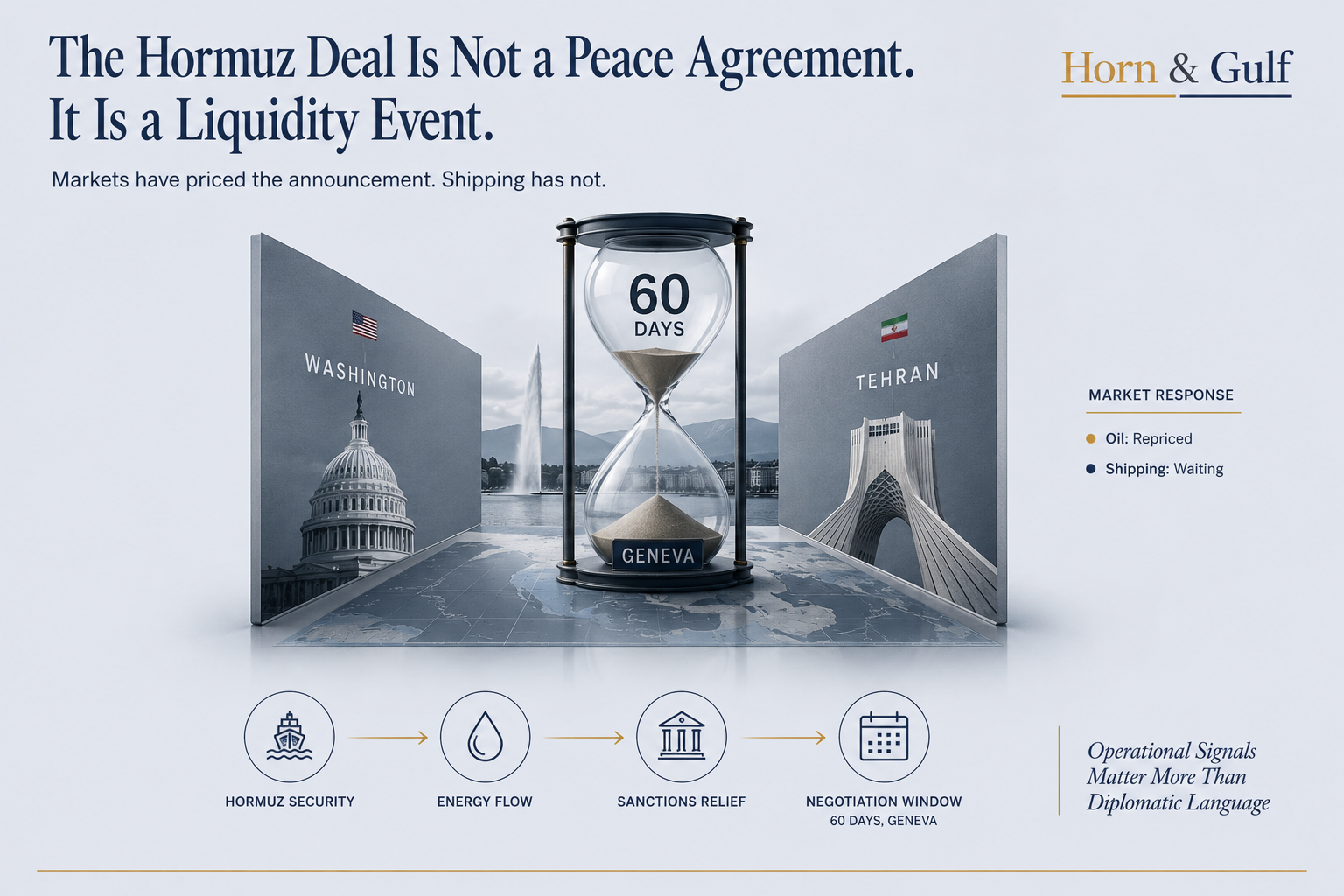
Washington and Tehran have not resolved their nuclear dispute. They have securitized it. The framework emerging from this week’s reported memorandum of understanding converts the Strait of Hormuz into a negotiating instrument. It offers Iran temporary economic access in exchange for deferring, not dismantling, the structural conflicts that produced the crisis. The distinction matters enormously for institutional actors trying to price what happened.
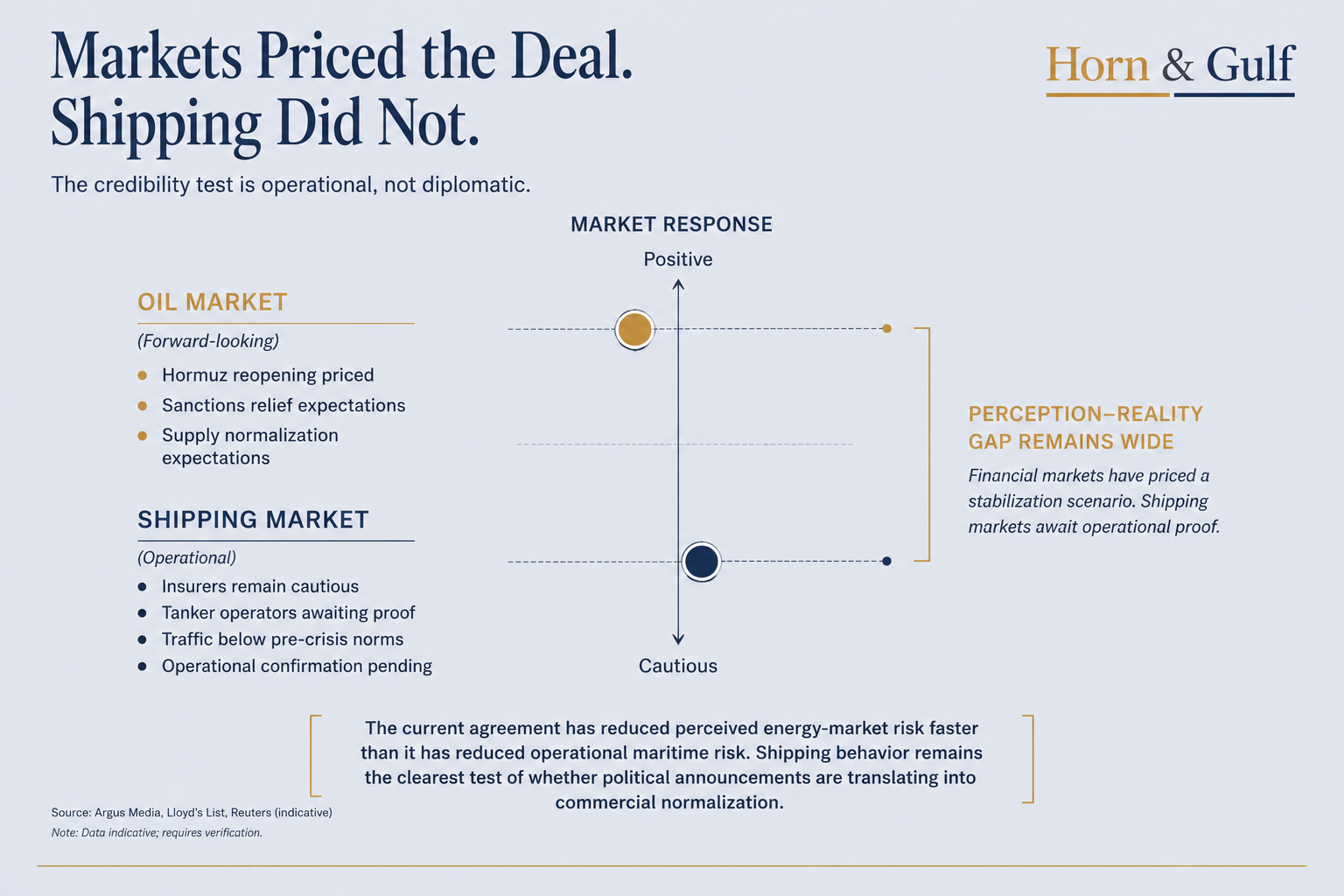
The clearest evidence that this is a liquidity arrangement rather than a peace architecture is a signal absent from every diplomatic statement. The ships are not moving. AIS tracking data reviewed across four hours of monitoring shows that tanker transits through Hormuz remain far below pre-crisis levels despite the announcement. Argus Media reporting and Lloyd’s List indicate that owners and insurers are demanding operational proof before redeploying vessels through the strait. Oil markets have priced the agreement. Shipping markets have not. That divergence is not a timing artifact. It is a reading.
Why the Mechanism Is Not What It Appears
The sequencing is the message
The 12-point text circulated under Bloomberg attribution is corroborated in its core architecture by Reuters reporting citing officials from both sides. Both outlets have widely described it as a ceasefire or preliminary peace accord. That framing obscures the actual transaction.
The deal’s operative logic runs as follows. Iran restores or permits unobstructed maritime flow through Hormuz and the adjacent Gulf lanes. The United States lifts its naval blockade on Iranian ports and grants oil-related sanctions waivers. Those waivers cover not just crude exports but the surrounding services infrastructure — banking, insurance, shipping, transportation. The nuclear file, the enrichment question, and the fate of Iran’s existing stockpiles move into a 60-day negotiation corridor, extendable, without preconditions on the Iranian program’s current state.
This is a sequenced structure. Hormuz reopens first. Revenue flows second. Nuclear architecture comes third — or not at all. Through this sequencing, Washington has effectively communicated its readiness to separate energy-flow stabilization from final nuclear settlement. That represents a significant departure from the prior posture, in which sanctions relief was conditioned on meaningful nuclear rollback. Commodity markets are pricing this as a Hormuz reopening event. It should also read as a recalibration of U.S. risk tolerance on the nuclear timeline.
The frozen-assets gap
The frozen-assets question remains the most unresolved economic element. Iranian officials and Iranian-aligned reporting continue to reference approximately $25 billion in released frozen assets as part of the framework. Reuters-linked reporting indicates that versions seen by Bloomberg did not contain this provision. U.S. officials have not publicly confirmed the figures.
The gap between these accounts is not a translation problem. It is a negotiating position papered over in the MoU rather than resolved within it. Institutional actors should price oil sanctions waivers as substantially more verified than frozen-asset releases.
The Structural Fault Line Washington Is Not Advertising
The Lebanon variable is where the framework’s internal logic breaks down.
Iran has consistently framed the agreement as ending conflict on all fronts — a formulation that includes Hezbollah’s operational situation in Lebanese territory. The United States has stated, through Reuters-sourced reporting, that Israeli withdrawal from Lebanon is not a condition of the bilateral arrangement. Israel has signaled no constraint on its Lebanon operations. The three positions are irreconcilable as stated, and no text in the reported MoU resolves them.
This matters for the Gulf institutional audience in a specific way. A framework that stabilizes Hormuz maritime flows while Lebanon remains operationally active creates a two-speed regional security environment: the maritime and energy layer normalizes while the security-order layer stays contested. Gulf sovereign actors have spent four years building the institutional and diplomatic architecture — the Abraham Accords, Saudi-Iranian normalization, the regional connectivity investment programs — on the assumption that de-escalation would eventually be comprehensive. A partial stabilization that insulates energy infrastructure from conflict while leaving political-military dynamics unresolved produces a structural premium on continuity bets rather than transformation bets. The investment calculus is not the same thing.
What the $300 Billion Figure Actually Signals
Reuters reporting has introduced one element that has received insufficient analytical attention: a proposed private-sector reconstruction and development fund worth approximately $300 billion. More than half its commitments are already sourced from private investors.
This is not a Marshall Plan for Iran. It is a signal about where private capital believes the post-sanctions opportunity lies — and more importantly, which institutional actors have already positioned themselves ahead of public announcement. The existence of a substantially pre-committed private fund suggests that some sovereign and institutional investors operated on non-public confidence in a deal framework well before this week’s announcement. Gulf institutional actors reading this analysis should note that this is not a market they are entering at the beginning. Early-mover positioning may already be established.
The fund structure also clarifies something about Washington’s posture. Offering economic reconstruction through private-sector vehicles rather than U.S. government instruments lets the administration advance engagement with Tehran while limiting Congressional exposure. It is a structural choice that signals something about the political durability of the arrangement. Deals built around private capital are more resilient to administration change than deals built around treaty obligations. They are also harder to verify and harder to unwind.
The Indicators That Will Determine Whether This Becomes Real
The most important signal over the next ten to fourteen days is not diplomatic language. It is operational behavior across four measurable dimensions.
Tanker transit volume
A return toward pre-crisis norms — approximately 138 vessels per day — requires passing through identifiable thresholds. Below 20 daily transits, the commercial layer does not believe the political announcement. Between 50 and 100, normalization is underway. No publicly available real-time AIS data showed Hormuz approaching even the lower threshold as of this writing. The divergence between oil market pricing and shipping market behavior is the most honest available gauge of the framework’s credibility.
War-risk insurance
Lloyd’s and the leading London market syndicates will move on Iranian routes before most institutional investors update their allocations. A meaningful reduction in war-risk premium is a more reliable indicator of durable de-escalation than any official statement.
Israeli operational tempo in Lebanon
A sustained period of reduced Israeli military activity in Lebanese territory would indicate that the Lebanon spoiler is being managed through back-channel coordination rather than public framework. Two weeks is the minimum meaningful signal; 72 hours is insufficient. Its absence within that window should be read as structural, not tactical.
Access to frozen assets
If Iranian officials confirm partial release of frozen funds through verified banking channels before the 60-day negotiation window closes, the economic incentive structure of the arrangement has real traction. If frozen funds remain in dispute at day 30, the MoU is functioning as a ceasefire mechanism rather than a transformative economic compact.
The Institutional Read
Gulf sovereign funds and development finance institutions
For Gulf sovereign wealth funds and development finance institutions, this framework produces a clear decision architecture. The energy-flow layer is the most verified and most immediately actionable element. Oil sanctions waivers are substantially corroborated. A return of Iranian crude to export markets represents a significant supply-side development. Reuters cites over 100 million barrels in stored inventory, with direct implications for Gulf fiscal planning and portfolio positioning across energy-linked assets.
The economic reconstruction opportunity is real but front-run. Institutional actors considering Iran-adjacent positioning should assess whether the $300 billion private fund leaves meaningful first-mover optionality or whether early commitments have already captured the primary upside.
Logistics investors and port infrastructure allocators
For logistics investors and port infrastructure allocators, the operative question is not whether Hormuz reopens — it will, if the framework holds — but how long the shipping market remains in wait-and-see mode. The gap between political announcement and commercial normalization is typically measured in weeks for non-conflict disruptions. For a strait that stranded over 600 vessels and recorded daily transits in single digits, the recovery curve is slower. Insurance recalibration is the binding constraint, not vessel availability.
Creditors with Horn of Africa and East African exposure
For creditors exposed to Horn of Africa and East African sovereign borrowers, the most immediately material implication of Hormuz normalization is remittance and trade finance restoration. The fiscal transmission of the Gulf disruption into Ethiopian, Djiboutian, and Somali budget structures — documented in prior H&G analysis — runs in reverse when Gulf commercial flows normalize. That reversal is not instantaneous, and it is not guaranteed by the MoU alone. It requires the oil-waivers provision to become operational and shipping volumes to recover.
The framework, as it stands, is less a peace agreement than a temporary conversion of Hormuz security into sanctions liquidity. Whether it becomes something more durable depends entirely on the parties’ ability to transition from energy-flow stabilization to security-order stabilization. That transition is one the Lebanon question has already complicated and the nuclear deferral has not resolved.
The ships will tell you when to believe it.