The interpretive gap emerging from the June 2026 framework may prove more consequential than the ceasefire itself. Washington, Tehran, and Jerusalem each welcomed different elements of the agreement — yet each appears to be operating from an entirely different understanding of its ultimate purpose. Consequently, the next 60 days in Geneva will determine whether those interpretations can coexist inside a single diplomatic process.

The framework agreement is now in place.
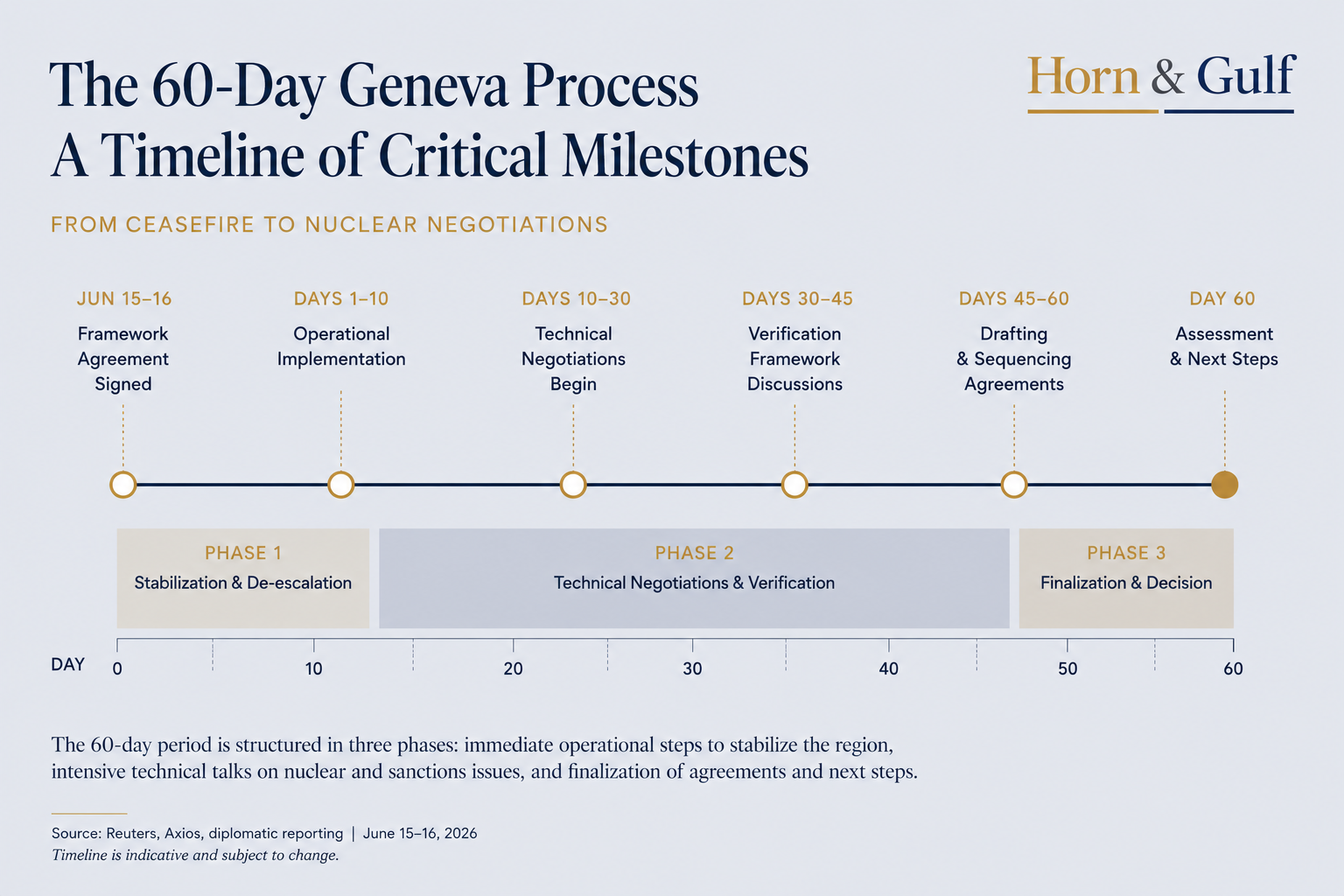
The Strait of Hormuz is set to reopen. Furthermore, a ceasefire has been declared, and a 60-day negotiation process in Geneva is about to begin.
Markets understood the message immediately. Oil prices fell, equities recovered, and international actors — from shipping companies to central bankers — welcomed the development as a sign of de-escalation.
Yet beneath that relief sits a strategic problem.
Washington, Tehran, and Jerusalem may have signed the same document. However, they do not appear to believe they signed the same agreement. That divergence is not a side issue — it is likely to define the next sixty days.
The Agreement Exists. Consensus Does Not.
By mid-June, reports indicated that parties had digitally approved the framework and were preparing a formal signing ceremony in Switzerland.
At a high level, the arrangement is straightforward. The Strait of Hormuz reopens, hostilities cease, nuclear negotiations move into a dedicated sixty-day track, and sanctions discussions shift to the next phase.
The difficulty begins, however, when the parties explain what those commitments actually mean.
Washington presents the agreement as the first step toward reducing and eventually dismantling Iran’s weapons-relevant nuclear capabilities. Tehran, by contrast, describes it as a framework that preserves sovereign nuclear rights while creating space for economic normalization. Israel views the arrangement through an entirely different lens, arguing that it leaves the country’s principal security concerns largely untouched.
Missile capabilities remain outside the framework. Similarly, Hezbollah is not at the center of the agreement, and Iran’s broader regional network faces no fundamental renegotiation.
All three interpretations contain elements of truth. Nevertheless, they cannot all become the final outcome.
That is not necessarily a flaw in the negotiation — it is largely how the negotiation became possible in the first place. Negotiators postponed the most contentious questions rather than resolving them. The challenge now is determining how long that postponement can hold.
A Two-Stage Deal Built on a Single Layer of Trust
The emerging structure is increasingly clear.
The first stage is operational, focusing on de-escalation: the ceasefire, maritime access, sanctions relief discussions, and the reopening of commercial routes. The second stage, meanwhile, is technical — covering uranium stockpiles, enrichment limits, verification procedures, inspection mechanisms, and the sequencing of sanctions relief.
The political breakthrough came in the first stage. As a result, the strategic risk has transferred into the second.
Recent reporting suggests discussions include access to frozen Iranian assets, potential oil sanctions waivers, and broader economic measures. Tehran sees this as recognition that economic normalization should begin before the nuclear file is fully settled. Washington, however, appears to view any meaningful relief as conditional on compliance and verification. That difference may become one of the first major tests of the Geneva process.
The more significant contradiction, moreover, sits elsewhere — it sits in Lebanon.
Iran insisted during negotiations that Lebanon could not be separated from the broader de-escalation framework, and Iranian officials subsequently described the ceasefire as applying across all fronts. Israel, however, has offered a different reading. Senior Israeli officials have publicly maintained that operations against Hezbollah remain subject to Israeli security requirements rather than U.S.-Iran understandings, and they have signaled that military deployments in southern Lebanon will continue where deemed necessary.
This is not a dispute over wording. Rather, it is a dispute over architecture.
The framework allowed each side to enter the agreement without fully resolving how Lebanon would fit into the post-conflict order. That ambiguity made compromise possible — yet it may also become a source of future friction.
The Verification Problem Has Not Gone Away
The nuclear file remains the most technically difficult part of the process.
International inspectors continue to face major uncertainties regarding Iran’s enriched uranium inventory — specifically around stockpile volumes, locations, and monitoring arrangements. Therefore, the debate is no longer merely about enrichment levels. It is about confidence.
Can the international community verify what exists? Can Iran accept the level of transparency required to rebuild confidence? Can negotiators create a verification system that satisfies Washington without Tehran interpreting it as a surrender of sovereign rights?
Those questions have not disappeared because a ceasefire was signed. Instead, they have simply moved to Geneva — and that matters, because verification disputes are often more difficult to resolve than political disputes. Political agreements can tolerate ambiguity. Verification systems cannot.
What Different Stakeholders Should Watch
For Gulf Infrastructure Investors and Logistics Operators
Political reopening and operational normalization are not the same thing. Shipping companies welcomed the agreement, but major operators have not rushed to alter routing decisions. The reason is straightforward: insurance calculations and commercial confidence take longer to rebuild than political momentum.
The most useful indicator, therefore, is not the oil price — it is shipping volume. Prices reflect sentiment; traffic reflects confidence.
For Credit Markets and Regional Risk Managers
The framework creates a period during which markets must simultaneously price de-escalation and uncertainty. If the second phase succeeds, current optimism may prove justified. If it fails, however, investors will need to reassess how much of the first phase was durable and how much was temporary. Treating escalation risk as eliminated would, consequently, be premature.
For Gulf Governments
One of the more consequential lessons emerging from the conflict is that Iran remains a significant regional actor even after sustained military pressure. Across the Gulf, policymakers are likely to study not only the agreement itself but also what survived the conflict.
Ballistic capabilities remain relevant. Nuclear uncertainty remains unresolved. Furthermore, regional influence networks remain part of the strategic landscape. The agreement does not fundamentally reorder the regional balance — instead, it reinforces an existing trend toward diversification, hedging, and greater strategic autonomy.
For Development Finance and Long-Term Capital
Economic normalization is no longer a theoretical discussion. If sanctions waivers materialize and frozen assets begin moving, new commercial opportunities will emerge — particularly in infrastructure, logistics, and reconstruction financing.
Yet those opportunities would develop alongside unresolved nuclear questions, uncertain verification arrangements, and continuing Israeli security concerns. The risk environment would improve; it would not, however, disappear.
The First Real Test Is Unlikely to Be Nuclear
Officially, Geneva is about the nuclear file. In practice, though, the agreement may face a different test first.
The most plausible disruption scenario remains a limited security incident in Lebanon or Syria. An Israeli operation conducted under a national-security rationale could be interpreted in Tehran as inconsistent with the broader spirit of the agreement. Washington would then face an uncomfortable position: attempting to preserve the diplomatic process while avoiding ownership of competing interpretations on the ground.
Such an incident would not necessarily end the agreement — it would not need to. It would only need to weaken the assumption that all parties share the same understanding of what de-escalation means.
The nuclear file, additionally, carries its own unresolved question. Reports suggest that a substantial quantity of highly enriched uranium may have survived the conflict, and the future of that material remains undecided. Will negotiators remove it, dilute it, or place it under enhanced monitoring? Alternatively, will it remain part of the negotiation itself? The answer will do much to determine whether Geneva produces a settlement, an extension, or another confrontation.
Conclusion
This is not yet a peace architecture — it is a transition framework.
Its durability depends on three separate challenges being managed simultaneously. Washington must maintain diplomatic momentum. Tehran must balance economic expectations with nuclear concessions. Moreover, international inspectors must build a verification mechanism that is credible, practical, and politically sustainable.
If those tracks remain aligned, the current framework may evolve into something more durable. If one breaks down, however, the agreement will not necessarily collapse overnight — but the foundations beneath it will begin to erode.
For now, the most important observation is also the simplest: the agreement has paused the conflict. It has not yet resolved the arguments that produced it.