The US–Iran agreement implementation process has become the central variable shaping Gulf risk calculations. While the Islamabad Memorandum of Understanding is now institutionally confirmed, the success of the framework depends less on its signature than on whether both sides execute their first commitments within the 60-day roadmap. For regional markets and policymakers, implementation is now more important than diplomacy itself.
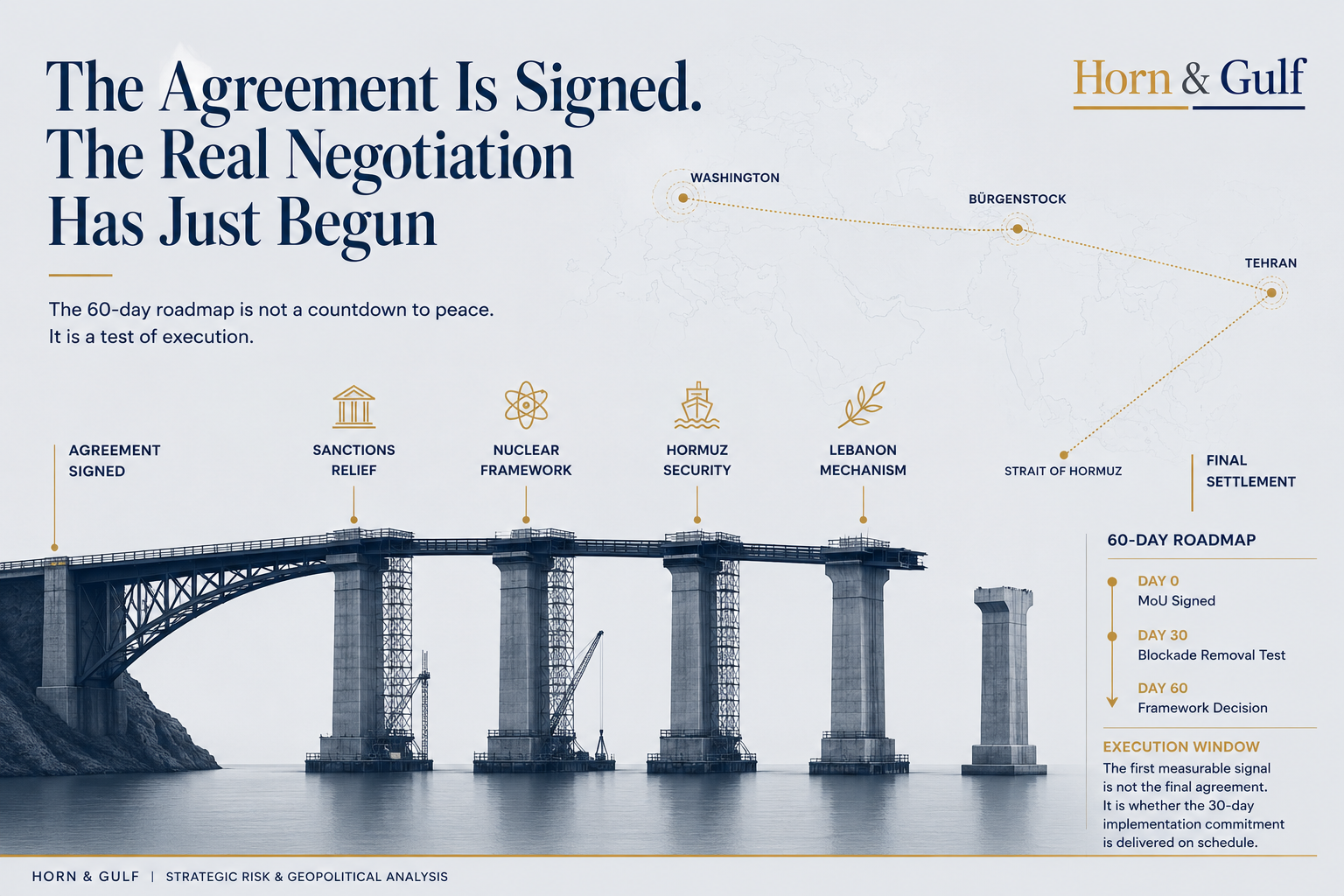
The Islamabad Memorandum of Understanding is institutionally confirmed. What it cannot yet guarantee is its own execution — and in the Gulf, the difference between a signed framework and a functioning one is measured in weeks, not intentions.
The question of whether a US–Iran agreement exists has now been settled. The White House transmitted the signed text of the Islamabad Memorandum of Understanding to Congress. Swiss authorities formally confirmed they are facilitating implementation discussions. Qatar and Pakistan announced that the first round of high-level talks at Bürgenstock produced a 60-day roadmap toward a final settlement. Iranian officials described the process as making good progress — a characterisation that briefly moved oil markets. The operational record that followed June 18 has displaced whatever ambiguity surrounded the original signing.
The question that replaced it is harder. A signed memorandum and a functioning framework are not the same thing. The Islamabad MoU is a floor — a minimum platform on which a more durable architecture might be constructed. Whether that construction proceeds depends on something the document itself cannot resolve: who moves first, and whether the first mover believes they will receive what they were promised.
THE SEQUENCING PROBLEM
Both sides arrived at Bürgenstock carrying the same structural constraint. Tehran’s domestic political economy demands early and tangible economic concessions — sanctions relief, oil-export flexibility, access to a portion of frozen assets — before Iranian negotiators can credibly engage on nuclear architecture. Supreme Leader Mojtaba Khamenei authorised the memorandum but attached assurances about protecting Iran’s rights and the Resistance Front. That language is not diplomatic boilerplate. It is a political instruction that limits how far the Iranian delegation can move before receiving something concrete in return.
Washington faces the mirror constraint. The Senate is watching the memorandum text that the White House sent to Congress. Offering substantive sanctions relief before a nuclear framework exists carries a domestic political cost that the administration has little appetite to absorb. Each side is, in effect, waiting for the other to demonstrate implementation before committing further — and each is watching the same clock run down.
The 60-day window is not a countdown to resolution. It is a countdown to the point at which both sides must decide whether continued engagement is worth the domestic cost of the next concession.
WHAT BÜRGENSTOCK ACTUALLY BUILT
The institutional outputs of the first Switzerland round deserve precise reading. Officials announced a 60-day roadmap toward a final deal. Technical negotiations will continue through the week. Participants established a mechanism to address Lebanon-related escalation risks. They also opened a communications channel to support commercial navigation through the Strait of Hormuz.
These are real outputs, and they matter. But they are instruments of crisis management, not conflict resolution. The Lebanon mechanism addresses a symptom — the spillover risk from a separate but related theatre — rather than the sequencing dispute at the core of the US–Iran relationship. The Hormuz communications channel is significant for maritime operators and cargo insurers. But a channel that exists is not the same as a channel that prevents incidents. Its utility depends on the willingness of both governments to use it under pressure — and that willingness remains untested.
The cancellation and subsequent resumption of the Switzerland talks is itself the most instructive early signal. Iran sought evidence of implementation before committing to further engagement. Washington cancelled, then returned. This is not a failure of the framework. Rather, it previews the rhythm the next 60 days will follow: incremental, conditional, and highly sensitive to any action either side reads as a breach of sequence.
THE DIMENSION THE ROADMAP DOES NOT PRICE
One structural feature of this process receives consistently less attention than it deserves.
The Islamabad MoU contains two operationally consequential maritime commitments. The US agreed to lift its naval blockade on Iranian ports within 30 days. Iran agreed to guarantee free commercial passage through the Strait of Hormuz for 60 days. These provisions do not affect both parties equally — and their effects on third parties are asymmetric in ways the diplomatic framing rarely acknowledges.
THE HORMUZ INSURANCE CALCULATION
The Hormuz guarantee does not simply normalise existing traffic if it holds. It changes the insurance arithmetic for every cargo operator routing through the Gulf. Marine war-risk premiums are calibrated to perceived threat probability. A verifiable 60-day guarantee — backed by an operational communications channel and observed compliance — would compress those premiums regardless of what happens in the nuclear negotiation. Conversely, a single credible incident during the guarantee period, even one attributable to non-state actors, would reprice risk upward faster than any diplomatic statement could contain. The Hormuz commitment is therefore not merely a confidence-building measure between Washington and Tehran. It is a live variable in the pricing models of every institutional insurer and logistics operator moving cargo through the waterway.
Gulf port operators and sovereign entities with infrastructure exposure to regional maritime flows — Jebel Ali, Khor Fakkan, and the broader Emirates logistics corridor — are not passive observers of this process. The competitive positioning of UAE port infrastructure relative to alternatives depends partly on the perception of Hormuz reliability. A framework that holds, even imperfectly, carries commercial value that extends well beyond the bilateral relationship it was designed to regulate.
THE WATCH VARIABLE
The 30-day US naval blockade removal is the first testable commitment in the memorandum. If Washington executes on schedule, Tehran gains a domestic justification for continued engagement and the framework gains operational credibility. If execution is delayed or qualified, Iran holds legitimate grounds to pause the next negotiating stage — and to frame that pause publicly as an American failure of implementation rather than an Iranian exit from the process. For institutional investors and Gulf policy planners, the blockade timeline is not a diplomatic detail. It is the first instrument reading on whether the 60-day framework is a functioning structure or a managed deferral.
WHAT THE 60 DAYS WILL DECIDE
Two scenarios are now live, and they are not equally probable — but both are plausible enough to price.
In the first, early economic measures — partial asset releases, targeted oil-export waivers — arrive quickly enough to give Tehran political cover for the nuclear discussions that follow. The Lebanon mechanism holds the ceasefire perimeter. The Hormuz channel functions without incident. By late August, the roadmap converts into a substantive negotiating text on nuclear architecture and sanctions relief. This is not optimism. It is the scenario in which both governments’ institutional interests — domestic stability, economic relief, reduced regional exposure — align sufficiently to override the sequencing distrust.
In the second, neither side delivers the early signal the other is waiting for. The 60-day window passes as a period of managed stasis, punctuated by a technical incident, a Lebanon escalation, or a domestic political shock in either capital. The framework does not collapse publicly — both sides have invested too much institutional capital in it — but it fails to generate momentum. By late August, the parties are managing the narrative of a process rather than executing one.
The structural difference between the two scenarios is narrower than the diplomatic language suggests. It turns not on the final disposition of Iran’s nuclear programme or the resolution of US sanctions architecture, but on the 30-day blockade commitment and whether one early, concrete economic signal reaches Tehran before the sequencing distrust calcifies. That is a small window. It is also the only one that is currently open.
For Gulf policy planners and regional capital allocators, this is the reading that matters. The agreement is real. The risk is not that it was never signed — the risk is that it was signed just well enough to create the appearance of a process without the momentum to sustain one. That distinction, invisible in the diplomatic language, is now the central variable in the region’s near-term stability calculus.