For weeks, global attention has been fixed on a single question: whether the Strait of Hormuz will reopen.
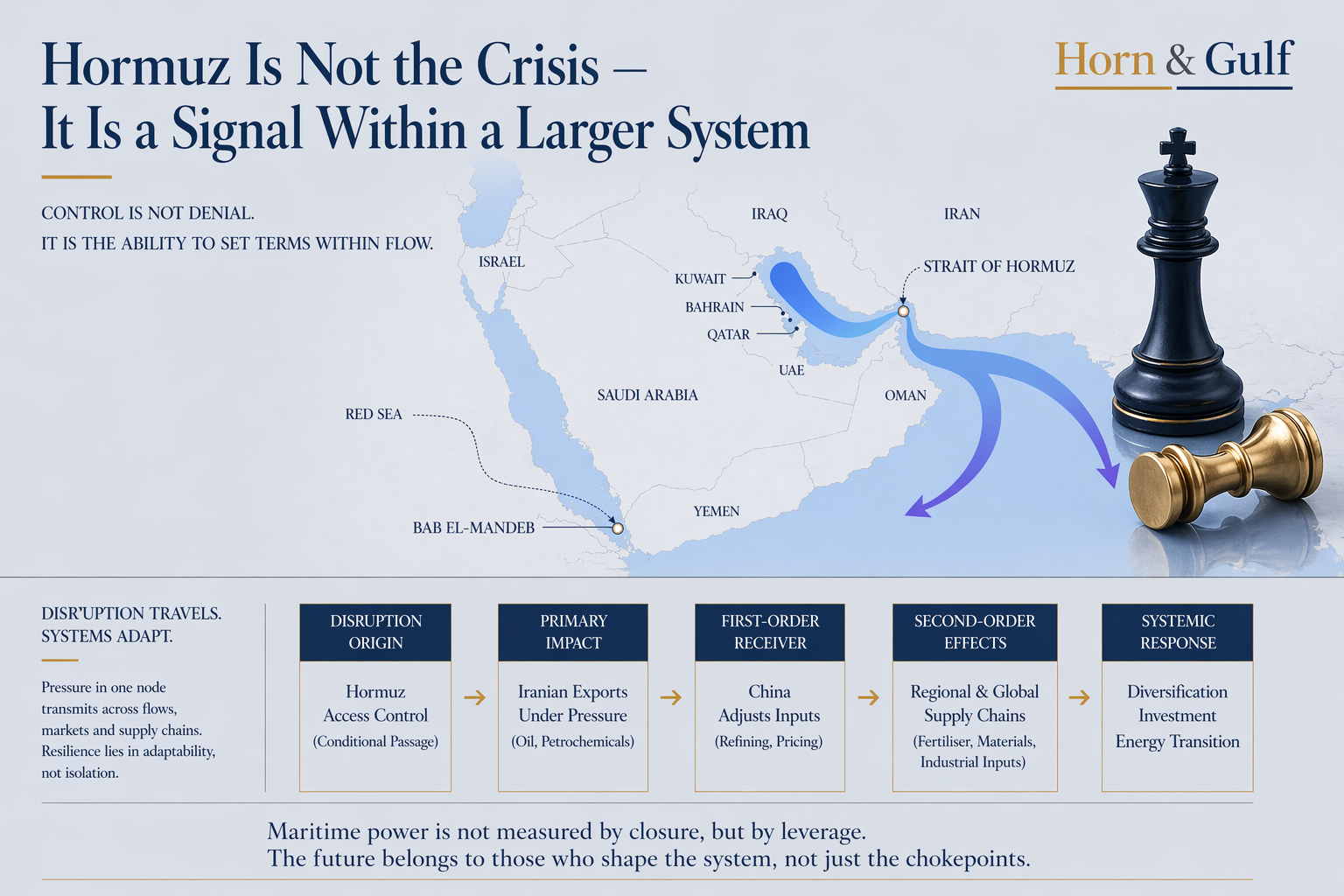
But framing the situation around a single chokepoint risks missing the broader structure in which it operates. What is unfolding is not simply a disruption of passage. It is a reconfiguration of leverage across a connected maritime system — stretching from the Gulf to the Red Sea and beyond.
From Closure to Control
Iran’s partial restriction of the strait has not resulted in a complete shutdown. Instead, it has introduced a controlled environment — where passage continues, but under altered terms. This distinction matters.
Because what is being exercised is not denial, but conditional access. And conditional access, in strategic terms, is a form of pricing power.
The reported practice of allowing transit under specific conditions — including informal toll mechanisms — signals an attempt to convert geography into negotiated leverage.
The U.S. Response Is Not Just Pressure — It Is Counter-Leverage
The U.S. naval response, framed as a blockade targeting Iranian ports, is often interpreted as a direct attempt to restore free navigation. But at a structural level, it serves a different function: to shift the point of pressure from transit routes to export nodes.
Iran’s oil system is not evenly distributed. A significant portion of its exports flows through a limited number of terminals, with Kharg Island alone handling the majority. Targeting these nodes does not merely restrict flow —
it redefines where control over the system is exercised.
Scale Matters More Than Shock
Much of the immediate analysis focuses on Iran’s share of global oil supply. At roughly 3–4% of global production, it is often described as “significant.” But significance depends on scale.
In a system defined by redundancy, rerouting and inventory buffers, a supply disruption of this magnitude does not automatically translate into systemic breakdown.
What it produces instead is:
- price volatility
- logistical adjustments
- temporary friction in flows
Shock, in this context, is not collapse.
Where the Real Pressure Travels
The effects of disruption do not remain where they originate. They travel. China, as the primary buyer of Iranian crude, becomes the first receiver of adjustment pressure. From there, it propagates through refining, pricing and trade mechanisms.
At the same time, regional dependencies — often overlooked — begin to surface. Gulf economies that import materials from Iran, from petrochemicals to agricultural inputs, are exposed not through energy markets, but through supply chains.
Fertiliser flows, particularly urea, introduce a second-order layer of impact — extending the system into global agriculture. This is how local disruption becomes global signal.
A Network, Not a Chokepoint
Focusing solely on Hormuz obscures the reality that maritime risk in this region is distributed across multiple corridors. Hormuz is one node. Bab el-Mandeb is another.
Red Sea transit routes, port infrastructures and alternative corridors together form an interconnected network. Pressure applied in one location does not stop there. It redistributes.
And systems built on flow tend to adapt before they fail.
The Analytical Error
The most common mistake in reading this environment is not underestimating risk. It is misplacing it. Short-term disruptions are often interpreted as indicators of structural collapse. But systems of this kind rarely break at the point of visible tension.
They absorb, reroute and recalibrate. The real question is not whether disruption exists. It is whether that disruption alters the architecture of the system.
Beyond the Immediate
The longer-term implications are not limited to oil flows. They extend into:
- diversification of energy sourcing
- investment in refining capacity
- restructuring of supply chains
- gradual shifts toward electrification and alternative energy systems
These are not reactions to a single crisis. They are responses to repeated signals within the same system.
Conclusion
What is unfolding is not a singular crisis centered on a narrow waterway. It is a dynamic interaction between geography, strategy and flow — where access, control and adaptation are continuously renegotiated.
Hormuz is not the story. It is where the system becomes visible.