In recent weeks, Dubai has re-emerged as a focal point of global attention—often for the wrong reasons.
While geopolitical tensions in the region primarily involve state actors elsewhere, much of the commentary—especially across social media—has gravitated toward Dubai. Not as a battlefield, but as a symbol. A proxy for broader anxieties about stability, capital flows and expatriate life.
This reaction says less about Dubai itself, and more about how it is perceived. The core analytical mistake is not overestimating risk. It is misreading what Dubai actually is.
What the Current Stress Actually Tests
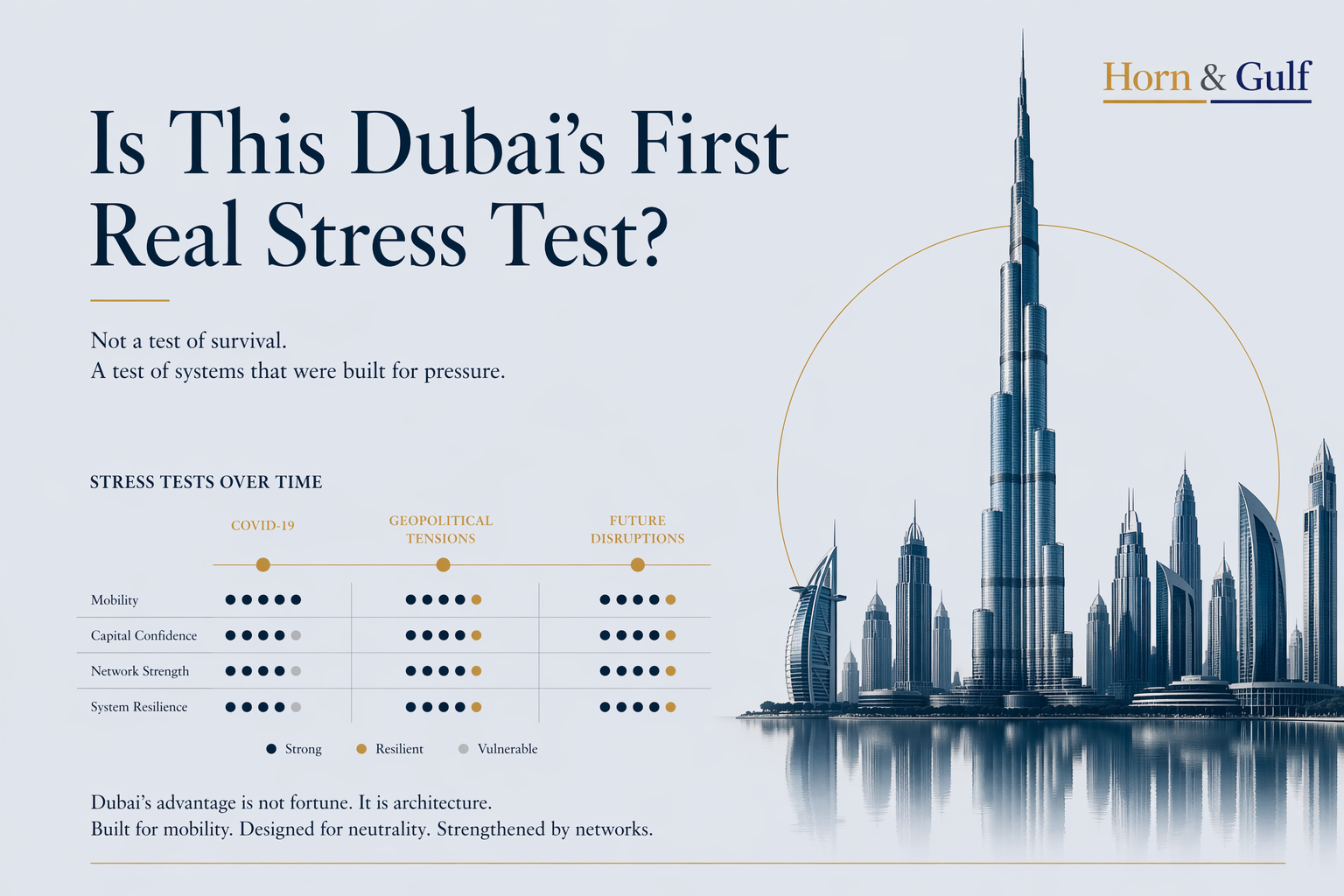
The current geopolitical tension is not testing Dubai’s survival. It is testing: mobility continuity, capital confidence perception stability. And these are not new variables. Dubai has faced similar structural stress before.
The COVID Stress Test
During COVID-19, Dubai encountered a more fundamental disruption: Borders closed globally, Aviation halted, Mobility—the core of its system—collapsed. For a city built on connectivity, this was an existential stress test. Yet the recovery pattern is instructive.
Dubai: reopened earlier than most global hubs, restored mobility faster than competitors, absorbed capital inflows while others remained restricted.
At a time when: Hong Kong imposed extended quarantines, parts of Europe remained intermittently closed. Dubai repositioned itself not as a risk zone, but as an operational alternative. The result was not just recovery—but relative strengthening.
Why It Rebounds? Cities collapse when their underlying logic disappears. Dubai’s has not. Its persistence is tied to three structural constants: Mobility remains central. Even under disruption, Dubai’s geographic position and aviation infrastructure retain strategic relevance. Capital still seeks neutral ground
In a fragmented geopolitical landscape, jurisdictions that offer operational neutrality—not alignment—become more valuable. Network clustering reinforces itself. People do not move randomly. They move where others like them already are.
Dubai’s growth has been cumulative, not cyclical. Misreading Risk vs Misreading Scale. The dominant narrative tends to treat events as binary: stable vs unstable, safe vs unsafe, rising vs collapsing. But Dubai does not operate within that binary.
Risk exists. Volatility exists. But scale determines impact. A localized disruption in a conventional city can cascade into systemic breakdown. In Dubai, the same disruption is often absorbed across multiple overlapping systems.
What appears as fragility at surface level is, in many cases, distributed resilience. What Actually Matters. The relevant question is not whether Dubai faces risk. All systems do.
The relevant question is: Has the underlying architecture that sustains Dubai been structurally altered? At present, there is no evidence of that. Its role as a coordination hub remains intact. Its institutional flexibility remains functional. Its network density continues to deepen
Conclusion
Dubai is not collapsing.
It is being observed through the wrong lens. It is not a city reacting to events. It is a system absorbing them. And unless the forces that created that system—mobility, neutrality, network convergence—are fundamentally disrupted, Dubai will not decline in the way it is often predicted. It will adjust. Rebalance.
And, as it has done before, continue operating—often more effectively after the stress has passed.