For much of modern geopolitical analysis, non-state actors have been treated as disruptors. They operate outside formal structures, challenge state authority and introduce instability into otherwise predictable environments. Their impact, while sometimes significant, was generally considered limited in scope.
This framing is becoming outdated. In the Red Sea and its surrounding system, certain non-state actors are no longer merely disrupting flows. They are shaping them. Not consistently, not comprehensively, but with enough effect to alter system behavior. This distinction is critical. A disruptor creates temporary friction. A system operator influences how the system functions over time.
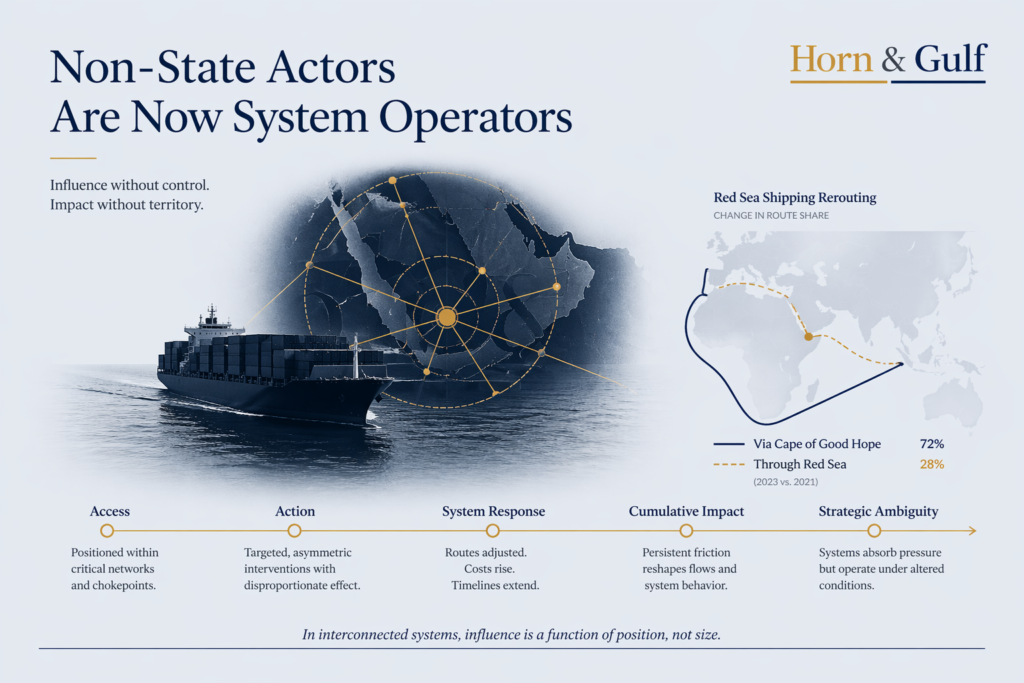
Recent developments illustrate this shift. Targeted actions against maritime traffic have led to sustained changes in shipping patterns. Routes have been adjusted, costs recalculated and timelines extended. These are not momentary disruptions. They are structural responses.
The actors behind these actions do not control territory in the conventional sense. They do not possess large-scale conventional capabilities. Yet their position within the system allows them to exert influence disproportionate to their size. This is the essence of system-level leverage.
It is not about control in the traditional sense. It is about positioning within a network where small interventions can produce cascading effects. In highly interconnected systems, influence does not require dominance. It requires access. This challenges several assumptions.
First, it complicates the distinction between state and non-state power. When non-state actors can influence global trade flows, their role can no longer be understood solely in terms of local insurgency or internal conflict.
Second, it introduces new forms of risk. Traditional risk models focus on large-scale events — wars, blockades, regime changes. The current environment requires attention to persistent, lower-intensity actions that cumulatively reshape system behavior.
Third, it raises questions about response mechanisms. Conventional military responses are not always suited to countering distributed, adaptive actors operating within complex systems. Overreaction can escalate. Underreaction can normalize.
The result is a form of strategic ambiguity. Systems continue to function, but under altered conditions. Flows are maintained, but at higher cost and lower predictability. The system absorbs the pressure, but does not fully resolve it.
This is where the concept of system operators becomes useful. Non-state actors do not need to replace existing structures to influence them. They operate within the system’s existing architecture, exploiting its dependencies and sensitivities.
Their effectiveness depends less on their internal strength and more on the system’s configuration. In regions like the Red Sea, where geography, trade and politics intersect tightly, this configuration amplifies their impact. Understanding this requires a shift in perspective.
The question is no longer whether non-state actors can disrupt systems. That is already evident. The question is how systems can be designed, adapted or reinforced to remain functional in the presence of actors who can influence them without formally controlling them.
In that sense, the emergence of non-state actors as system operators is not an anomaly. It is a feature of the current global environment. And it is likely to persist.