
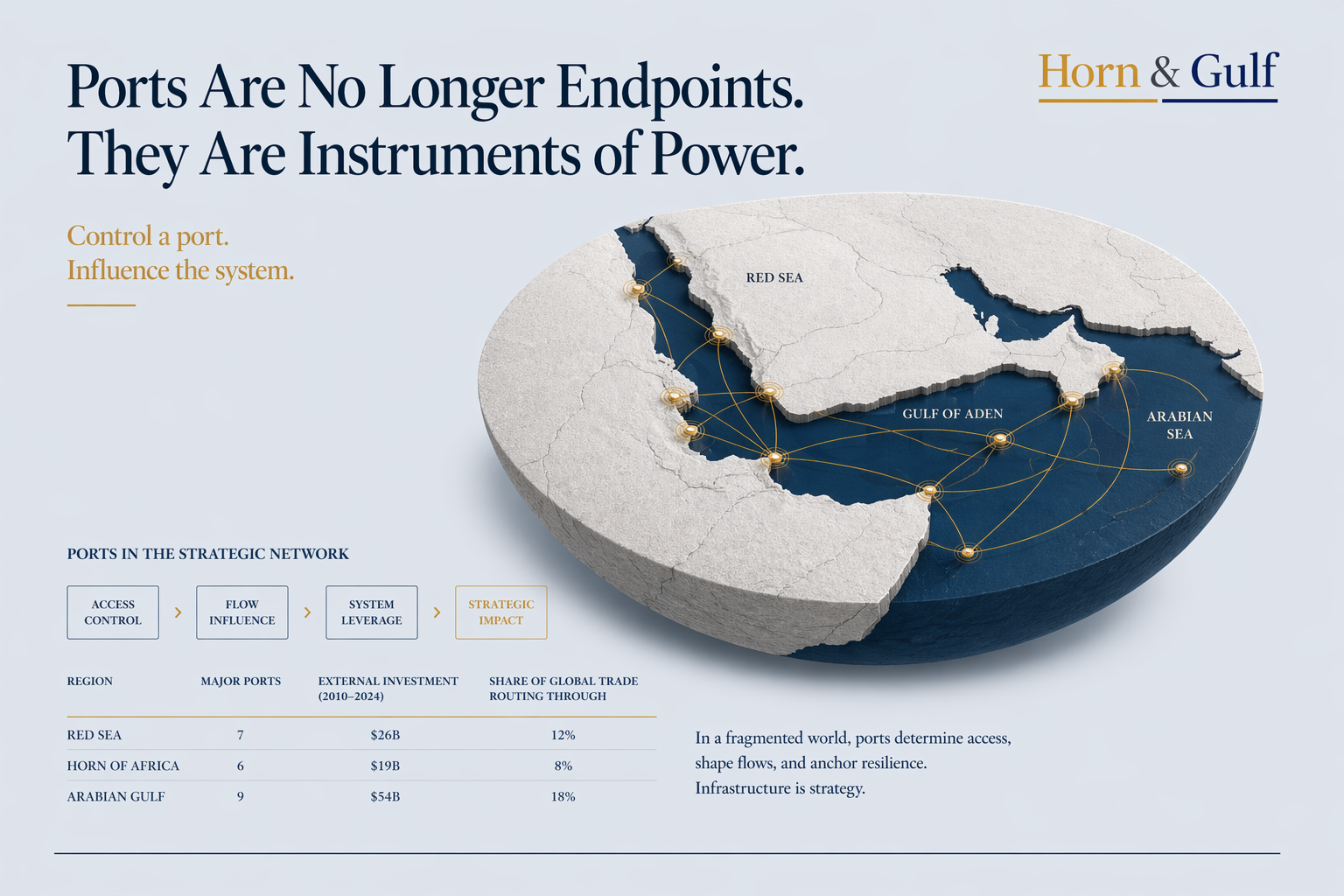
Ports were once endpoints. They marked the arrival of goods, the interface between sea and land, the logistical backbone of trade. Their value was measured in throughput, efficiency and connectivity. Security, where relevant, was a separate domain — managed by states, militaries and intelligence structures.
That separation is no longer clear. Across the Red Sea, the Horn of Africa and the Gulf, ports have evolved from logistical assets into strategic instruments. They no longer simply support systems. They shape them.
This transformation did not happen overnight. It emerged gradually, as global trade networks became more concentrated and more interdependent. As supply chains lengthened and synchronized, the importance of specific nodes increased. Certain locations began to matter disproportionately.
Ports were among them. What has changed in recent years is not just their importance, but their function. Ports are now points of leverage. They influence access, dictate flow and, increasingly, determine resilience.
This is visible in how states engage with them. Investments in port infrastructure are no longer purely economic decisions. They are long-term positioning strategies. Control, access or influence over a port translates into influence over the network it serves. In regions where formal political control is fragmented, this becomes even more significant.
The Horn of Africa offers a clear example. Multiple external actors have invested in ports across the region, often in parallel, sometimes in competition. These investments are not only about trade. They are about anchoring presence in a system where geography amplifies impact.
At the same time, the Gulf’s relationship with these ports reflects a broader strategic logic. Connectivity is not an abstract concept. It is built, managed and, when necessary, protected through specific nodes.
This is where logistics becomes security. A disruption at a port is no longer a local event. It affects timelines, costs and availability across entire supply chains. Conversely, stability at a port can anchor wider system stability, even in volatile environments.
This has led to a convergence of roles. Commercial operators, state entities and security actors increasingly operate within the same space. Their objectives may differ, but their activities overlap. The implication is straightforward: infrastructure cannot be understood in isolation.
Ports are not neutral
They are embedded in political, economic and security dynamics. Their governance, ownership and operational model all carry strategic weight.
This also changes how resilience is built. In the past, redundancy was often geographical — alternative routes, additional capacity. Today, resilience depends on network design. It requires diversification not just of routes, but of nodes and control points.
A system overly dependent on a small number of ports is inherently fragile, regardless of how efficient those ports are. The shift from ports as endpoints to ports as instruments of power reflects a broader transformation in how global systems function. Logistics is no longer a background process. It is a frontline variable. Understanding this requires moving beyond traditional categories.
Trade is not separate from security. Infrastructure is not separate from strategy. And ports are no longer just where goods arrive. They are where influence begins.