
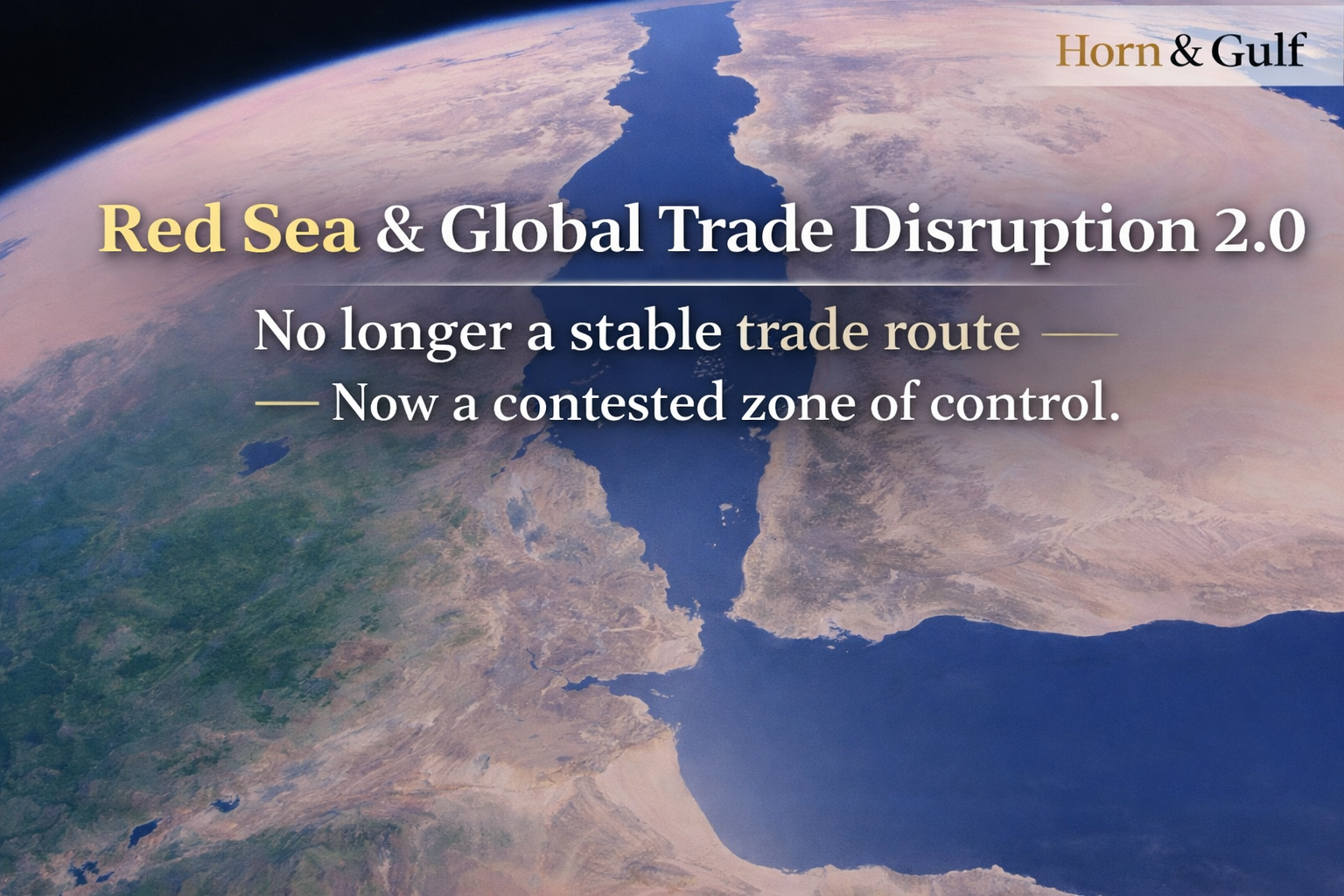
For months, the disruption in the Red Sea has been framed as a temporary shock to global trade — a passing security issue that will eventually stabilize as naval presence increases and tensions subside. The assumption has been clear: this is a crisis that can be contained, managed, and ultimately resolved.
That assumption is wrong. What we are witnessing is not a disruption in the conventional sense. It is not a short-term breakdown in an otherwise stable system. It is a transition — a structural shift in how one of the world’s most critical trade corridors operates. The Red Sea is no longer a stable trade route. It is becoming a contested zone of control.
The dominant narrative reduces the situation to a logistics problem. Ships are rerouting. Insurance premiums are rising. Delivery times are extending. From this perspective, the issue appears technical — something that can be fixed through coordination, security deployments, and time. But this framing misses the underlying transformation. Because what is unfolding is not about ships, routes, or temporary disruption. It is about who controls the system through which global trade flows.
The Red Sea is not breaking down under pressure. It is being redefined under competition.
To understand this shift, the region must be seen not through isolated incidents but through the actors shaping it. The Red Sea is no longer governed by a single security logic or a dominant power structure. Instead, it is shaped by overlapping alignments, each with its own priorities and methods. The security architecture that once underpinned global trade is now fragmented.
Traditional security enforcers such as the United States and NATO remain focused on preserving the flow of trade and maintaining stability. Their approach is rooted in continuity — keep routes open, contain escalation, and prevent systemic breakdown.
At the same time, regional stabilizers like Saudi Arabia and Egypt operate with a different set of concerns. Their priority is not global trade per se, but the containment of instability within their immediate environment — protecting borders, economies, and internal balance.
Running parallel to this is a third layer of actors who do not seek stability, but leverage disruption. The Houthis, backed in broader strategic terms by Iran, operate through asymmetry. Their objective is not to control the system, but to pressure it — at low cost and with disproportionate global impact.
Finally, there are actors who approach the Red Sea not primarily as a security theatre, but as an infrastructure and control network. The United Arab Emirates represents this model — focusing on ports, logistics hubs, and maritime nodes rather than territorial dominance.
What emerges from this is not a hierarchy. It is a contested network, where influence is distributed and constantly renegotiated. To fully grasp the implications, the Red Sea must be understood not as a route, but as a system.
It connects critical chokepoints and flows: the Suez Canal, Bab el-Mandeb, the Gulf of Aden, and onward into the Indian Ocean. These are not isolated passages; they form an integrated operating system that sustains a significant portion of global trade.
For decades, this system functioned on three core assumptions: predictability, security guarantees, and coordination between key actors. These conditions allowed global trade to operate with efficiency and confidence. Today, all three are eroding. The geography has not changed. The chokepoints remain where they always were. But control over them is no longer consolidated. It is fragmented, layered, and increasingly unstable.
What is unfolding is not a conventional security crisis. It is a structural shift in how power operates within global trade systems. The traditional model was built on centralized control: secure the route, protect the flow, and guarantee passage through dominance. Stability was a function of clear authority. That model is now being challenged.
Disruption no longer requires control.
Influence no longer requires territory.
Actors with limited conventional power can now generate systemic impact. A single point of disruption can force global rerouting, increase costs across continents, and alter supply chain dynamics at scale. This is not because the system is weak. It is because the system is interconnected. The implications are already visible.
For global trade, efficiency is no longer the primary objective. For decades, supply chains were optimized for speed and cost. That logic is now being replaced. Resilience is becoming the new benchmark.
Buffers, redundancies, and alternative routes are no longer inefficiencies — they are necessities. For supply chains, the “just-in-time” model begins to lose its dominance. Delays are no longer anomalies; they are structural risks that must be priced in.
For regional powers, the focus shifts away from land-based influence toward control of nodes — ports, corridors, and maritime access points. Geography still matters, but infrastructure matters more.
For the broader global order, the implications are even deeper.
Security is no longer guaranteed by dominance.
It is negotiated through continuous friction.
The Red Sea is not experiencing a temporary disruption. It is undergoing a reconfiguration. Trade is not stopping. It is adapting. And the system through which it moves no longer belongs to a single power.
That is the real shift.