For years, the tension between Iran and Israel has been described as a shadow war — contained, indirect, and carefully managed below the threshold of open conflict. That framing suggested a degree of stability within instability, an understanding that both sides knew where the limits were and how far they could go without triggering a wider war.
That assumption is becoming increasingly fragile.
What we are seeing today is not the breakdown of deterrence, but its gradual erosion. The system still functions, but under growing strain. Each new incident tests the boundaries a little further, stretches response thresholds a little thinner, and introduces a higher degree of uncertainty into what was once a more predictable pattern of escalation.
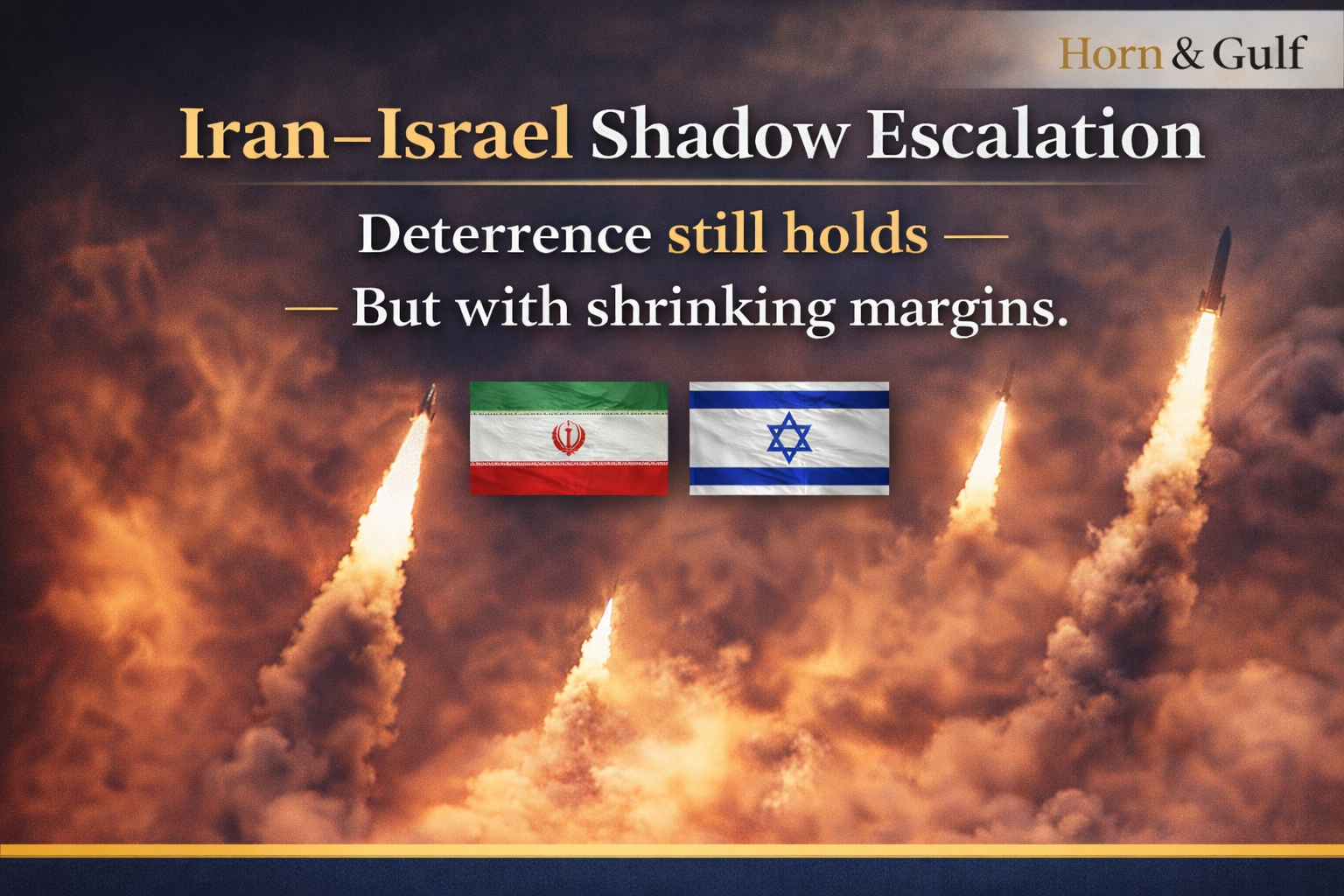
Deterrence still works — but with shrinking margins.
At the surface level, the situation appears deceptively controlled. There is no formal declaration of war, no large-scale mobilization, no sustained direct confrontation between Iran and Israel. Instead, the conflict unfolds through calibrated actions — targeted strikes, limited retaliation, signals designed to communicate resolve without crossing critical thresholds.
This creates the impression of stability.
But it is a narrow form of stability, dependent not on de-escalation, but on precise calibration. The absence of full-scale war is not evidence of peace. It is evidence of a system being managed at its limits.
The core dynamic has shifted from deterrence as prevention to deterrence as continuous negotiation. Each side is no longer simply trying to avoid war; it is actively shaping the space just below it.
That space is increasingly crowded.
The conflict is no longer defined by direct confrontation, but by a dense web of proxy engagements. Iran’s influence operates through a network of aligned non-state and semi-state actors across multiple theatres, allowing it to project power without exposing itself to immediate retaliation at scale. Israel, in turn, responds with precision — targeting infrastructure, logistics, and command structures rather than engaging in open battlefield escalation.
This networked architecture changes the logic of conflict.
It allows actions to be taken without clear ownership. It creates plausible deniability. It lowers the cost of engagement while preserving strategic ambiguity. But it also introduces a critical vulnerability: the more actors involved, the harder it becomes to control the pace and direction of escalation.
A strike in one theatre can trigger a response in another. A localized incident can reverberate across the system. Control becomes distributed, and with that, less predictable.
What once operated as a contained bilateral tension now resembles a multi-node conflict environment.
In this environment, the role of the United States becomes central, but also more complex. Traditionally, deterrence in the region relied heavily on American presence — both as a security guarantor and as a stabilizing force capable of imposing limits on escalation.
That role is now being tested.
The United States continues to project power, maintain military presence, and signal commitment to its allies. But the nature of the challenge has evolved. It is no longer about deterring a conventional state-on-state conflict. It is about managing a dispersed, network-driven confrontation where escalation can emerge from multiple points simultaneously.
This makes deterrence less about dominance and more about responsiveness.
The question is no longer whether the United States can deter escalation in principle, but whether it can manage escalation in real time, across multiple theatres, with actors that do not always respond to traditional deterrence signals.
This is where the margin begins to shrink.
Each side is operating under a logic of controlled escalation. Actions are designed to send messages, establish boundaries, and test responses without triggering full-scale conflict. But the effectiveness of this model depends on precision — on both sides correctly interpreting signals, correctly calibrating responses, and correctly assessing risk.
That precision is becoming harder to maintain. Misinterpretation becomes more likely. Overreaction becomes more tempting. And the line between signaling and escalation becomes increasingly blurred.
The system does not collapse all at once. It degrades gradually.
Each incident that pushes the boundary without triggering a major response encourages the next one to go further. Each successful act of limited escalation expands the perceived safe zone. Over time, this creates a dangerous dynamic: escalation becomes normalized. And once escalation is normalized, miscalculation becomes inevitable.
This is the paradox of the current moment. The absence of full-scale war suggests that deterrence still holds. But the increasing frequency and intensity of shadow engagements indicate that its stabilizing effect is weakening. The system is not failing. It is tightening.
The space between controlled escalation and uncontrollable conflict is narrowing, not because actors seek war, but because the mechanisms designed to prevent it are being stretched to their limits. The Iran–Israel dynamic is no longer defined by whether conflict will occur. It is defined by how close it can get to open war without crossing into it.
And that distance is getting shorter.