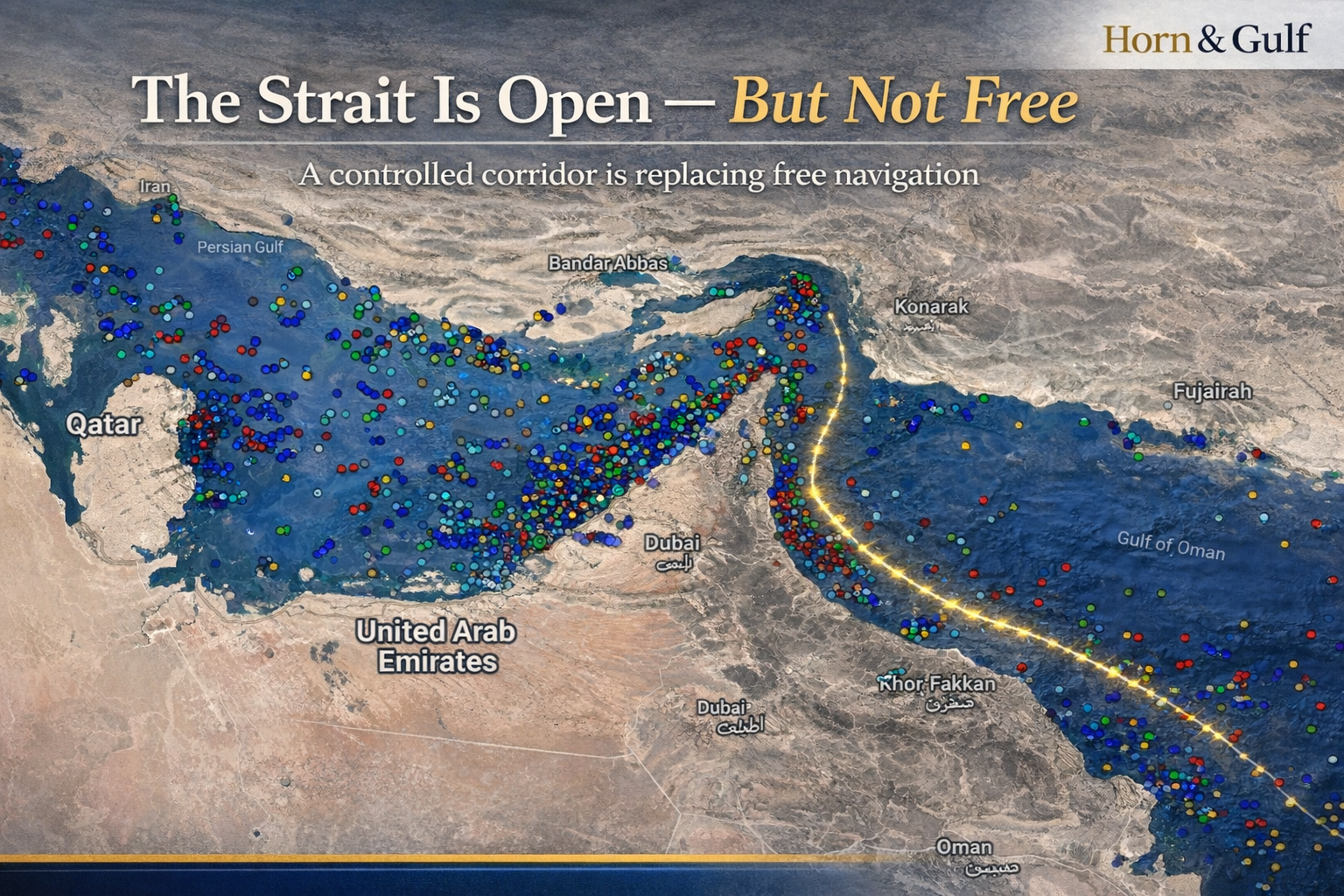
The Strait of Hormuz is not closed. But it is no longer open either. What emerged over the last 24 hours is something far more complex — and far more dangerous: a controlled corridor, shaped not by maritime law, but by overlapping spheres of power. This is no longer about access. It is about control.
A Corridor Under Permission, Not Freedom
Iran’s announcement that the Strait remains open to commercial traffic initially calmed global markets. Oil prices dropped sharply. Shipping sentiment improved. But beneath that headline lies a structural shift.
Transit through the Strait is now effectively permission-based:
- Vessels are required to coordinate with Iran’s Revolutionary Guard
- Movement is restricted to designated “safe routes”
- Military vessels are explicitly excluded
This is not freedom of navigation. This is managed passage under sovereign pressure.
Parallel Control: The US Layer
At the same time, the United States maintains its own form of control — not through geography, but through enforcement. Naval presence and selective interception policies continue to:
- Target Iran-linked trade flows
- Influence routing decisions of commercial vessels
- Impose indirect financial and operational risk
The result is a dual-layer system:
- Iran controls the water
- The US controls the risk
And between them, global shipping is forced to navigate uncertainty.
Traffic Is Back But Confidence Is Not
There are early signs of movement. A UAE-linked crude tanker has successfully transited the Strait.
Flows are resuming — slowly. But this is not normalization. Operators are not returning because they trust the system.
They are returning to test it. This distinction matters. Because in global shipping, reality is not defined by announcements — but by insurance pricing, risk models, and operator behavior.
Markets React Faster Than Systems
Energy markets responded immediately. Oil and gas prices dropped sharply as the “closure scenario” was priced out. But markets often react to headlines. Logistics systems react to risk. And right now, risk has not disappeared — it has simply changed form. From disruption to conditional access
The Real Test: Will the System Normalize?
The key question is no longer whether ships can pass. It is whether they will choose to pass at scale.
That depends on:
- Insurance underwriting decisions
- Shipping company risk tolerance
- The predictability of enforcement on both sides
Until these stabilize, the Strait remains operational — but not reliable.