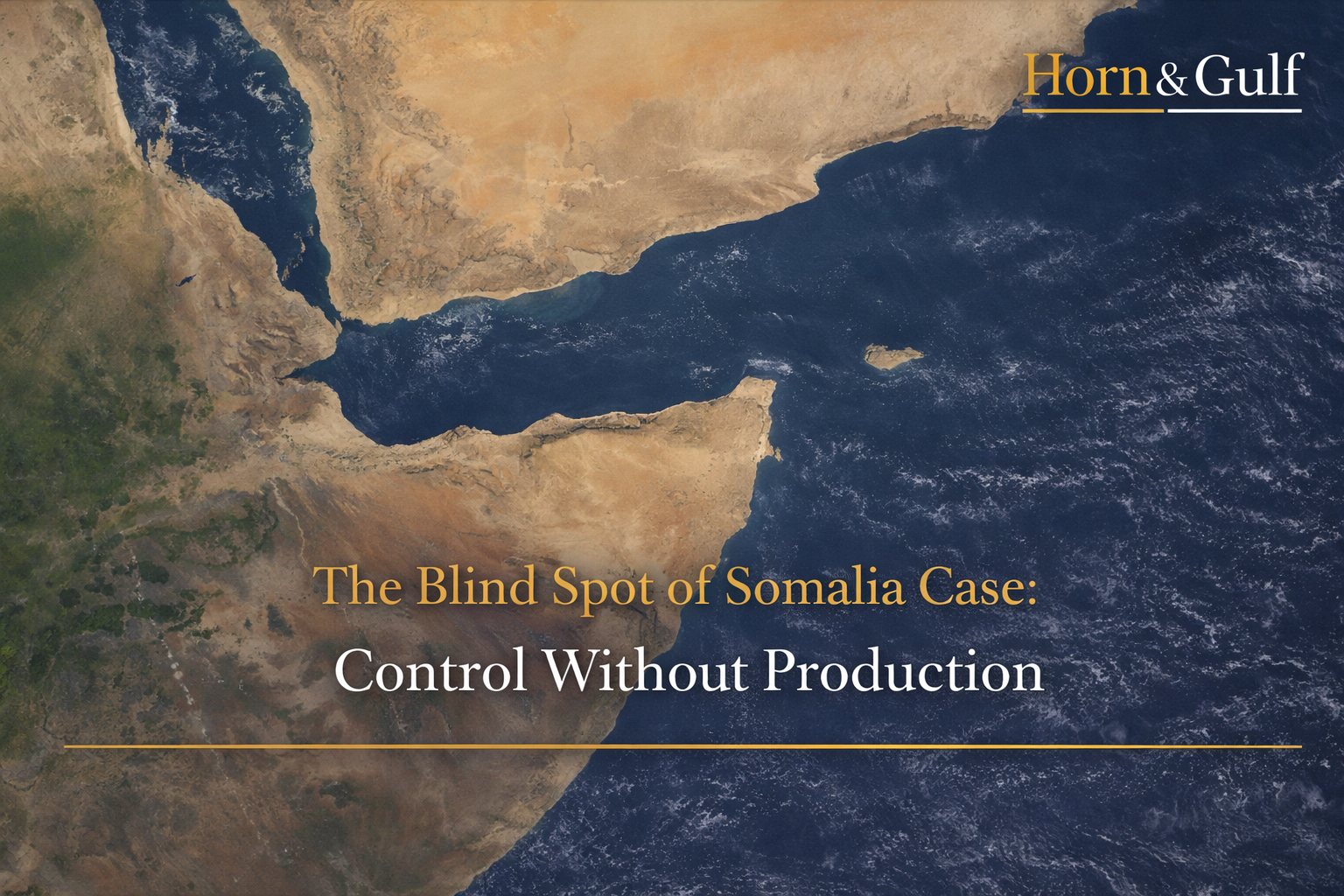
In the Somalia file, what is being discussed today is neither wrong nor irrelevant—but it is fragmented. The core problem is not the absence of information; it is the inability to read the system as a whole. Because this is no longer simply about Somalia or Somaliland. It is a Red Sea security file, a Bab el-Mandeb chokepoint file, and a Gulf competition file—simultaneously.
From Local Crisis to System-Level Contest
Two structural axes have now emerged on the ground. The first is the Somalia–Türkiye axis. The second is a looser but strategically consequential alignment forming around Somaliland, involving Israel and Ethiopia. Layered onto this are Saudi Arabia in a cautious balancing role, and Qatar, positioned closer to Mogadishu. This is no longer a localized Horn of Africa crisis; it is a multi-layered geo-economic and geo-strategic system under active reconfiguration.
Axis One: Legitimacy, Statehood, and Structured Power
The Somalia–Türkiye axis operates through a recognized state framework. Anchored in Mogadishu, it is built on sovereignty, territorial integrity, and international legal legitimacy. Türkiye is not merely a partner; it is simultaneously a security provider, a capacity builder, and a strategic stakeholder. The TÜRKSOM military training base, maritime security agreements, and the acceleration of energy cooperation in 2024 form the three pillars of this axis.
Ankara’s intent is clear: stabilize the Somali state, consolidate coastal and maritime security, and translate that into long-term economic and energy leverage. From Somalia’s perspective, the expectations are more direct: regime continuity, preservation of central authority, external balancing against pressure from Somaliland and Ethiopia, and sustained military support against Al-Shabaab.
The primary strength of this axis is legitimacy. Türkiye operates through an internationally recognized government, providing legal grounding for its military and economic engagements. Its structural weakness, however, lies in the internal fragility of the Somali state itself. The federal system remains only partially consolidated, and tensions between the center and regional entities persist. In practical terms, Türkiye is partnering with a state whose internal coherence is still contested—introducing inherent fragility into the long-term durability of its position.
Axis Two: Access, Corridors, and Functional Reality
On the opposing side, the Somaliland-centered alignment functions differently. It is not a formal alliance, but a convergence of interests. Here, legality is secondary to operational reality. Somaliland’s priority is recognition and economic viability. For Ethiopia, the issue is structural: permanent access to the sea. With a population approaching 120 million and no coastline, maritime access is not optional—it is strategic necessity. Berbera, in this context, is not just a port; it is an outlet.
For the United Arab Emirates, deepening its position through DP World at Berbera Port is part of a broader Red Sea strategy. Abu Dhabi is constructing a chain of logistics and security nodes across the maritime corridor. Port operations, free zones, airfield infrastructure, and capacity-building initiatives form an integrated model of influence. Somaliland is not an isolated asset; it is a forward operating platform with access to African hinterlands.
Abu Dhabi Perspective: Logistics First, Risk Managed Expansion
From Abu Dhabi’s perspective, engagement in Somaliland and across the Horn is not primarily ideological or confrontational—it is structural and commercial. The model is best understood as a logistics-first expansion strategy, where ports, corridors, and trade facilitation mechanisms form the backbone of influence.
Rather than framing involvement through traditional alliance structures, Abu Dhabi operates through a hybrid approach: commercial operators, infrastructure investments, and long-term concessions that embed presence without requiring formal political alignment. In this sense, DP World’s role is not incidental but central—serving as the operational arm of a broader geoeconomic vision.
This approach also reflects risk management. By engaging with multiple local actors and geographies, Abu Dhabi avoids overexposure to any single political center. It builds redundancy into its network, ensuring continuity of access and influence regardless of internal political shifts within Somalia.
Critically, this model does not seek to replace state structures but to operate alongside them, prioritizing continuity of trade flows and corridor stability over formal political recognition debates. From this vantage point, Somaliland is not only a political question—it is a functional node within a wider Red Sea logistics architecture.
The Emerging Layer: Israel and Strategic Depth
The Israeli dimension remains emergent but increasingly relevant. Recent diplomatic signals and recognition debates suggest a growing interest shaped by Red Sea security concerns, Iranian and Houthi-linked maritime threats, and the need for strategic depth. At minimum, recognition alone carries geopolitical weight. At most, it could signal the early stages of a new security layer aligned with existing Gulf frameworks. However, operational clarity remains limited; what is visible is the directional shift, not yet its full architecture.
Fault Line One: Legitimacy vs. Reality
Between these two axes, the first domain of contestation is legitimacy. The Somalia–Türkiye axis is anchored in sovereignty and territorial integrity. The Somaliland-centered alignment operates through de facto control and functional access. One defends legal frameworks; the other seeks to reshape them through facts on the ground. As such, the primary battleground is not kinetic—it is diplomatic and legal.
Fault Line Two: Ports Are Not Just Ports
The second domain is ports and trade corridors. Mogadishu functions as the central state gateway for Türkiye. Berbera serves as the northern access point for Ethiopia and the UAE. This is not a binary port competition; it is a contest over who will design the region’s logistical architecture.
A strengthened Berbera–Ethiopia corridor reduces Mogadishu’s leverage. Conversely, deeper Turkish engagement in Somali maritime security raises the geopolitical cost of the Berbera axis.
Fault Line Three: Security as Structure, Not Presence
The third domain is security architecture. Türkiye is training the Somali army and assuming a maritime security role. The UAE, through its network of engagements, is contributing to capacity building and infrastructure-linked security across key nodes in the region. These approaches differ in method and entry point, but both ultimately intersect with the same objective: securing trade routes and ensuring continuity of maritime flows.
This creates a layered environment where stability is not derived from a single system, but from the interaction of multiple approaches to security provision.
Fault Line Four: Energy, Law, and Maritime Claims
The fourth domain is energy and maritime jurisdiction. Türkiye’s energy agreements with Somalia are based on the recognized government’s claims over coastal and offshore areas. Should Somaliland’s status evolve, or maritime boundary disputes intensify, the political legitimacy of these agreements could be challenged.
In this sense, the Somaliland file is not merely diplomatic—it is directly tied to Türkiye’s economic and energy exposure.
The Balancers: Containment Over Expansion
Within this configuration, Saudi Arabia occupies a more cautious, system-preserving position. Riyadh’s priority is preventing systemic fragmentation. Red Sea stability, trade continuity, and maritime security are core Saudi interests. As such, its posture avoids both aggressive alignment with Somaliland and unconditional backing of Mogadishu. It operates as a balancer, seeking to contain escalation rather than redefine the system.
Qatar, by contrast, has historically aligned more closely with Mogadishu. Its investments and influence are channeled through the central government, reflecting a preference for legitimacy-based engagement. This dynamic mirrors broader Gulf competition patterns: Qatar and Türkiye working through recognized state structures, while the UAE builds influence through multi-actor, multi-port networks.
The Blind Spot: Control Without Production
Taken together, this landscape reveals that the competition is no longer purely military or diplomatic. It is also a competition between economic models. And it is precisely here that the core blind spot emerges.
Both the Somalia–Türkiye axis and the Somaliland-centered alignment remain focused on controlling ports. Yet sustainable power is not derived from control of ports alone—it is derived from what those ports produce. Long-term influence over Bab el-Mandeb will not be secured through naval presence, but through the construction of value chains.
From Transit Nodes to Production Engines
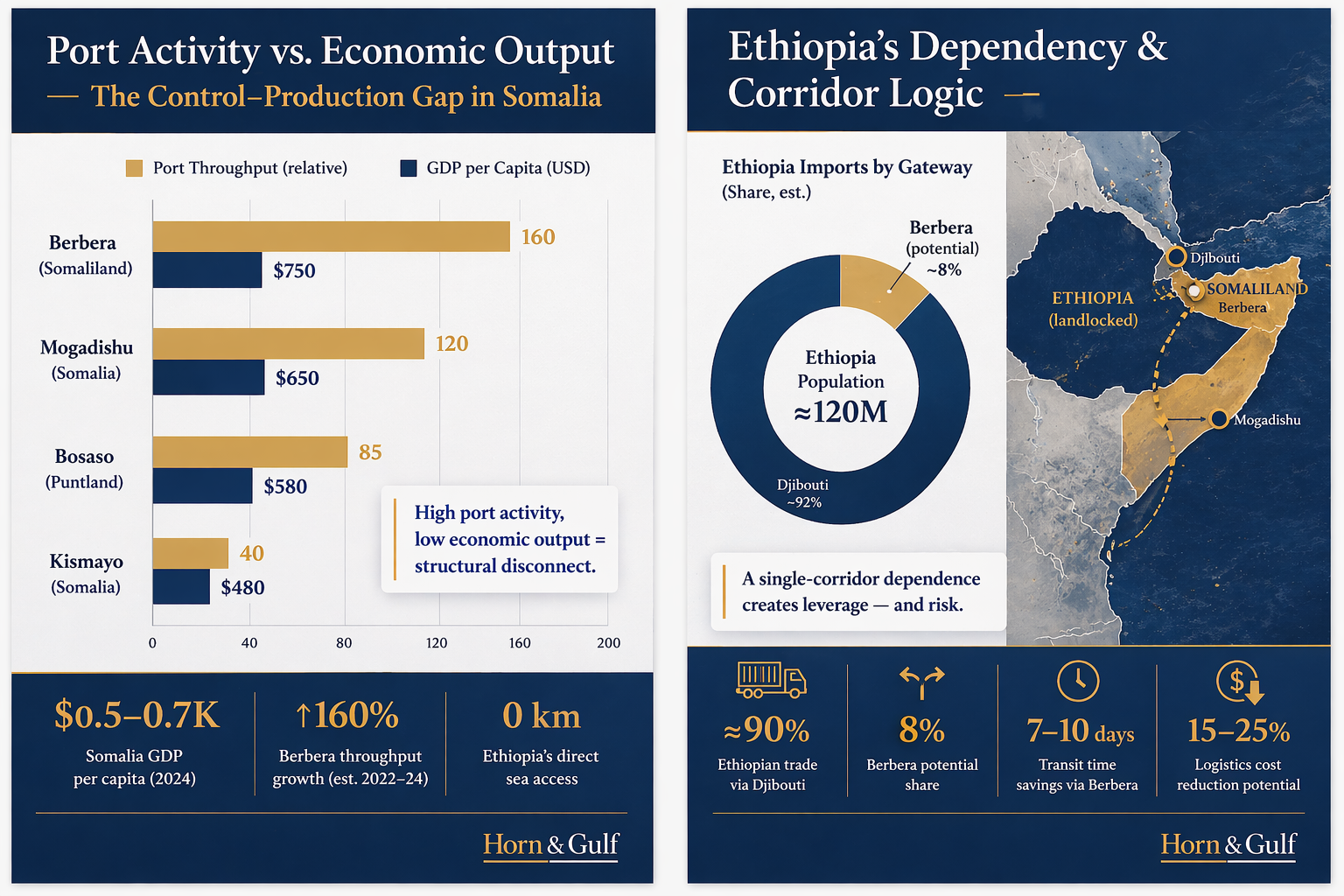
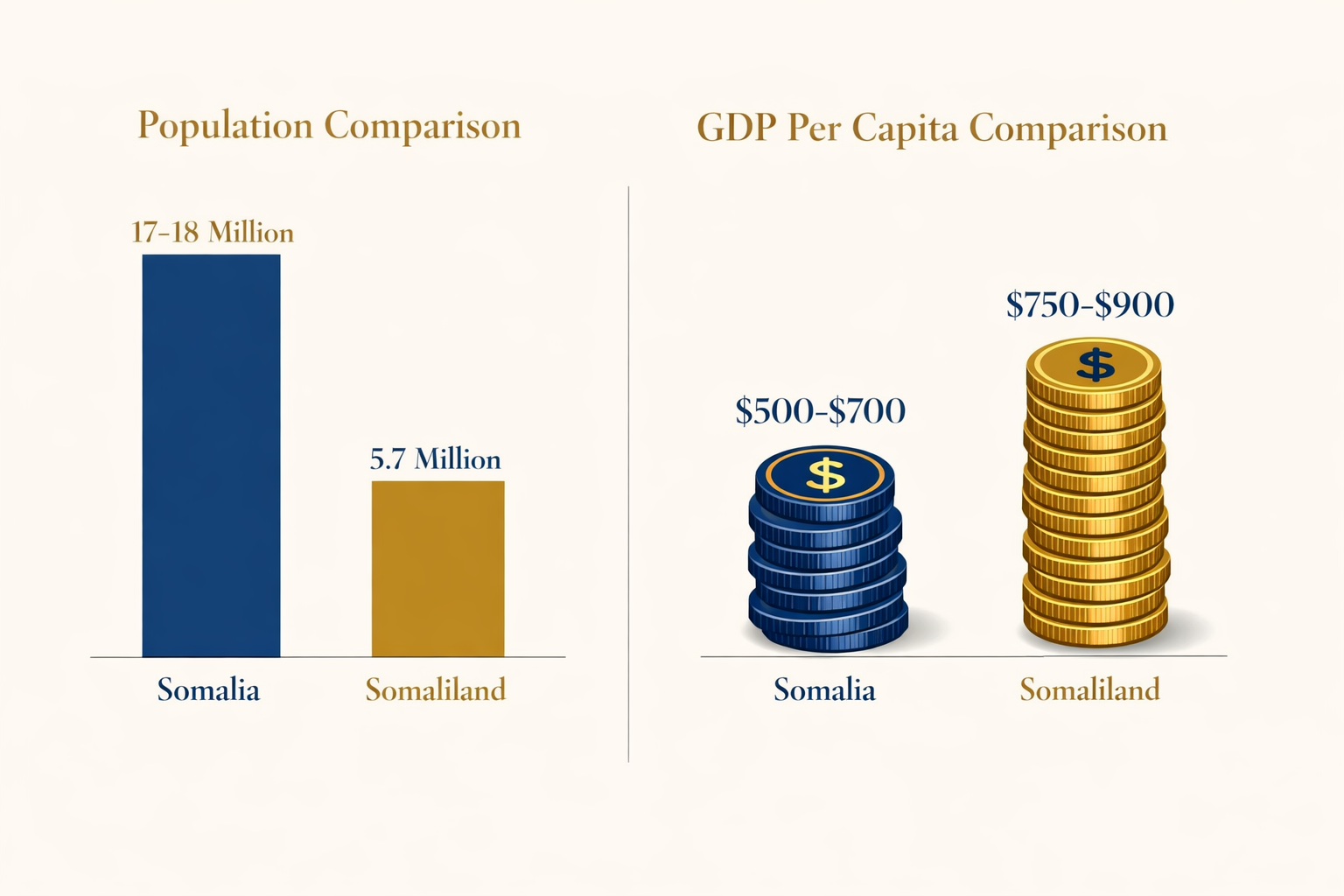
Somalia’s population of approximately 17–18 million, with per capita income in the $500–700 range, and Somaliland’s smaller but similarly constrained economy, point to the same structural issue: the value transiting through these ports is not captured locally.
The next phase, therefore, is not logistical—it is industrial. Ports must transition from transit nodes to production hubs.
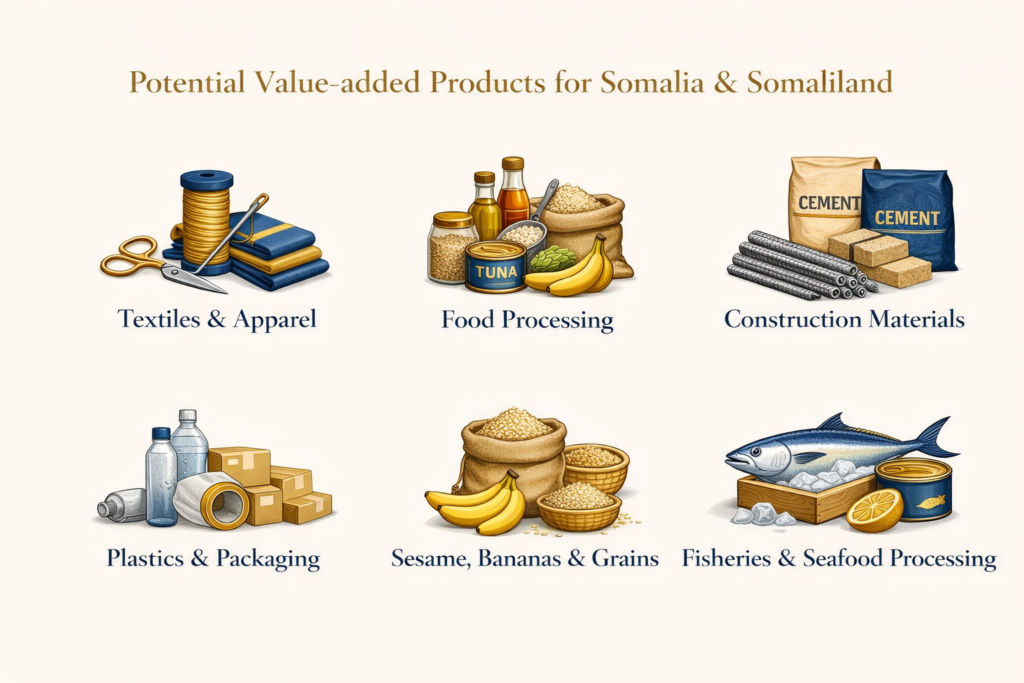
Whether in Berbera or Mogadishu, without the development of sectors such as textiles, food processing, construction materials, plastics and packaging, and fisheries processing, the current competition will not generate durable stability.
Stability Is an Economic Output
The implications extend beyond economics. Production generates employment, integrates clan structures into formal systems, redistributes income, and crucially, reduces the recruitment base of groups such as Al-Shabaab.
If Türkiye’s ongoing energy exploration efforts yield a significant discovery, it would act as an additional accelerator. But energy alone is not a solution. Resource revenues only become stabilizing when layered onto a functioning production economy.
The Real Divide: Two Futures, Not Two Blocs
The region is therefore not defined by two blocs, but by two competing trajectories. One produces a competition over ports without internal economic depth. The other transforms ports into engines of production, creating both economic resilience and security stability.
From a Signal over Noise perspective, the conclusion is straightforward: Power in Bab el-Mandeb will not belong to those who control passage— but to those who can build an economy around it.