Capital, Risk, and the New Cost of Staying Open
What you are seeing on the streets of Dubai today—crowded malls, rising foot traffic, schools reopening—is not just a psychological rebound. It is the visible surface of a system that has absorbed a shock, redistributed its cost, and kept operating.
The partial easing of pressure around the Strait of Hormuz has helped calm markets. Oil prices have pulled back. Movement has resumed. But the region did not become cheaper.
On the contrary, the cost of staying open has been fundamentally repriced.
Safety is no longer a default — it is a managed outcome
For years, the Gulf’s investment proposition was built on a simple equation: low taxes, deep liquidity, political stability, open trade. That equation still holds. But it is no longer sufficient. A new layer has been added: shock absorption capacity.
Over the past two weeks, the UAE’s response has been structured, not reactive:
- The Central Bank of the UAE activated a resilience framework backed by roughly AED 1 trillion in assets, reinforcing systemic liquidity and confidence.
- Dubai introduced fee deferrals and operational cost relief across licensing and business services to reduce immediate cash pressure.
- Dubai International Financial Centre and Dubai Financial Services Authority implemented regulatory flexibility and payment easing, prioritizing continuity over strict enforcement cycles.
- Major banks such as Emirates NBD and Abu Dhabi Commercial Bank rolled out fee reductions, loan deferrals, and trade finance support.
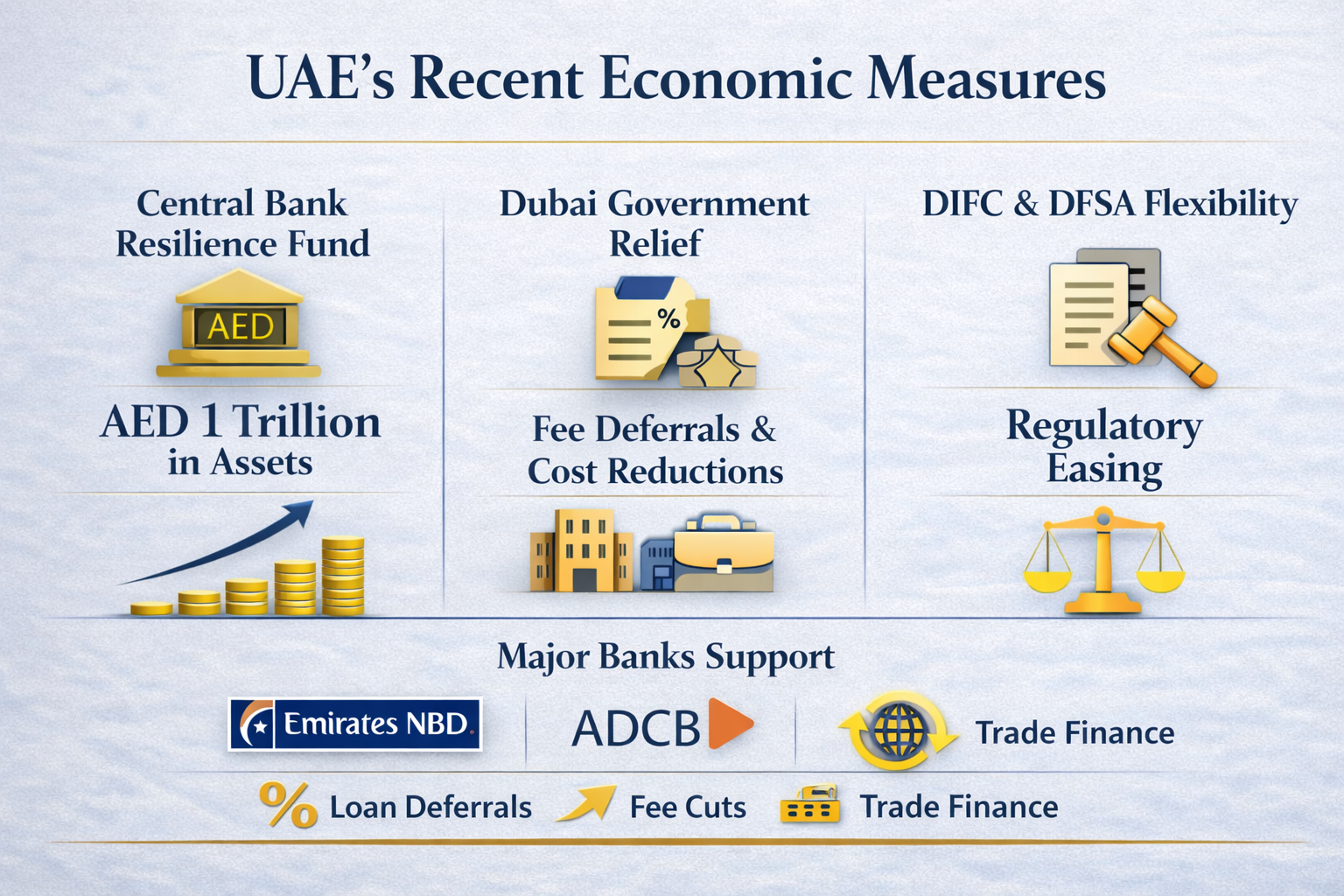
This is not a system trying to eliminate the crisis. It is a system distributing the cost of the crisis to keep itself running. That distinction defines the new era.
Oil corrected. Risk did not disappear.
Energy markets reacted first—and violently.
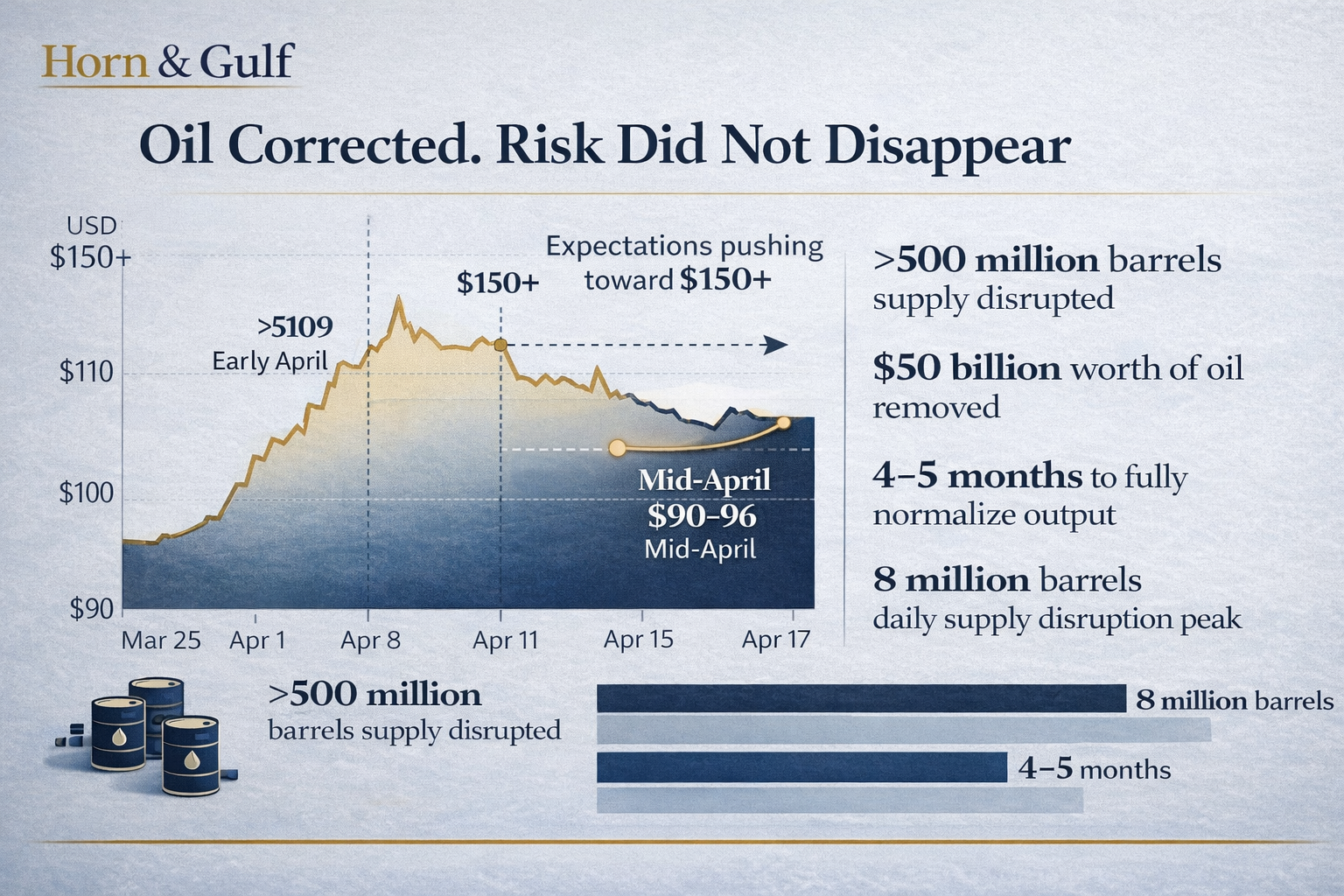
- Early April: Brent surged above $109
- Worst-case scenarios pushed expectations toward $150+
- Mid-April: Brent corrected back to roughly $90–96
At first glance, this looks like normalization. It is not.
Beneath the price action:
- More than 500 million barrels of supply were disrupted
- Approximately $50 billion worth of oil was effectively removed from the system
- Heavy production capacity may take 4–5 months to fully normalize
- Daily supply disruptions peaked around 8 million barrels
Markets are no longer pricing just oil. They are pricing:
- route accessibility
- insurability
- geopolitical predictability
- the probability of renewed disruption
This is the shift: the barrel is no longer the core variable. The system around the barrel is.
The real repricing: from commodities to continuity
The deeper transformation is not in oil—it is in everything connected to it. Costs across the region are being rewritten in real time:
- Trade finance (L/Cs, guarantees, compliance layers)
- Insurance premiums (marine, political risk)
- Redundant logistics and alternate routing
- Free zone operational costs under stress conditions
- Regulatory and reporting infrastructure
- Premium access to financial ecosystems
- Banking relationships that sustain liquidity cycles
Being tax-efficient is no longer enough. Being operationally resilient is now the real premium. Dubai’s value proposition has shifted accordingly. It is no longer a low-cost platform. It is a continuity platform.
From safe haven to stress-tested system
Dubai has long been described as a “safe haven.” This period challenged that narrative.
In March:
- Real estate transaction volumes dropped by roughly 37% year-on-year
- Select assets saw 12–15% price adjustments
- Investors paused, reassessed, repriced
But by mid-April:
- Dubai’s main equity index reached a six-week high
- Weekly gains approached 4.8%
- Banking and real estate led the recovery
Capital did not exit. It recalibrated. That distinction matters. Dubai is no longer being priced as a place untouched by risk. It is being priced as a place that continues to function under risk.
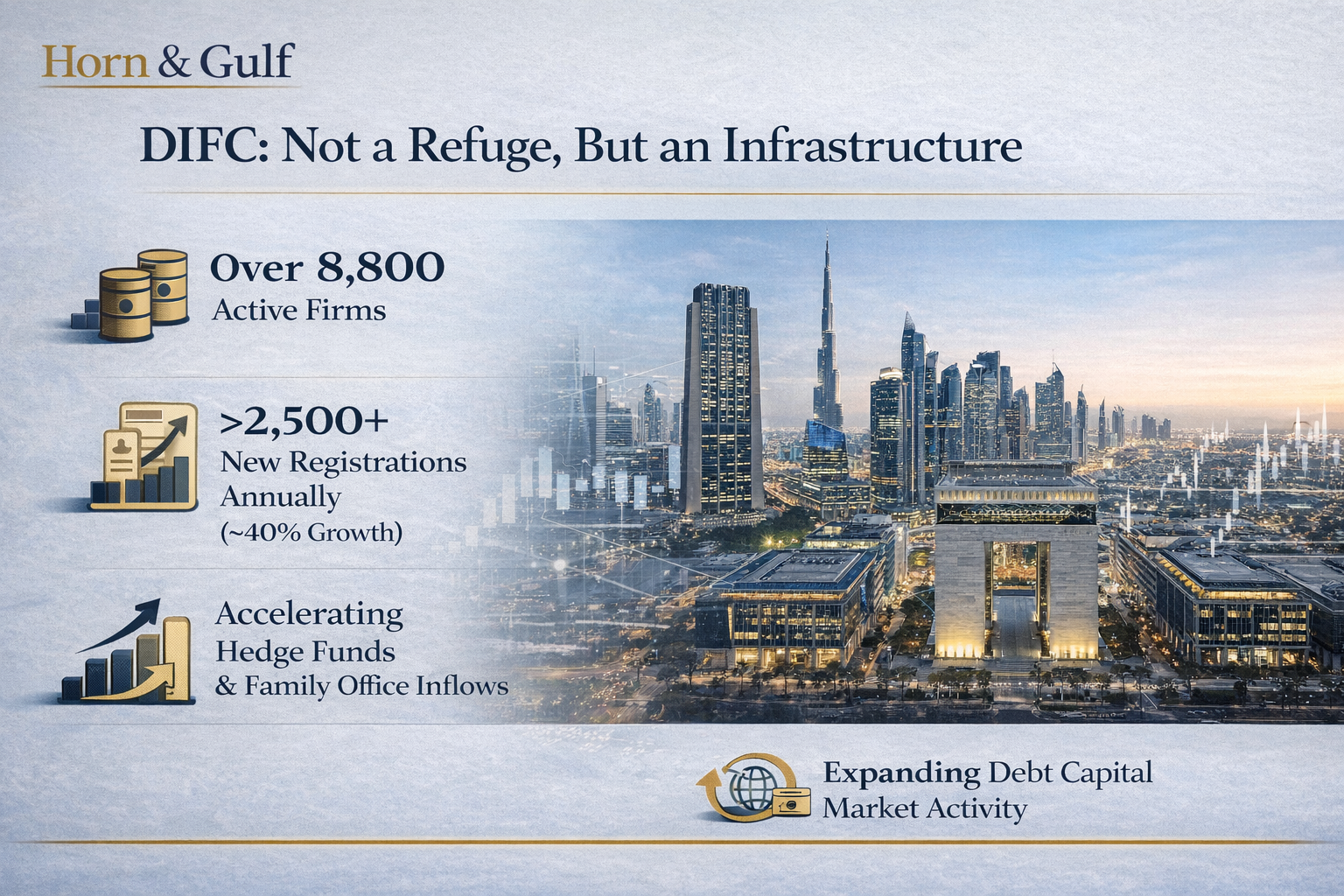
DIFC: not a refuge, but an infrastructure
At the center of this transformation sits Dubai International Financial Centre. Its strength is not branding. It is architecture.
- Over 8,800 active firms
- More than 2,500 new registrations annually (~40% growth)
- Accelerating inflows from hedge funds and family offices
- Expanding debt capital market activity
But the real value lies deeper.
DIFC provides:
- legal certainty
- regulatory clarity
- dispute resolution mechanisms
- family wealth structuring infrastructure
- access to capital markets
- regional operational integration
Investors are not just seeking returns. They are buying protection, structure, and continuity.
The new equilibrium: stability has a price
If oil has fallen and flows have resumed, why does nothing feel cheaper? Because the new equilibrium is not built on eliminating risk—but on managing it.
- Risk persists → it is now priced, not ignored
- Systems operate → but at a higher cost base
- Capital flows → but more selectively, more analytically
The new pricing model rests on three pillars:
- Physical risk
- Continuity of flows
- Access to stable systems
Dubai remains strong across all three. But its advantage is no longer cost.
It is quality under pressure.
Conclusion: the end of a comfortable illusion
This moment has quietly ended a long-standing assumption: that safety in the Gulf is structural and permanent. It is not. Safety is now a constructed, maintained, and priced asset. Dubai remains one of the few systems capable of sustaining that asset at scale. But sustaining it comes at a cost.
And that cost is now visible— in pricing, in policy, and in capital behavior. In this new environment, the winners will not be those who avoid risk. They will be those who absorb it, structure it, and keep operating through it.
That capability is no longer a given. It is a premium.