For two decades, Dubai was marketed—often simplistically—as a tax-efficient jurisdiction. Low or zero income tax, free zones, ease of incorporation. That narrative worked when capital was primarily yield-seeking and opportunistic.
That era is fading. What we are observing now is not the end of Dubai’s attractiveness—but a structural re-pricing of what investors are actually paying for. The premium is no longer “tax-free.” It is resilience. It is operational continuity. It is the ability to absorb shocks without systemic breakdown.
Dubai is no longer selling upside. It is selling survivability.
The Quiet Shift: From Yield Optimization to Risk Minimization
Global capital is not behaving the way it did in the 2010s.
Back then, investors chased arbitrage—higher yields, lower taxes, faster returns. Today, the equation has flipped. The dominant question is no longer “How much can I make?” but “How much can I protect?” This shift is measurable.
Global FDI flows have become more selective and risk-aware. According to UNCTAD, while global FDI declined in recent years due to macro volatility, the UAE consistently ranked among the top 20 recipients—often outperforming much larger economies on a per capita basis.
Dubai alone attracted over $12–14 billion in FDI annually in recent years, with a notable increase in greenfield investments, not just capital inflows seeking passive exposure.
This matters. Greenfield investment signals long-term commitment. Factories, regional HQs, logistics hubs—these are not quick entries. They are embedded decisions. Capital is no longer visiting. It is relocating.
Stress Tests Define Value
Dubai’s real premium has been built during periods of instability—not growth.
The COVID-19 shock, the Ukraine war, supply chain disruptions, and most recently, regional geopolitical tensions—all functioned as live stress tests.
The results were not theoretical.
- Dubai’s ports remained operational at near full capacity, with Jebel Ali sustaining its position as one of the world’s top container ports (handling ~19 million TEU annually).
- DXB airport consistently ranked among the world’s busiest international hubs, surpassing 86 million passengers in 2024.
- Tourism rebounded rapidly, reaching ~18 million international visitors in 2024 (+9% YoY).
- The real estate market surged over 60% between 2022–2025, even as global property markets cooled.
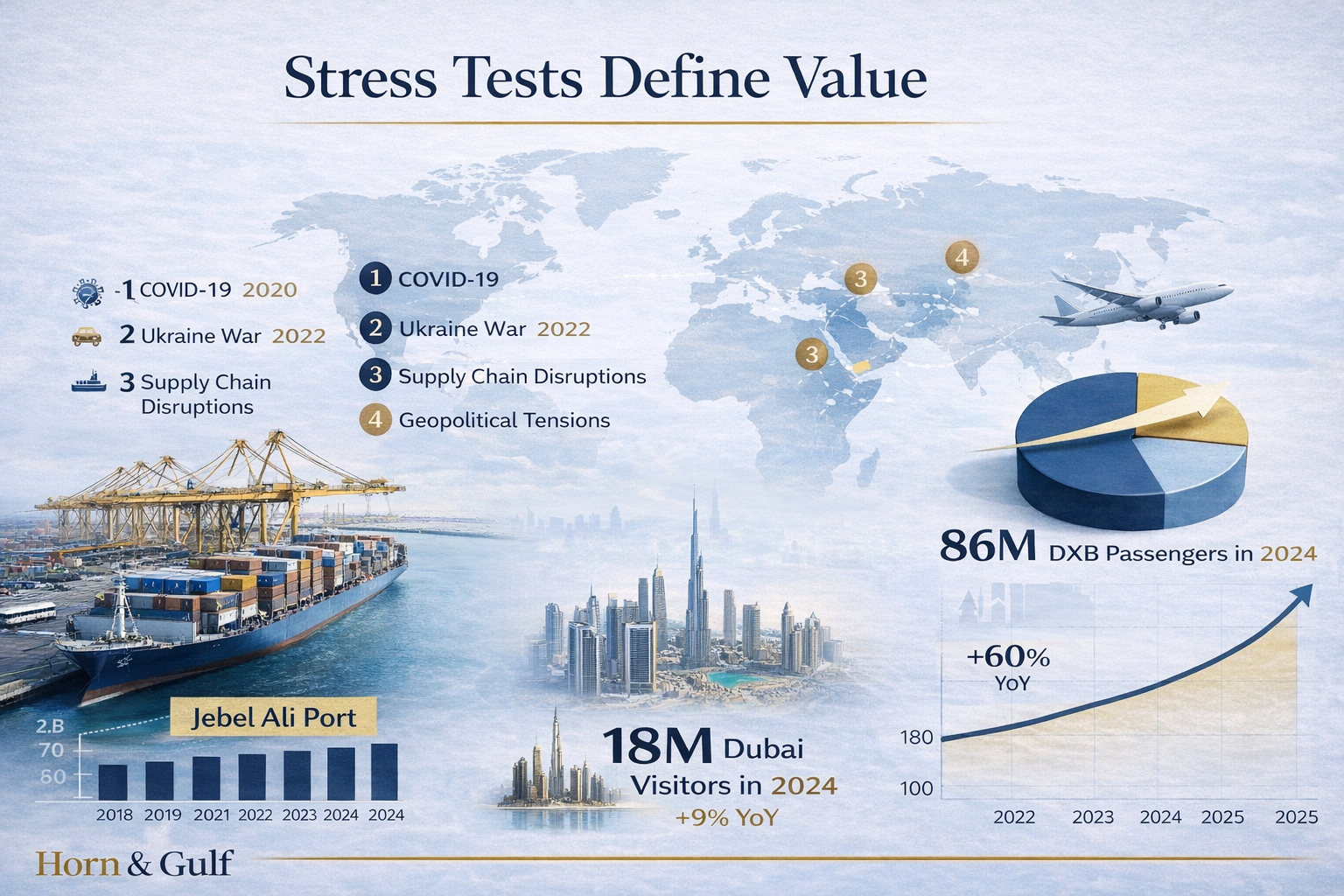
These are not isolated metrics. They form a pattern. In times of disruption, Dubai does not freeze. It accelerates.
Infrastructure as Insurance
Most markets treat infrastructure as a cost center. Dubai treats it as a strategic hedge. The 2026 UAE federal budget allocates approximately 48% to infrastructure and construction, translating to tens of billions of dollars in continued capacity building. This is not growth for growth’s sake.
It is pre-positioning.
- Ports that can absorb rerouted trade flows
- Airports that can scale during aviation disruptions
- Digital infrastructure that enables uninterrupted financial and government services
- Free zones that allow companies to reconfigure supply chains in real time
Dubai’s infrastructure is not designed for efficiency alone. It is designed for redundancy. Redundancy is expensive. But in volatile systems, it becomes the highest-value asset.
The Currency Anchor: Stability by Design
One of the most under-discussed elements of Dubai’s resilience is its monetary architecture. The UAE dirham’s peg to the US dollar eliminates a major layer of currency risk—especially for international investors operating across volatile regions.
In contrast to emerging markets where FX volatility can erase returns overnight, Dubai offers predictability. This matters more than yield. A 10% return in a volatile currency regime is often inferior to a 6% return in a stable one. Capital understands this. And increasingly, it is pricing it in.
Legal and Financial Continuity
Resilience is not only physical. It is institutional. Dubai’s legal and financial ecosystem—particularly through structures like DIFC—provides a hybrid environment combining regional access with international standards.
- Independent courts operating under common law principles
- Regulatory clarity for financial institutions
- Rapid dispute resolution mechanisms
- Strong banking system with high liquidity ratios
During crises, these systems do not stall. Transactions continue. Contracts are enforced. Liquidity remains accessible. This is what differentiates a functioning hub from a fragile one.
Real Estate: Pricing the “Safety Premium”
Dubai’s property market is often misread as speculative. In reality, its recent growth reflects a repricing of risk. Prime segments—Palm Jumeirah, Downtown, Dubai Hills—have seen sustained demand not just from investors, but from relocating residents.
This is a critical distinction. Investor demand is cyclical. Relocation demand is structural. When families, entrepreneurs, and high-net-worth individuals choose to move—not just invest—they are buying into a system, not an asset.
They are paying for:
- Regulatory predictability
- Personal security
- Education and healthcare access
- Lifestyle continuity under uncertainty
This is not speculation. This is capital seeking a base.
The Cost of Stability Is Rising
Here lies the paradox.
As Dubai proves its resilience, it becomes more expensive.
- Prime real estate prices are rising
- Cost of living is increasing
- Corporate setups are becoming more structured and regulated
- The introduction of corporate tax signals maturity, not decline
This is not a loss of competitiveness. It is a transition. Dubai is moving from a low-cost entry point to a high-value platform. The premium is no longer “cheap access.” It is “reliable access.”
Conclusion: A Different Kind of Arbitrage
Dubai’s proposition has not weakened. It has evolved. The old model offered tax efficiency and growth potential. The new model offers something far more scarce: system-level resilience.
In a world defined by fragmentation—geopolitical tensions, supply chain disruptions, regulatory divergence—the ability to operate without interruption becomes a form of arbitrage.
Dubai has positioned itself precisely there. Not as the highest-yield market. But as the market where yield survives.
And in the current global environment, that distinction is everything.