What we are witnessing in the Gulf is not a breakdown. It is a redistribution of pressure. The Strait of Hormuz did not collapse into chaos. It slowed, narrowed, and became selective. Ships did not disappear; they queued. Flows did not stop; they became conditional. Insurance did not fail; it repriced.
The system is still functioning—but under strain, and on different terms. This is the key shift. The Gulf is no longer defined by crisis events. It is defined by how much friction it can absorb while remaining operational.
And in this new configuration, the burden is not evenly distributed.
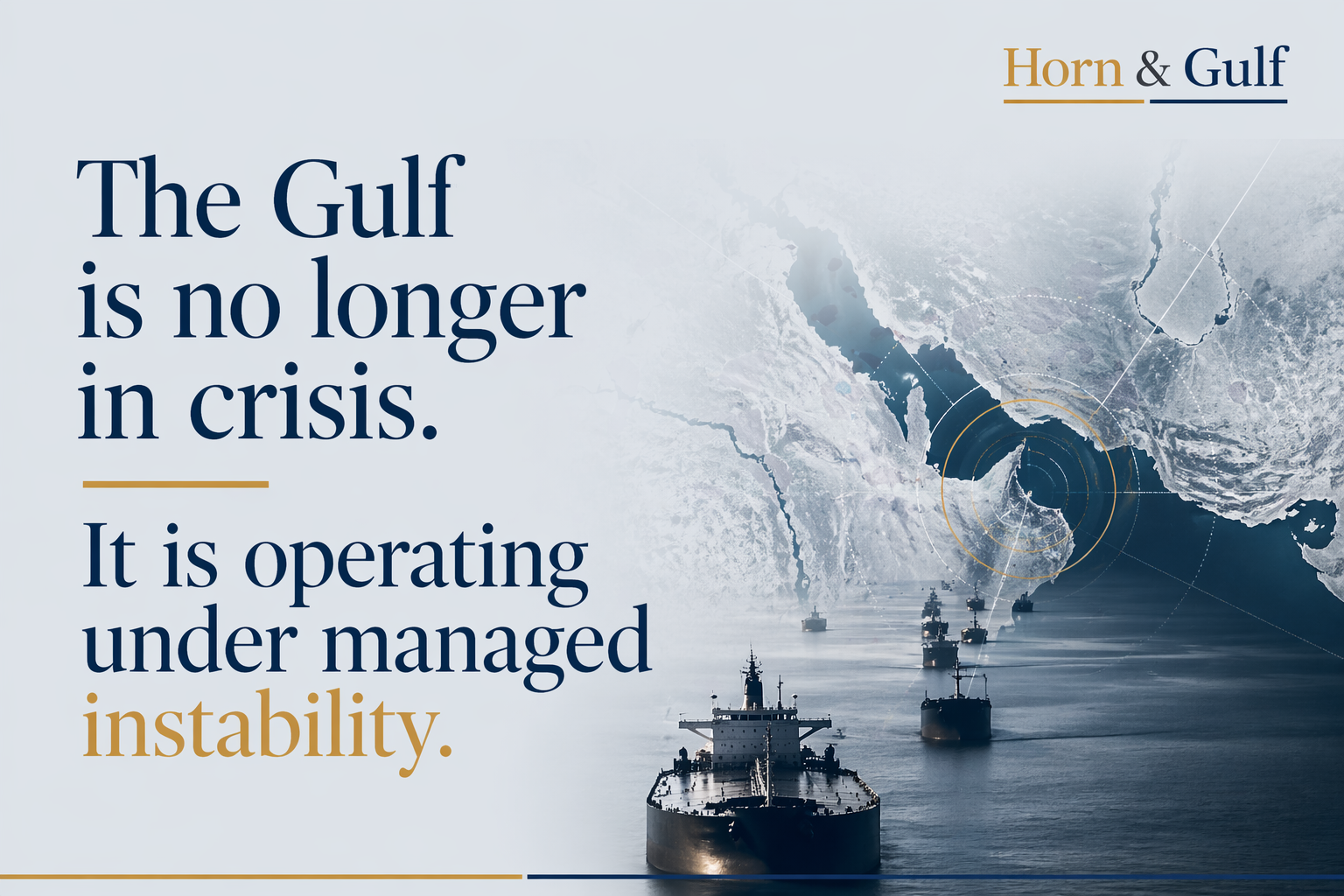
The Gulf is no longer in crisis. It is operating under managed instability
The current configuration reveals a structural asymmetry. Strategic decisions are being shaped outside the Gulf.
Economic consequences are being absorbed within it.
Washington calibrates pressure through naval posture and financial leverage. Tehran signals escalation through ambiguity—threatening disruption without fully executing it. Tel Aviv operates along a separate but intersecting axis of deterrence and preemption.
None of these actors bear the immediate cost of keeping the system running. The Gulf does.
Ports remain open, but throughput slows. Energy exports continue, but with rising premiums. Shipping lanes function, but under layered uncertainty—security risks, insurance recalculations, and rerouting costs.
The result is not interruption. It is degradation. This is where the distinction matters. A disrupted system can be repaired.
A degraded system becomes the new normal.
The Strait as a Control Zone, Not a Chokepoint
For decades, Hormuz was framed as a chokepoint—something that could be closed or kept open. That binary no longer holds. The Strait is now a control zone. It is neither fully blocked nor fully free. It is governed—informally, dynamically, and through pressure rather than policy.
Access is shaped by risk tolerance, flag exposure, insurance cover, and timing. Transit is not denied; it is negotiated in real time. This transforms the nature of power in the region.
Closing the Strait would be an act of war. Controlling it selectively is something more subtle—and more sustainable. It allows escalation without full confrontation. It imposes cost without triggering total breakdown.
And it keeps all actors inside a moving threshold of tension.
Markets Are Not Panicking — They Are Adapting
The market response reflects this shift. Oil has not spiked uncontrollably. It has repriced upward and stabilized within a higher band. Equities have not collapsed. They have rotated, hesitated, and recalibrated. Capital has not exited. It has become more selective, more conditional.
This is not fear-driven behavior. It is systems-driven adaptation. Markets are recognizing that the infrastructure of the Gulf—ports, financial systems, currency stability—remains intact. But they are also pricing the cost of operating within a corridor that is no longer frictionless.
The premium is no longer about scarcity. It is about uncertainty.
The Strategic Position of the UAE — Stability Under Pressure
For the UAE, this environment creates a dual reality. On one hand, it reinforces its structural strength. Logistics continue. Financial systems remain liquid. The dirham peg holds. Ports operate close to capacity.
On the other, it raises the cost of maintaining that stability. Every shipment carries a higher insurance load. Every transaction reflects a recalibrated risk assumption. Every flow is slightly slower, slightly more complex, slightly more expensive.
The UAE is not collapsing under pressure. It is absorbing it—and converting it into a managed operating environment. That is both its advantage and its burden.
Stability Has Been Redefined
The Gulf is not experiencing a temporary disruption. It is transitioning into a new operating model.
A model where:
- conflict does not stop flows, but reshapes them
- control is exercised without formal ownership
- costs are distributed unevenly across the system
And most importantly:
The actors who shape the game are not the ones who carry its economic weight. This is the defining imbalance of the current moment. The Gulf pays—in higher costs, tighter margins, and operational strain. Others decide—through posture, signaling, and calibrated escalation.
And between these two realities, a new equilibrium is forming. Not stable. Not unstable.
But managed.