The Strait of Hormuz is often described as a narrow maritime passage—a strategic bottleneck exposed to geopolitical risk. That description captures the map. It does not capture the system. To understand Hormuz today, it must be read alongside another seemingly distant node: Taiwan.
One sits at the center of global energy flows. The other anchors the world’s semiconductor supply. They are not connected by geography. They are connected by structure.
Where Flows Converge, Fragility Forms
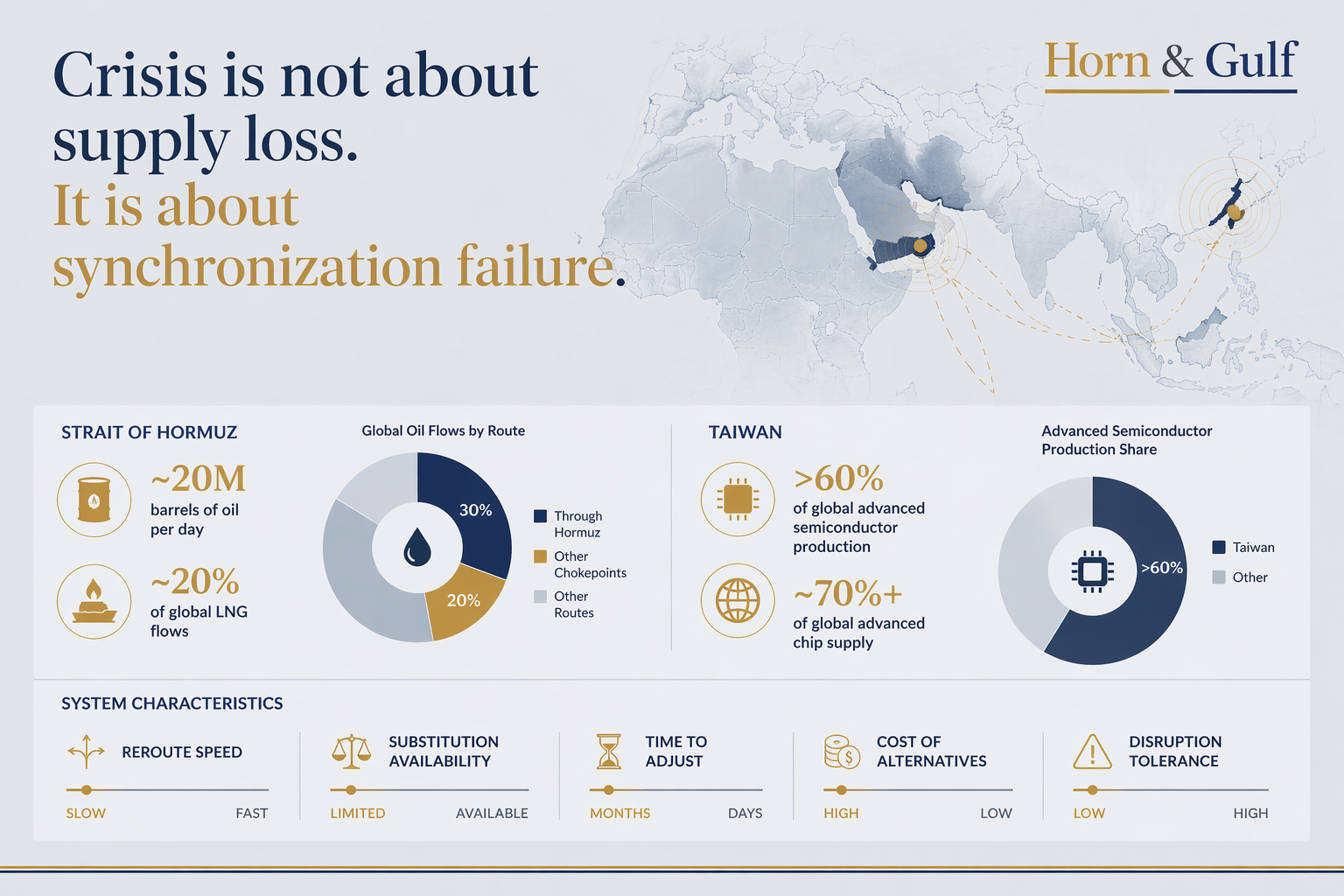
Hormuz channels roughly:
- 20 million barrels of oil per day
- around 20% of global LNG flows
Taiwan, by contrast, concentrates:
- the majority of advanced semiconductor manufacturing
- a decisive share of global chip supply chains
Different sectors. Same pattern. Both compress high-value, low-substitutability flows into narrow, highly exposed nodes. The key variable is not volume. It is dependency density. The system-level questions are identical:
- How quickly can flows be rerouted?
- What substitutes exist at scale?
- How long can downstream systems absorb disruption?
In both cases, the answers converge: Alternatives exist—but they are slow, costly, and incomplete. Pipelines cannot fully replace maritime oil flows. LNG logistics cannot be reconfigured overnight. Semiconductor fabrication cannot be relocated in months.
The system does not fail instantly. It begins to drift out of alignment.
When Timing Breaks, Systems Don’t Stop — They Misalign
What presents as a supply disruption is, in practice, a breakdown in synchronization. Modern global systems are not built for interruption. They are built for timing.
When Hormuz is disrupted:
- tankers are delayed
- refinery input cycles break
- petrochemical output declines
- fertilizer production slows
- agricultural systems feel the impact
When Taiwan is disrupted:
- chip supply tightens
- manufacturing lines stall
- automotive and electronics sectors pause
- downstream industries accumulate delays
These are not linear chains. They are synchronized systems operating on tightly coordinated flows. Crisis, in this structure, is not defined by how much supply is lost. It is defined by how quickly coordination fails.
Once timing is disrupted, effects compound. A delay measured in days at the front of the system
becomes a disruption measured in months at the back.
A System That Is Stronger — and More Fragile at the Same Time
The global economy has become:
- more interconnected
- more optimized
- and therefore more sensitive to disruption
Hormuz and Taiwan are not isolated risks. They are expressions of the same architecture. Fragility no longer sits at the edges of the system. It sits where flows are most concentrated and least replaceable.
This produces a new operating reality:
- disruption is not contained
- substitution is not immediate
- recovery is not linear
Energy flows through Hormuz are tied to food systems and industrial inputs. Semiconductor flows through Taiwan are tied to global manufacturing capacity. The system does not collapse. It accumulates stress.
From Chokepoints to Compression Points
The traditional language of chokepoints assumes that disruption is about blockage: something stops, and systems adapt. That assumption no longer holds. What defines modern vulnerability is not stoppage, but compression. Hormuz concentrates the energy lifeblood of the global economy. Taiwan concentrates its technological core.
Disruption at either point does not simply reduce supply. It distorts timing, fractures coordination, and amplifies systemic stress. These are not locations where the system breaks. They are locations where the system is most exposed to misalignment.
Hormuz is not a chokepoint. It is a compression point of global dependency.