Over the past 24 hours, developments across the Strait of Hormuz, Yemen and the Horn of Africa point to a deeper shift. The issue is no longer whether trade flows — but under what conditions, at what cost and with what degree of control.
Passage Is No Longer a Neutral Condition
Recent activity in the Strait of Hormuz has reinforced a critical shift. Transit continues.
But it is no longer neutral. Vessel interference, selective enforcement and rising security friction are not stopping flow. They are redefining it. The assumption that maritime trade operates under predictable, rules-based conditions is eroding.
What remains is a different reality: Access exists. Assurance does not. This distinction is now central to how the system functions.
From Movement to Pricing Power
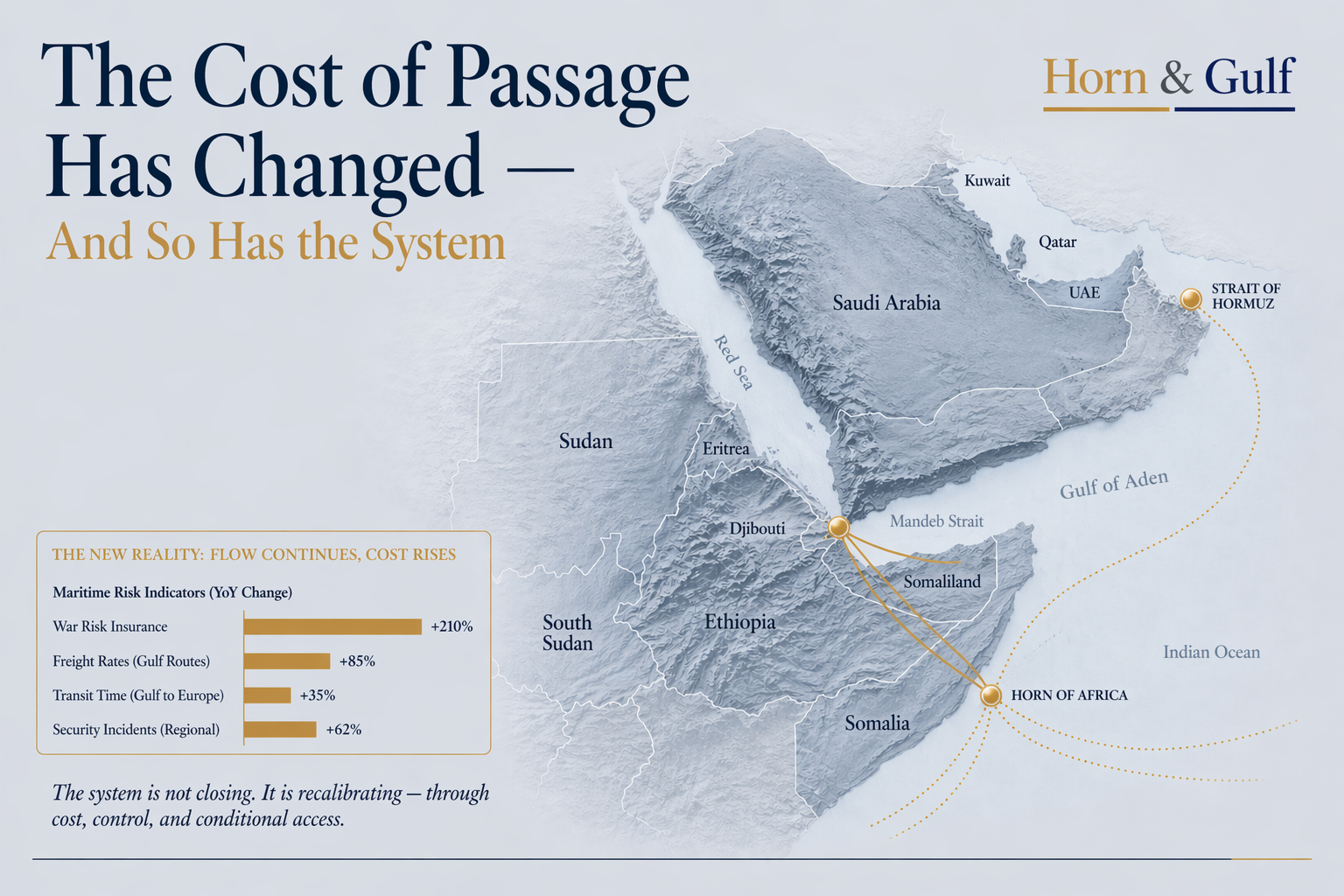
The Gulf is no longer just a space where goods move. It is a space where movement is priced. Insurance premiums, freight rates, routing decisions and contractual terms are increasingly shaped by geopolitical conditions. Risk is no longer an external shock. It is embedded directly into the cost structure of trade.
This marks a structural shift: Flow is not interrupted. Flow is repriced. And once pricing mechanisms adjust, they rarely revert fully.
The System Expands: Yemen and the Red Sea as Extensions
This shift does not remain confined to the Gulf. It extends outward.
Yemen is no longer just a fragmented conflict zone. It is a strategic land interface linked directly to maritime control. Competing regional actors are positioning themselves not only for influence within Yemen, but for access to coastlines, ports and adjacent sea lanes. At the same time, the Red Sea and Bab el-Mandeb have absorbed rerouted flows and strategic attention.
Together, these zones form a connected system:
Hormuz → Gulf → Yemen → Bab el-Mandeb → Red Sea → Horn of Africa
The geography has always existed. What has changed is how it functions. This is no longer a series of separate theatres.
It is a single, continuous operational environment.
The Horn of Africa as a Structural Extension
As pressure builds within the Gulf, the Horn of Africa absorbs part of that strain.
Ports, corridors and political alignments in countries such as Somalia, Sudan and Eritrea are increasingly shaped by external competition. Strategic positioning is no longer confined to the Gulf coastline. It extends into Africa.
This creates a new dynamic: Diversification reduces dependence on a single route. But it distributes vulnerability across multiple nodes. The system becomes wider. But also more complex.
A New Baseline: Persistent, Low-Intensity Stress
The most important change is not immediate disruption. It is the emergence of a new operating baseline.
Not crisis. Not stability. But sustained pressure.
This has measurable effects:
- shipping costs incorporate permanent risk buffers
- logistics planning prioritizes resilience over efficiency
- capital flows become more selective and cautious
- operational timelines extend and fragment
Trade continues. But under constraint. Investment continues. But with recalibrated expectations.
Conclusion
The events of the past 24 hours do not point to collapse. They point to transformation. The Gulf–Red Sea–Horn system is not breaking. It is being redefined — through cost, control and conditional access.
The cost of passage has changed. And with it, the logic of the system itself.