
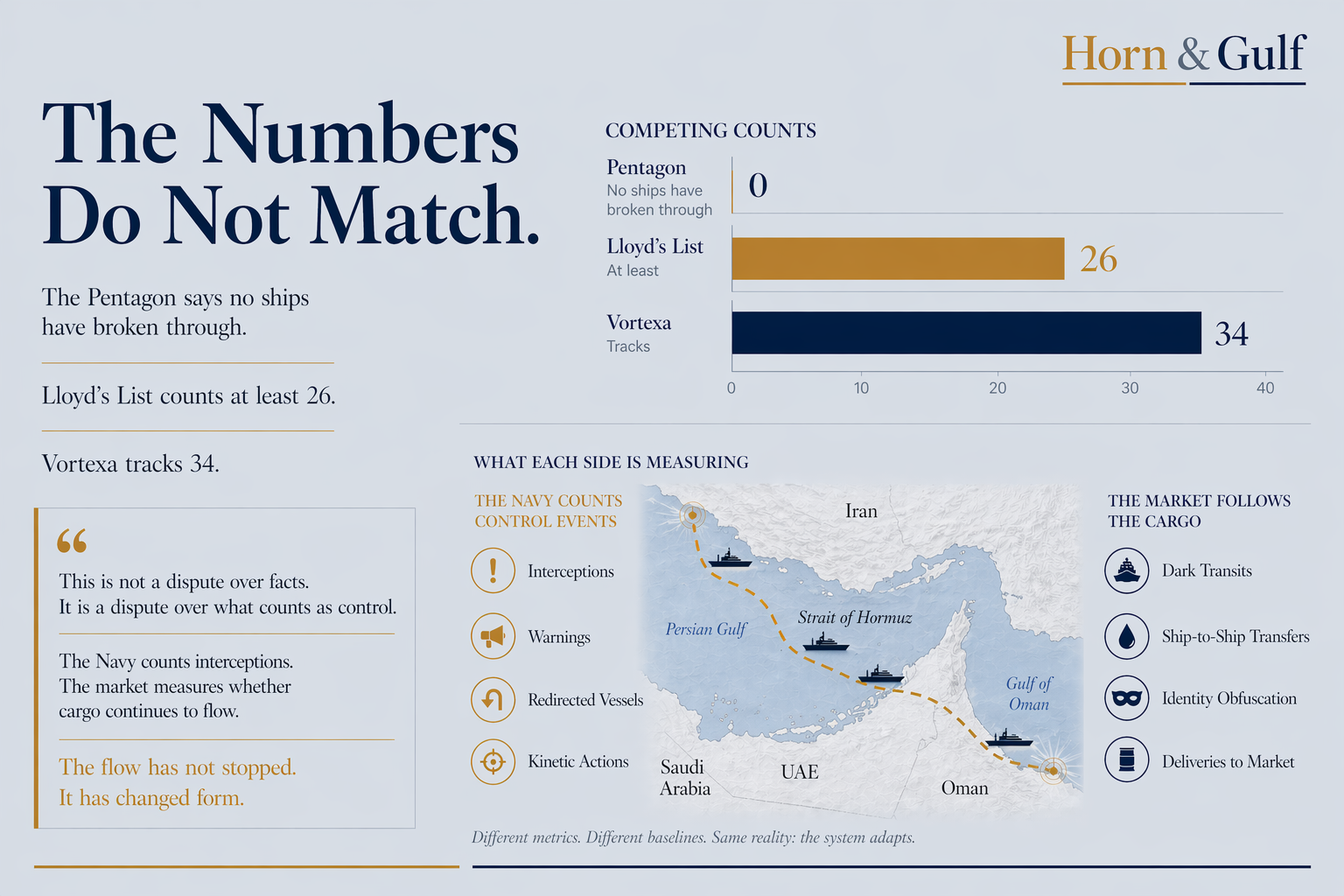
The numbers do not match. The Pentagon says no ships have broken through. Lloyd’s List counts at least 26. Vortexa tracks 34.
At first glance, this looks like a dispute over facts. It is not. It is a dispute over what counts as control.
Because while the Navy counts interceptions, warnings, and redirected vessels, the system that moves oil is measuring something else entirely: whether cargo continues to flow to market. And on that question, the answer is not binary.
The flow has not stopped. It has changed form.
The Illusion of Control — What the Navy Is Actually Enforcing
The US naval operation is real, visible, and operationally significant.
- Over 10,000 personnel
- Dozens of aircraft
- More than a dozen warships
- 29 vessels “directed” to turn back
- 2 kinetic interventions in nine days
This is not symbolic enforcement. It is active pressure. But the method matters. Most interventions are not physical. They are radio warnings. Most vessels do not get seized. They comply. The blockade, in practice, is not a hard seal.
It is a filter applied to visible traffic. And that distinction is where the system begins to diverge.
Three Vessels, Three Methods — A System Reveals Itself
To understand the limits of the blockade, it is enough to look at how different vessels behave once pressure is applied.
In one case, a sanctioned VLCC simply disappears. A 300+ meter crude carrier, flagged, listed, and traceable—until it is not. Its AIS signal goes silent for over a month. Satellite imagery later suggests movement beyond the blockade line, while military sources claim interception. The public data cannot reconcile the two. What remains is not the outcome, but the condition:
a vessel large enough to carry two million barrels can move through a zone of active enforcement without leaving a continuous trace.
In another case, the issue is not invisibility but timing. A tanker cycles through multiple flags—Botswana, Palau, Cameroon—each registry fragmenting its identity. It loads crude before the blockade begins, transits early, and is only intercepted weeks later, far from the Gulf. By the time forces board it, the cargo has long since entered the global system.
Enforcement catches the vessel. The trade has already moved.
A third pattern is quieter. A smaller tanker slows to near-zero speed off the Iranian coast, in waters long associated with ship-to-ship transfers. Its signal weakens, then disappears. No official interception is recorded. No destination is declared. But the location and behavior are enough.
At that speed, in that zone, the question is not where the vessel is going—but what has already come alongside it.
These are not isolated anomalies. They are different expressions of the same system.
The Real System — Built Before the Crisis
None of these behaviors emerged after April 13.
- AIS shutdowns
- Spoofed positions
- Multi-flag identity cycling
- Stateless vessel profiles
- Ship-to-ship transfers in offshore zones
This infrastructure was built gradually, under years of sanctions pressure. What has changed is not the method.
It is the intensity of scrutiny. The same mechanisms that once operated against financial enforcement are now operating under naval pressure. Different tools. Same logic.
Control vs Flow — The Structural Break
The critical mistake is to treat the blockade as a question of success or failure. It is neither.
The Navy can:
- Intercept visible vessels
- Enforce against designated targets
- Apply pressure within its operational window
But the system can:
- Remove visibility
- Fragment identity
- Shift cargo between hulls
- Decouple origin from delivery
This creates a new reality:
Control is applied to what can be seen.
Flow adapts through what cannot.
The gap between the two is where the system now operates.
The Missing Layer — Repricing, Not Disruption
The most important effect is not whether oil moves. It is how it moves, and at what cost. This is where the analysis must extend beyond vessels and into markets.
1. Shipping Costs Are No Longer Neutral
- Longer routes to avoid detection
- Idle time during dark periods
- STS transfer coordination delays
Each adds friction. Freight is no longer a logistics variable. It becomes a risk-adjusted premium.
2. Insurance Is No Longer Standardized
Sanctioned or ambiguous cargo:
- struggles to access traditional insurance
- relies on opaque or state-backed coverage
- carries higher default and liability risk
This increases not only cost, but uncertainty.
3. Buyers Become Selective
Not all barrels are equal anymore.
- Visible, compliant cargo trades at one price
- Shadow cargo trades at another
Discounts widen. Risk is priced into origin, route, and traceability.
4. Capital Repositions, Not Exits
Investors do not leave the system. They adjust exposure.
- financing becomes more selective
- counterparties are scrutinized more aggressively
- compliance thresholds tighten
The system continues to function. But with filters embedded in capital allocation.
The Strategic Outcome — A System That Leaks by Design
The shadow fleet was not built to defeat a single blockade. It was built to ensure that no single enforcement layer could fully seal the system. What we are seeing is not failure of enforcement. It is the interaction between enforcement and pre-built leakage mechanisms.
Nine days of naval pressure cannot close a system designed over ten years to remain porous.
Conclusion — What This Actually Means
The question is not whether the blockade is working. It is working. The question is whether it is decisive. It is not. Because the system has evolved beyond a single point of control. Oil is still moving. But it is moving:
- with less visibility
- through more complex routes
- under higher cost structures
- with greater risk dispersion
This is not disruption. This is transformation.