Beyond the Immediate Headlines
Periods of geopolitical tension tend to produce fast conclusions. Disruptions appear, headlines accelerate, and interpretation follows close behind. In such moments, the visible often takes precedence over the structural. Flights are delayed, insurance costs rise, and market sentiment shifts. These developments are real, but they do not, on their own, define the condition of a system.
What matters more is how capital behaves while these pressures unfold.
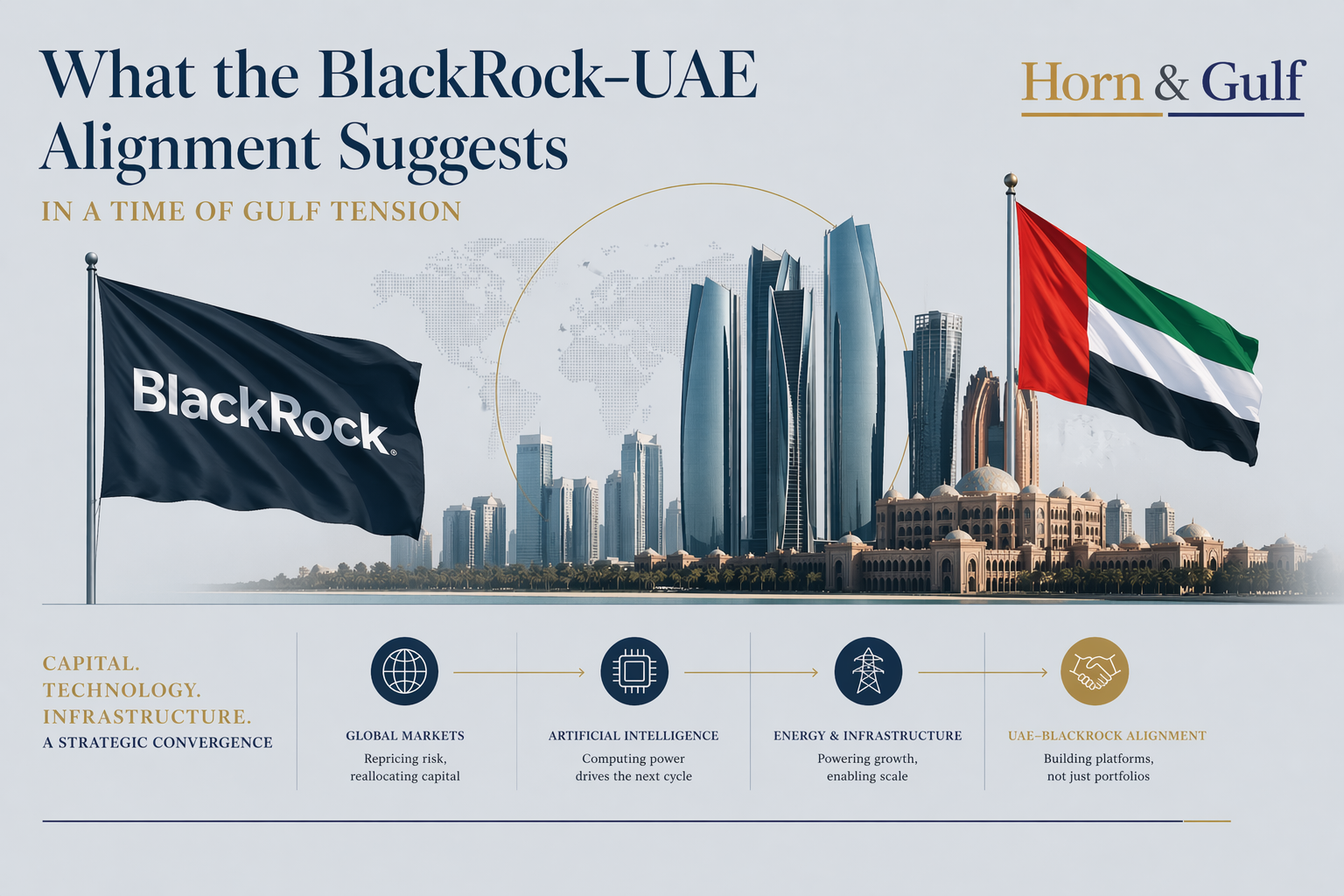
The recent meeting in Abu Dhabi between HH Sheikh Mohamed bin Zayed Al Nahyan and Larry Fink did not produce a list of agreements or a detailed joint statement. Official communication remained concise, referring to discussions on global markets, artificial intelligence, and advanced technologies. On the surface, this appears consistent with the language of many high-level meetings. Yet in this case, the absence of detail is not a lack of substance. It reflects the nature of what was being addressed.
Where Finance Meets Infrastructure
The convergence of finance, computation, and infrastructure has become the defining axis of global capital allocation. These are not separate domains. They are increasingly interdependent, shaping how and where long-term investment is positioned. When such themes are discussed at the level of head-of-state engagement with the world’s largest asset manager, the significance lies less in immediate outcomes and more in strategic alignment.
Larry Fink does not represent a conventional financial institution. The scale of BlackRock’s assets places it closer to a system-level allocator than a market participant. Its decisions influence not only investment flows but also the structure of markets themselves. Engagement at this level, particularly during periods of regional uncertainty, is not routine. It reflects a judgment about continuity.
Timing as a Signal
The timing of the visit is therefore central to its meaning. It took place against a backdrop of heightened tension across the Gulf and the wider maritime system. Questions around security, logistics, and regional stability have been circulating with increasing intensity. Under such conditions, capital does not necessarily withdraw, but it becomes more selective. It seeks environments where operational reliability is expected to hold, even under stress.
The UAE has, over time, positioned itself within this category. Its role is not defined solely by growth or by the absence of disruption. It is defined by its ability to function within global systems that are themselves under pressure. This distinction is often overlooked, particularly when analysis remains focused on short-term indicators.
From Market to Platform
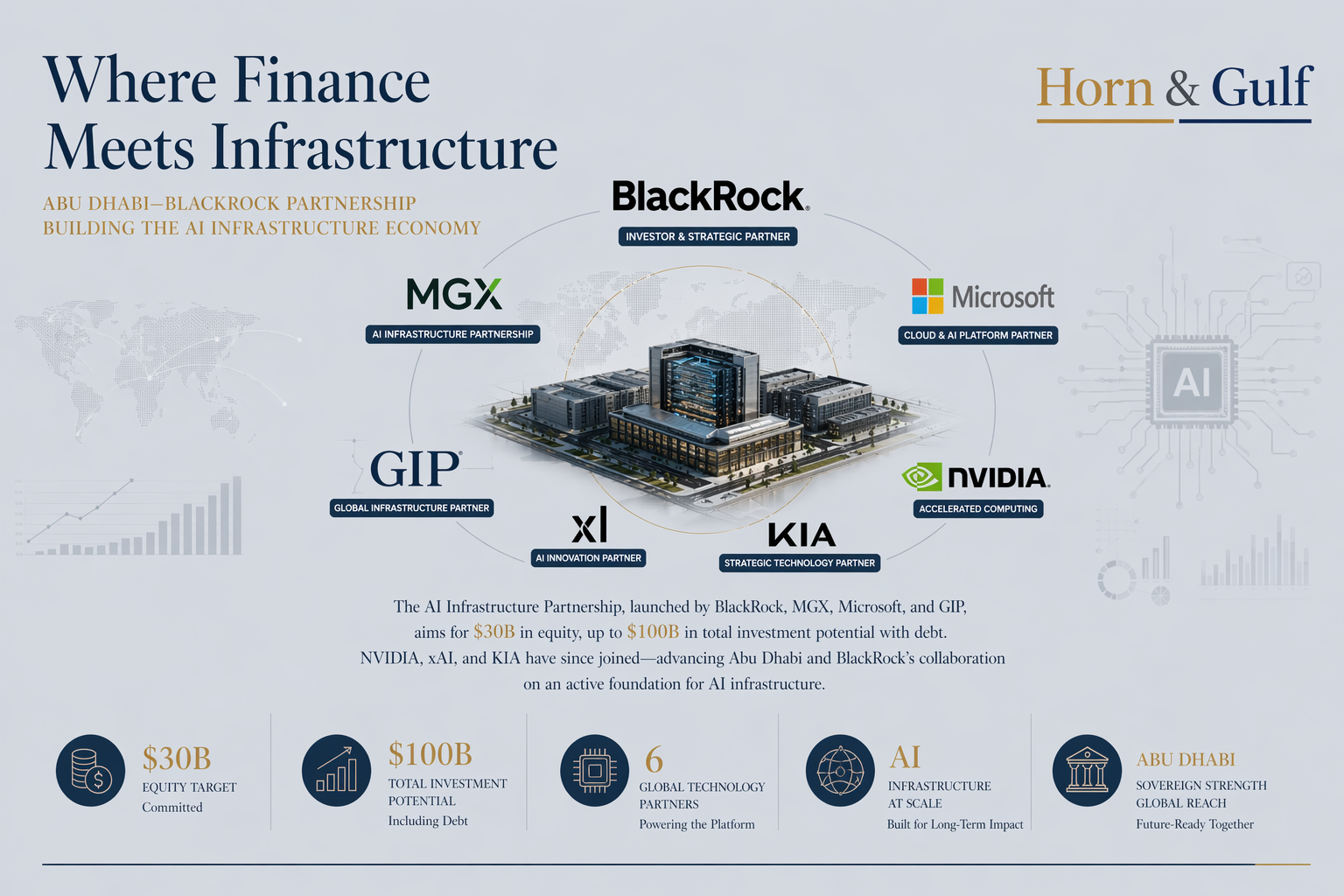
The relationship between UAE-based institutions and BlackRock has already moved beyond conventional investment. It has extended into areas that require a different level of commitment: large-scale infrastructure, artificial intelligence platforms, and financial structures designed to operate across jurisdictions. These are not easily reversible engagements. They depend on regulatory clarity, institutional coordination, and a degree of predictability that extends beyond market cycles.
In this context, the meeting in Abu Dhabi can be understood as part of an ongoing process rather than an isolated event. It reflects a continuity of engagement at a time when discontinuity might otherwise be expected.
Perception and Behaviour Diverge
Much of the current commentary surrounding the region has been shaped by visible signs of pressure. There has been discussion of slowing transaction volumes, cautious investor sentiment, and the rising cost of operating within a more complex environment. These observations are not incorrect. They describe the surface of the system. What they do not capture is the behaviour of long-term capital beneath that surface.
If the underlying structure were weakening, the expected response would be a reduction in strategic engagement. Large institutional actors would delay expansion, limit exposure, or redirect capital toward less volatile environments. What has been observed instead is a continuation, and in some cases an expansion, of involvement.
This divergence between perception and behaviour is where the analytical gap emerges.
Stress Without Dislocation
The presence of Larry Fink in Abu Dhabi during a period of regional uncertainty does not eliminate risk. It does not suggest that the system is insulated from external pressures. It does, however, indicate that these pressures are being absorbed without a loss of confidence at the highest levels of global capital.
The tendency to interpret stress as a precursor to breakdown is understandable, but it is not always accurate. Systems that are deeply integrated into global networks rarely fail through sudden collapse. They adjust, reprice, and reconfigure. The question is whether these adjustments lead to fragmentation or to continued alignment.
In the case of the UAE, the available signals point toward the latter. Trade flows have not ceased. Financial institutions continue to operate. Strategic partnerships are being maintained and, in some cases, extended. The system is not static, but it remains coherent.
What This Moment Reveals
The meeting between HH MBZ and Fink does not resolve the uncertainties facing the region. It does not remove the pressures that have emerged in recent months. What it does is offer a clearer view of how those pressures are being managed.
When capital remains engaged under strain, it suggests that the underlying structure continues to hold. Not because it is untouched, but because it is capable of functioning within a more demanding environment.
In moments like this, that distinction is easy to miss. It is also the one that matters most.