From Peripheral Geography to Structural Node
For much of the past two decades, the Horn of Africa was treated as an adjacent theatre — relevant, occasionally volatile, but ultimately secondary to the core energy artery of the Gulf. That framing no longer holds. What is unfolding across Djibouti, Somaliland and the Bab al-Mandab corridor is not a spillover from the Gulf crisis. It is the system adjusting itself.
The pressure applied in the Strait of Hormuz is not contained within it. It travels. It redistributes. And increasingly, it settles along the western edge of the Arabian Sea, where the Horn of Africa is no longer a peripheral geography, but a structural component of how global flows are being reorganized.
Djibouti: Stability as a Strategic Asset
The recent re-election of Ismaïl Omar Guelleh in Djibouti, extending his rule into a sixth term, would under normal circumstances register as a domestic political continuity story. In the current environment, it reads differently. Djibouti is not simply a small state maintaining internal stability. It is one of the most densely militarized maritime nodes in the world, hosting multiple foreign bases while sitting at the southern gateway of the Red Sea.
Political continuity here is not just about governance; it is about preserving a fixed point in a system that is otherwise becoming fluid. In a network where volatility is spreading, stability itself becomes a form of infrastructure.
Somaliland: Recognition as Alignment
At the same time, the quiet re-emergence of diplomatic signals around Somaliland — particularly in policy circles in Washington — is not an isolated political curiosity. It reflects a broader recalibration.
Recognition, or even partial normalization, is no longer only about statehood in the classical sense. It is about securing alignment along a corridor that is gaining structural weight as pressure builds elsewhere. What appears as diplomacy is, in effect, corridor positioning.
Hormuz Pressure and Systemic Spillover
To understand why this matters, it is necessary to move beyond event-driven analysis and look at the underlying architecture.
The Strait of Hormuz has entered a phase where passage is neither fully denied nor fully guaranteed. It operates within a spectrum shaped by military signaling, insurance pricing, legal ambiguity and tactical enforcement. This does not stop flows. It conditions them. The result is not closure, but friction — persistent, variable and politically mediated.
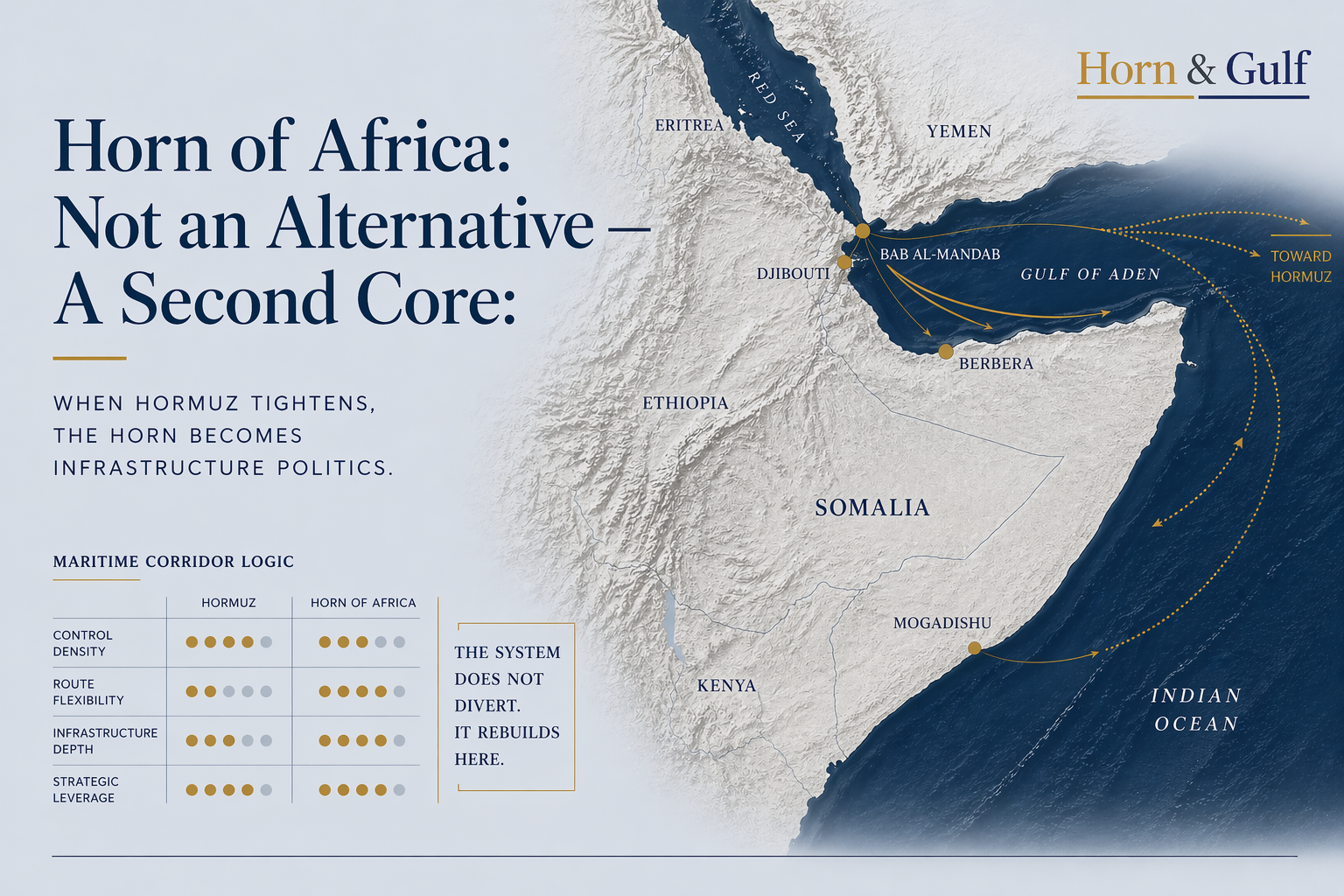
Friction in a system of this scale does not remain local. It forces adaptation across connected nodes. This is where the Horn of Africa enters the frame not as an alternative, but as an extension of the same system logic.
The Emergence of a Parallel Maritime Layer
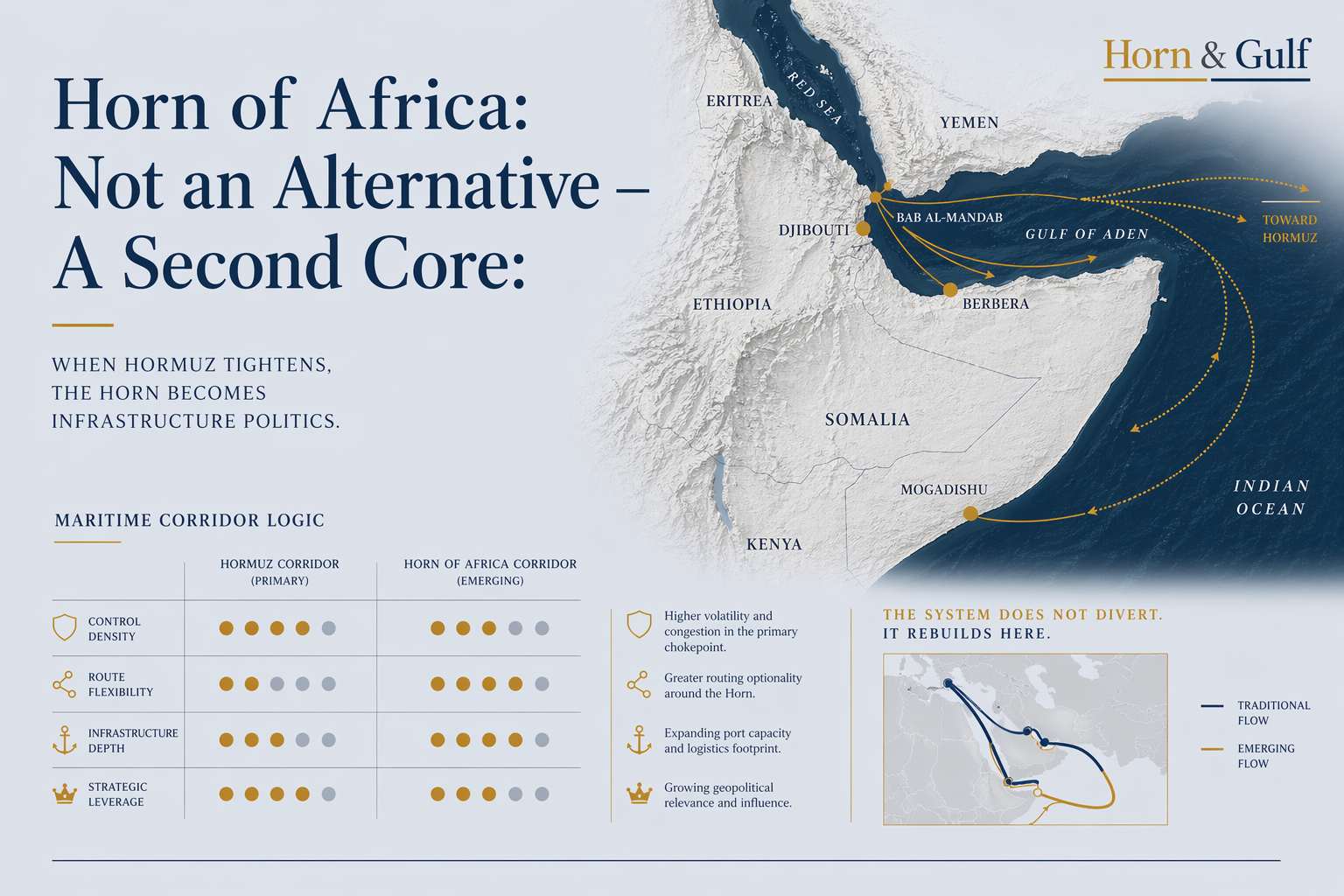
From Djibouti down through Berbera and across the Bab al-Mandab into the Gulf of Aden, a parallel set of assets begins to carry more weight. Ports that were once primarily logistical endpoints are increasingly embedded in strategic calculations. Their relevance is no longer defined by throughput alone, but by their position within a network that is absorbing redirected risk.
This is not a shift from one route to another. It is the emergence of a layered maritime system, where multiple corridors operate simultaneously under different risk, cost and governance conditions.
From Legal Debate to Corridor Control
As passage through Hormuz becomes more conditional, the legal frameworks that once underpinned maritime stability are themselves pulled into the field of negotiation. Freedom of navigation is no longer simply a principle; it is a variable that can be interpreted, contested and selectively enforced.
At the same time, the competition to shape alternative maritime pathways is becoming more explicit. What appears on the surface as overlapping engagements in Yemen or along the Red Sea coast is, at a deeper level, a divergence in how states design redundancy into the system. Some seek to secure direct export continuity. Others invest in distributed port networks that extend influence across multiple nodes.
Overlaying this is a broader structural shift: the gradual erosion of the long-standing assumption that security guarantees alone can stabilize energy flows. In its place, a more fragmented landscape is emerging — one in which actors hedge across corridors, diversify risk exposure and embed flexibility into their logistical and political alignments.
Market Signals: Real-Time Confirmation of Structural Shift
The real-time data layer reinforces this structural reading.
Ship diversions, insurance repricing and contractual tensions are not isolated reactions. They are measurable indicators of a system redistributing load. As certain passages become more conditional, others are not simply used more. They are re-evaluated, renegotiated and, in some cases, politically redefined.
Beyond Alternative Routes: The Horn as Infrastructure Politics
This is why the Horn cannot be understood as a fallback route.
It is becoming a space where infrastructure, diplomacy and security converge in new ways. Djibouti’s stability, Somaliland’s evolving status, the operational relevance of ports like Berbera, and the persistent strategic importance of the Bab al-Mandab are all expressions of the same process: the system seeking equilibrium under pressure.
When Hormuz tightens, the adjustment does not occur through a single bypass. It unfolds through a network. And in that network, the Horn of Africa is no longer at the edge. It is one of the places where the rules are being rewritten.
Conclusion: From Chokepoint to System Logic
The implication is not that the center has shifted from the Gulf to the Horn. It is that the distinction between center and periphery is eroding. What used to be seen as separate theatres are now functionally integrated.
Hormuz is not just a chokepoint under stress. It is a mechanism that transmits that stress across the system.
And the Horn is where part of that stress is now being absorbed, negotiated and, increasingly, structured into something more permanent.