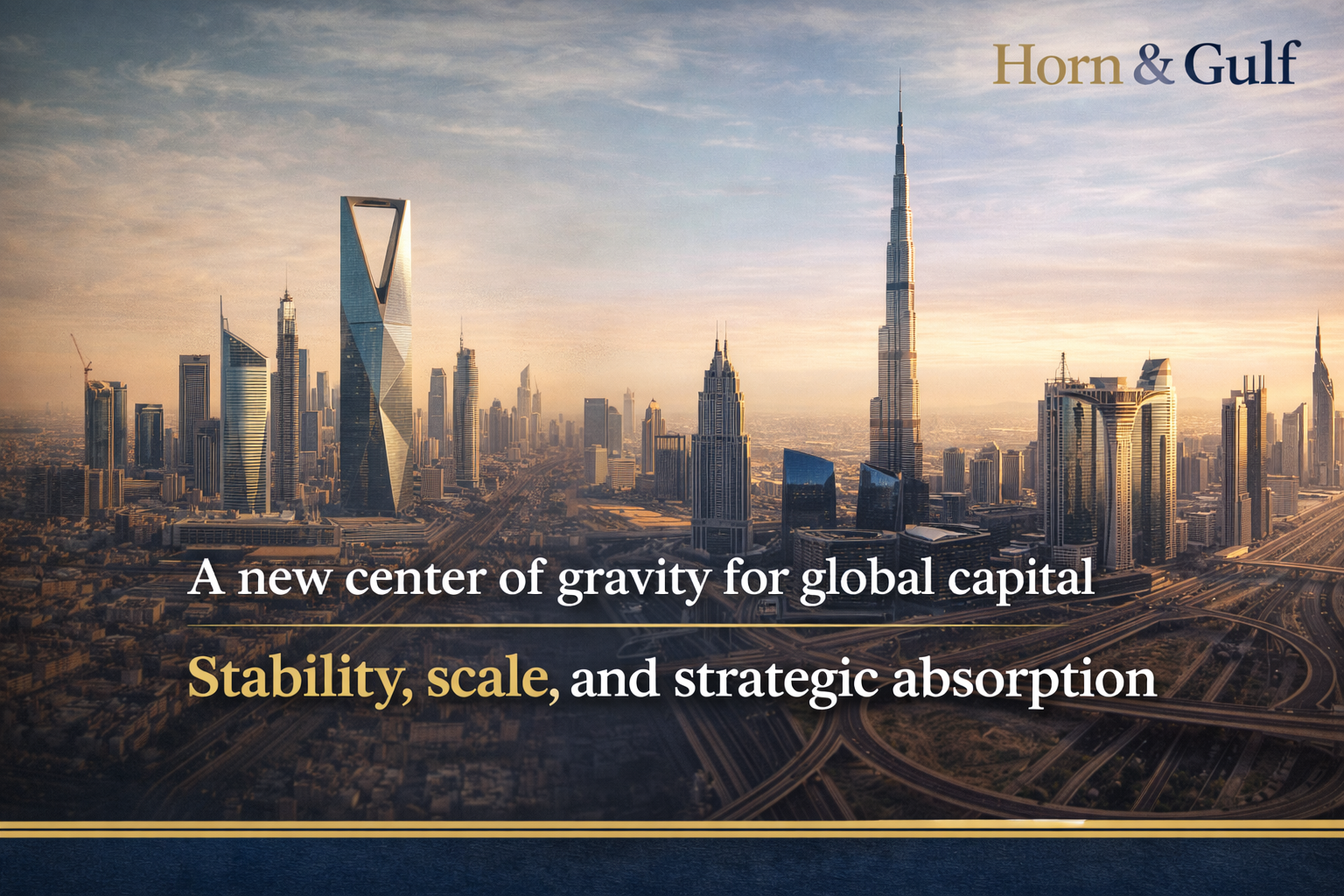
Dubai and Riyadh have emerged as two of the most powerful destinations for global capital in recent years. Flows are coming from multiple directions — Europe, Russia, Asia, and increasingly from within the region itself. The drivers are clear: political stability, currency anchoring, tax efficiency, and a regulatory environment that prioritizes continuity in a world defined by fragmentation.
But capital does not move randomly. It moves with intent — and increasingly, it is moving toward structure.
The Gulf today is not just attracting capital. It is absorbing it with a level of coordination and scale that is beginning to reshape regional markets. Dubai has positioned itself as a global liquidity hub, where capital can enter, circulate, and, when needed, exit with efficiency. Riyadh, by contrast, is building something more structural — an environment where capital is not only deployed, but embedded into the domestic economy through large-scale projects, sector development, and long-term planning.
This dual model creates a unique advantage. One system optimizes for movement. The other optimizes for anchoring. Together, they form a regional architecture that is increasingly capable of both attracting and retaining capital.
For investors, the appeal is not difficult to understand. In a global environment shaped by sanctions, policy divergence, and recurring shocks, the Gulf offers a rare combination: stability without stagnation, and growth without systemic fragility. Capital is not simply seeking returns — it is seeking environments where those returns can be sustained.
This is particularly visible in real estate and financial markets. In Dubai, property has evolved beyond a local asset class into a global store of value, driven as much by international demand as by domestic fundamentals. In Riyadh, capital is being directed into sectors that are designed to generate long-term economic capacity. These are not parallel trends; they are complementary layers of the same system.
At the same time, scale introduces a new dimension. As capital flows increase, markets begin to reflect not only underlying fundamentals, but also the dynamics of liquidity and positioning. This is not a sign of weakness. It is a signal of maturity. The transition from a peripheral market to a central one always brings greater visibility, greater participation, and, inevitably, greater complexity.
The Gulf is now entering that phase.
What matters, therefore, is not whether the region is a safe haven. That question has largely been answered by the behavior of capital itself. The more relevant question is how this scale is managed — how liquidity is absorbed, how assets are priced, and how growth is translated into durable economic structures.
This is where the distinction between passive inflow and strategic absorption becomes critical. Dubai continues to operate as a high-efficiency node for global capital flows. Riyadh is increasingly focused on transforming those flows into long-term economic assets. Together, they represent a system that is evolving beyond simple capital attraction toward capital design.
From a Capital & Risk perspective, the Gulf is no longer just a destination. It is becoming a framework — one that links geopolitics, capital allocation, and real asset development into a single, integrated model.
What we are seeing is not simply the emergence of a safe haven.
It is the rise of a system that is learning how to carry capital at scale — and shape what that capital becomes.