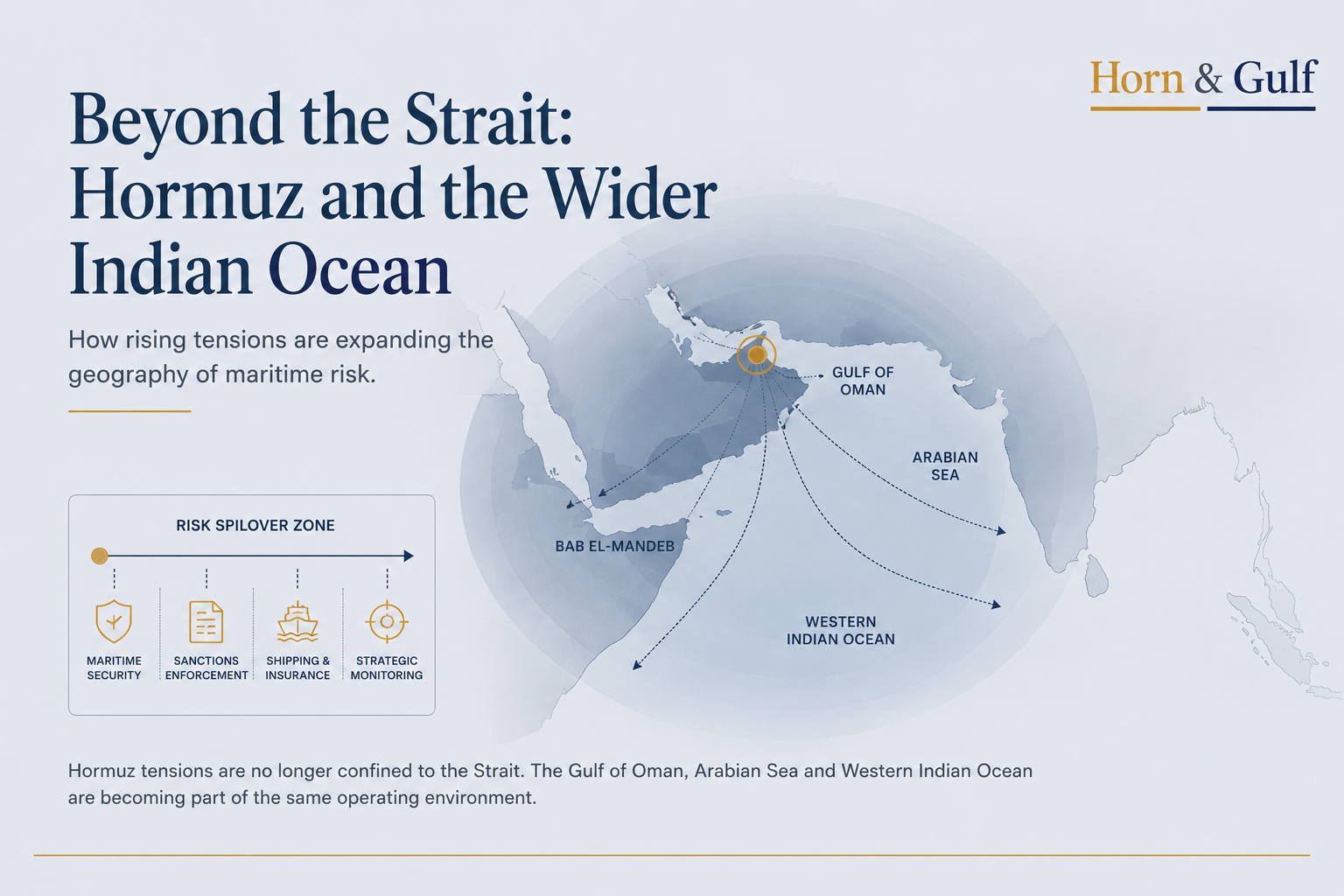
Indian Ocean security risks are becoming a more important part of the Hormuz debate. While the Strait remains the focal point of energy security concerns, recent developments suggest that maritime risk, insurance exposure and security activity increasingly extend into the Gulf of Oman, Arabian Sea and wider Western Indian Ocean.
The Strait of Hormuz is usually discussed in narrow terms: oil, LNG, tanker traffic and the risk of military escalation in the Gulf.
That remains the starting point. But it is no longer the whole map.
Recent developments point to a wider operating environment. Naval encounters in the Gulf of Oman, sanctions-related vessel activity in the Arabian Sea, growing insurance concerns and closer scrutiny of shadow-fleet tankers show that the effects of Hormuz tensions are not always contained inside the Strait.
The geography of risk is beginning to stretch.
This should not be overstated. A wider naval footprint does not automatically mean a new maritime order is forming. Crisis conditions often push military activity, enforcement measures and market attention beyond the original point of disruption.
Still, the pattern is worth watching. Hormuz may remain the trigger, but the operational space around it is larger than the chokepoint itself.
Beyond the Strait
Shipping companies already treat Hormuz and the Gulf of Oman as a linked risk environment. A delay near the Strait can affect scheduling, insurance, crew planning and port calls across a wider route.
The same applies to naval planners. When tensions rise, patrols, surveillance and escort calculations rarely stop at the exact boundary of the Strait. They extend into surrounding waters where commercial vessels, sanctioned cargoes and military assets may cross paths.
That is why the Western Indian Ocean matters.
The Gulf, Gulf of Oman, Arabian Sea and routes toward the Red Sea are often analysed separately. In operational terms, they are connected. A disruption in one zone can change behaviour across another.
The issue is not always rerouting. Sometimes it is simply hesitation, delay, higher insurance, darker vessel signals or closer monitoring.
Sanctions Enforcement Enters the Maritime Picture
One underappreciated dimension is the link between maritime security and sanctions enforcement.
Shadow-fleet tankers, sanctioned cargoes and vessels with unclear status do not move only near Iranian waters. They travel across long-distance routes. As a result, monitoring and interdiction activity can move further into the Indian Ocean.
This does not necessarily signal escalation by itself. It may reflect the practical challenge of tracking vessels that operate across multiple jurisdictions and often use opaque ownership, flagging and insurance arrangements.
But it changes the operating environment.
Commercial shipping, military surveillance, sanctions policy and insurance risk begin to overlap in the same maritime space. For vessel owners and insurers, this creates a more complicated calculation than a simple question of whether the Strait is open or closed.
Why the Western Indian Ocean Matters
The Western Indian Ocean links the Gulf to East Africa, South Asia and the Red Sea. It sits near several important maritime corridors, including Hormuz, Bab el-Mandeb and the approaches to the Mozambique Channel.
That geography gives the region strategic weight.
When pressure builds around Hormuz, the effects can travel into adjoining waters through insurance pricing, vessel monitoring, naval activity and risk perception. Even if cargo volumes remain stable, the cost of uncertainty can widen.
This is where the debate becomes more important than the headline question of closure.
A closed Strait would be a major crisis. But even without closure, sustained insecurity can alter behaviour. Ships may wait. Insurers may raise premiums. Governments may expand patrols. Companies may reassess exposure to routes that previously felt routine.
The maritime system does not need to break in order to become more expensive to operate.
A Case for Caution
There is a strong counterargument.
Analysts often widen the map during crises. A few incidents can quickly become part of a larger narrative about regional transformation. Maritime history is full of disruptions that created temporary alarm but did not permanently change shipping geography.
The current focus on the Indian Ocean may therefore reflect heightened attention rather than structural change.
That possibility matters. The evidence supports a widening of risk awareness. It does not yet prove that the security architecture of the Indian Ocean is being remade.
The more disciplined reading is narrower: Hormuz-related tensions are encouraging states, insurers and shipping operators to look beyond the Strait when they assess maritime risk.
That is not a revolution. It is still strategically important.
What to Watch
The next indicators will matter more than the current language around the crisis.
If vessel traffic normalises, insurance premiums fall and naval activity contracts, the Indian Ocean dimension may remain a temporary feature of escalation.
A stronger signal would emerge if shipping advisories begin to cover wider areas more consistently, if insurers maintain elevated pricing outside Hormuz, or if sanctions-related interdictions become more frequent across the Arabian Sea and Western Indian Ocean.
Port data could also matter. Salalah, Duqm, Djibouti and other regional nodes may become useful indicators of how companies manage uncertainty around Gulf-linked trade.
For now, the evidence points to wider risk awareness rather than confirmed structural transformation.
Conclusion
Hormuz has not stopped being a Gulf issue. But it is becoming harder to understand it only as a Gulf issue.
The Strait remains the trigger point. The operational consequences increasingly touch a wider maritime space: the Gulf of Oman, the Arabian Sea and parts of the Western Indian Ocean.
For shipping companies, insurers, naval planners and governments, the relevant question is no longer only whether vessels can pass through Hormuz.
It is how far the risk environment around Hormuz extends.
That answer remains incomplete. But the direction of the question has changed. Understanding Hormuz now requires looking beyond Hormuz.