
Saudi retaliation in Yemen entered a new phase after the coalition publicly identified four strategic targets but did not immediately follow with military action. Instead, the following day produced one of the deadliest reported engagements in years, raising broader questions about deterrence, Red Sea security and the limits of Riyadh’s current strategic leverage.
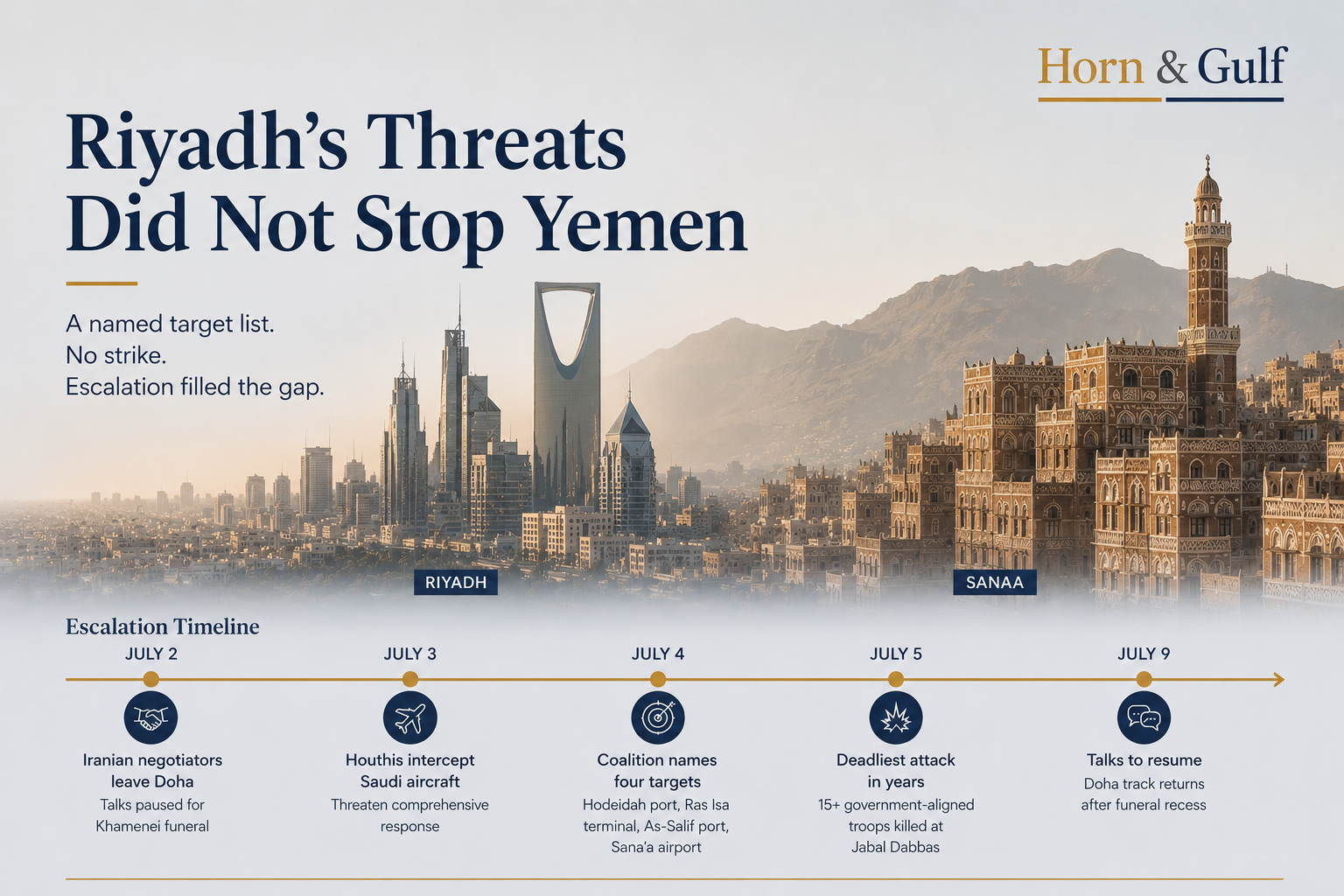
On July 4, the Saudi-led coalition supporting Yemen’s government named four specific facilities as targets for retaliation. It vowed to respond “with unprecedented determination and force”: Hodeidah port, the Ras Isa oil terminal, As-Salif port, and Sana’a International Airport. A named target list normally functions as a deterrent: it marks infrastructure for consequence and prices aggression in advance. Less than a day later, Houthi forces struck the same governorate the coalition had just marked. They killed at least fifteen government-aligned troops at Jabal Dabbas, in an assault one pro-government officer called the deadliest in years. No coalition airstrike has followed. The list did not prevent escalation. Escalation happened inside the window the list should have closed.
A Named Target List Was Followed by an Escalation, Not a Strike
The sequence began on July 3. Houthi forces said they intercepted Saudi aircraft attempting to block an Iranian civilian flight from landing in Sana’a. They threatened a “comprehensive response” against Saudi airports and vital interests, on land and sea. The coalition’s answer on July 4 was specific rather than general. Riyadh’s coalition spokesman named the same four facilities Israel had struck in a prior operation. That specificity is what makes the following day’s silence analytically significant. A vague threat that goes unanswered is unremarkable. A named target list that goes unfollowed by action is a different kind of signal — especially one day before the named province produced the conflict’s deadliest single engagement in years. It may suggest to institutional observers that public signalling and operational response have become less closely aligned during the current escalation cycle.
The Funeral Recess Is Doing the Escalating
None of this is happening inside the channel meant to manage it. Iranian negotiators left Doha on July 2 as Tehran entered a six-day funeral period for Ayatollah Khamenei. Qatar’s foreign ministry has said the next round of US-Iran talks will happen only after the processions conclude around July 9. The Doha track exists to manage Hormuz — shipping routes, frozen funds, the mechanics of de-escalation between Washington and Tehran. The track does not cover Yemen. Its recess has coincided, not by design but by consequence, with the most active week the Yemen file has had in months. The mediating architecture that might otherwise absorb shocks elsewhere in the region is simply offline for this one. That is the exact moment this file needed it most.
A Red Sea Pivot Built on a Lever Riyadh Doesn’t Hold
Saudi Arabia’s exposure here is structural rather than incidental. Riyadh is not a party to the Doha talks. Washington and Tehran run that track bilaterally, through Qatari and Pakistani mediation. Public coalition statements have become the most visible instrument of deterrence during the current phase. This would matter less if Saudi Arabia’s economic strategy still centered on the Gulf side of the peninsula. It does not. The kingdom’s post-Hormuz portfolio diversification toward Red Sea infrastructure is a considered response to Hormuz’s unreliability during the wider conflict with Iran. That diversification includes new port capacity, industrial zones along the western coastline, and a planned shift of crude export volume toward Yanbu. But that diversification increases Riyadh’s dependence on a corridor where its primary lever is words, not shipping escorts or negotiating seats. The westward pivot creates a different category of strategic exposure whose long-term management remains uncertain.
Yemen’s Verification Layer Expired in March
A second structural gap compounds the first. UNMHA, the UN mission on the Hodeidah front, maintained liaison officers on both sides and could cross-reference casualty and violation claims from each side. Its mandate expired on March 31, 2026, without renewal. Every count moving through this cycle now arrives without the independent verification layer that used to slow the exchange of claims. That includes the fifteen deaths reported at Jabal Dabbas. This is not a detail. A threat becomes cheaper to make when the cost of an unverified claim falls. An escalation becomes easier to justify retroactively when no neutral body stands ready to say otherwise. The absence of UNMHA does not cause the escalation. It removes the friction that once gave both sides a reason to pause before the next statement.
The Horn Is Quiet on a Slower Clock, Not a Calmer One
The Horn of Africa produced no comparable event in the same seven-day window. That absence is itself worth noting, not dismissing. Ethiopia’s pursuit of Red Sea access, the unresolved tension over Assab, and Sudan’s civil war are all compounding on a slower clock than the Yemen-Saudi file. The underlying pressure has not eased. None of those disputes has a trigger event comparable to a funeral recess or a named target list. Reading the Horn’s quiet week as stability would mean mistaking tempo for calm. The two axes share a corridor: the Red Sea and Bab al-Mandab together. A shock on the Yemen side could still materialize — the coalition has threatened an airstrike but withheld it so far. That shock would land on a Horn-side risk picture that has been accumulating rather than resolving.
What Institutional Positioning Should Price In Now
Sovereign wealth funds and institutional investors carrying Red Sea and Bab al-Mandab exposure should note one operative fact. The US-Iran “quiet week” understanding on Hormuz has no bearing on the Yemen-Saudi file. That file is running on its own clock and has already produced the year’s highest reported single-incident casualty count. Premiums keyed only to Hormuz-track headlines will misprice this exposure by treating two independent escalation cycles as one.
For Gulf policy planners, the absence from the Doha table is not specific to this funeral recess. It recurs by design every time US-Iran diplomacy enters a pause that Yemen’s file is not bound by. It will recur again the next time Doha stands down for reasons that have nothing to do with Yemen.
Creditor institutions and infrastructure investors with Horn of Africa exposure should read this week’s quiet as unpriced accumulation, not resolved risk. A Gulf-side event on the Yemen coast would transmit directly through the shared Bab al-Mandab corridor.
The absence of an immediate follow-on strike complicates interpretations that the target announcement alone restored deterrence. They may indicate that public signalling and operational timing have not moved in parallel during this phase of the conflict. That gap — not the funeral pause itself — is what institutional readers should be pricing.