Dubai air traffic surge is not only a sign of rising passenger demand. It shows how global aviation flow continues to concentrate around efficient hubs such as DXB.
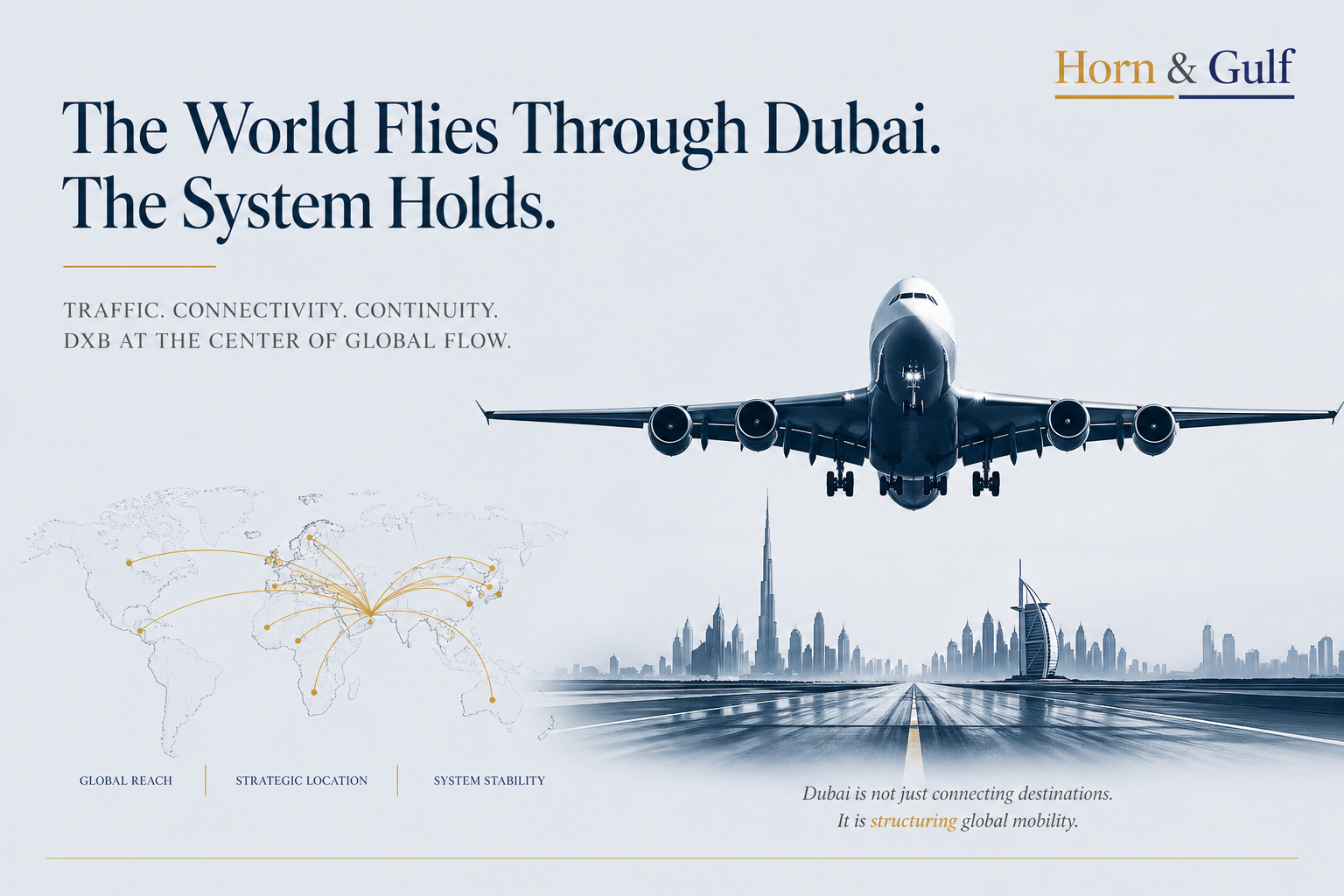
The image circulating online suggests a simple story: planes are back, the skies are full, and Dubai is once again at the center of global aviation. That interpretation is not wrong. But it is incomplete.
What we are seeing is not just a rebound in passenger traffic. It is a structural reassertion of Dubai’s role inside the global mobility system — one that never truly disappeared.
From Recovery Narrative to System Continuity
It is tempting to frame current air traffic levels as a post-crisis recovery. The numbers seem to support that instinct.
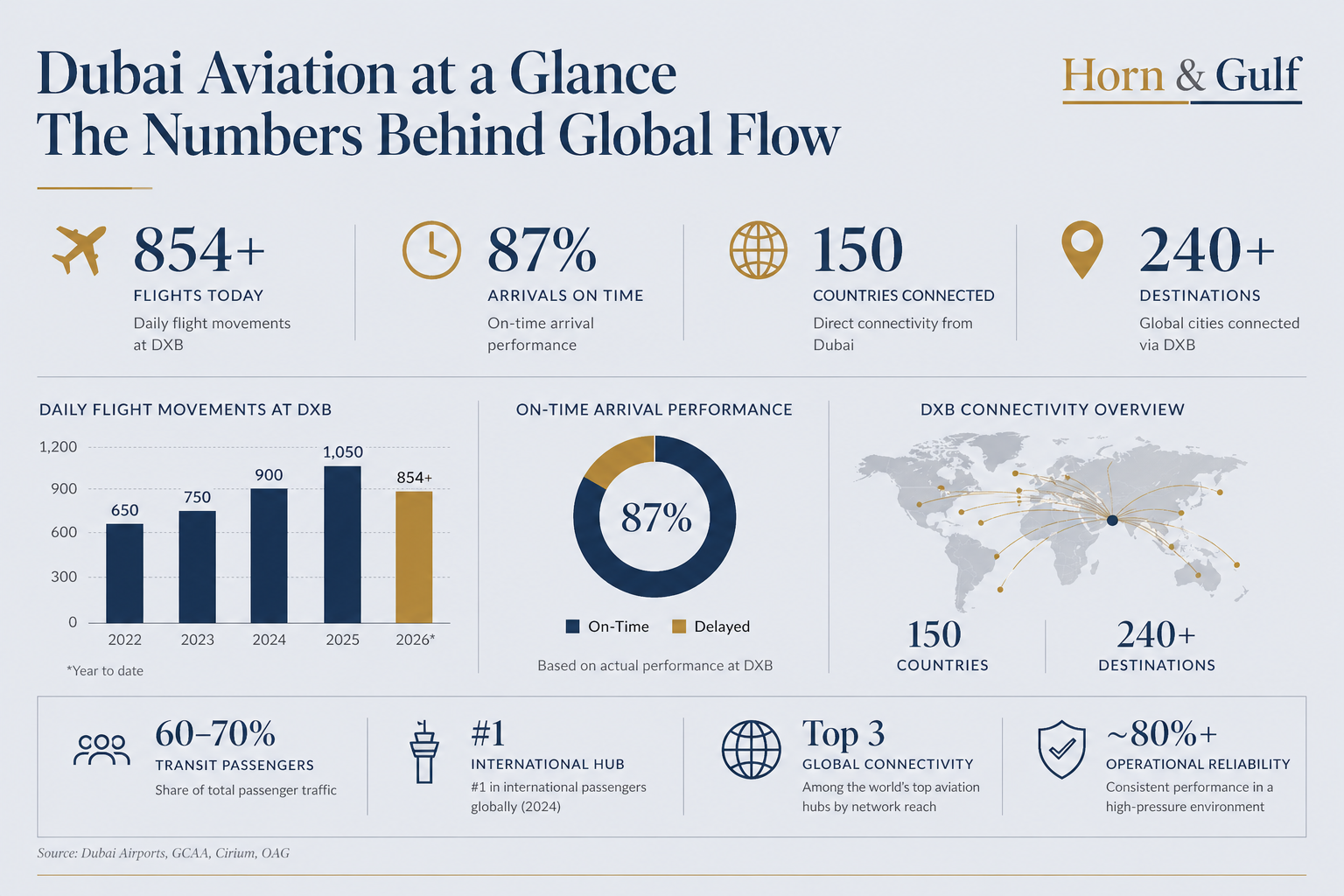
Dubai International Airport handles roughly 900 to 1,100 daily flight movements, with peaks exceeding that range during high-demand periods. On-time arrival performance, often cited around 80–87%, remains within the upper tier of global aviation hubs. The airport connects to over 240 destinations across more than 100 countries, maintaining one of the widest international networks in operation.
These figures are not exceptional because they are new. They are significant because they are consistent. Dubai did not “come back.” It continued.
The Geography of Flow: Why Dubai Holds
Air traffic does not distribute itself evenly across the globe. It concentrates around nodes that reduce friction — geographic, regulatory, and operational. Dubai sits at the intersection of three high-density corridors:
- Europe ↔ Asia
- Asia ↔ Africa
- Europe ↔ Africa
This positioning allows airlines, particularly Emirates, to operate a hub-and-spoke model at scale, capturing transit flows that bypass more fragmented regional systems. Unlike point-to-point networks, this model thrives on concentration.
Volume is not a byproduct. It is the mechanism. As long as global mobility remains intercontinental and time-sensitive, the logic holds.
More Flights, Same System
The visual density of aircraft over the Gulf can create the impression of sudden acceleration. In reality, it reflects something more stable: load returning to an already existing system architecture.
Daily flight counts approaching or exceeding four digits are not anomalies for Dubai International Airport. They are within its designed operational envelope.
The same applies to connectivity. While social media claims often exaggerate reach — citing “150 countries” — the verified figure sits closer to 100–110 countries, which is still among the highest globally.
The distinction matters. Not because the system is weaker than portrayed, but because it is already operating near its intended capacity.
Operational Stability in a High-Pressure Environment
Sustaining ~80%+ on-time performance at this scale is not trivial. It reflects a layered system:
- coordinated airspace management under General Civil Aviation Authority
- centralized airport operations by Dubai Airports
- airline-level integration, particularly from Emirates
This is where Dubai differentiates itself. Not in peak numbers, but in consistency under load.
In an environment where global aviation remains exposed to weather, geopolitics and capacity constraints, predictability becomes a competitive advantage.
Transit, Not Destination
A large share of Dubai’s air traffic is not origin or destination-based. It is transit. Estimates consistently place transit passengers at 60–70% of total flow. This means the system’s health is tied less to local demand and more to global route dependency.
Passengers are not choosing Dubai as an endpoint. They are passing through it because the system routes them that way.
This distinction reinforces the core idea: Dubai is not just participating in global aviation. It is structuring parts of it.
What the Surge Actually Signals
The current density in UAE airspace is often read as a sign of demand returning. That is only partially true. The deeper signal is this:
- global travel demand remains strong
- long-haul connectivity is still central to the system
- and the network continues to concentrate around efficient hubs
Dubai benefits from all three.
Implication: A Hub That Does Not Need Reinvention
Many global cities are trying to rebuild aviation relevance after disruption. Dubai does not face that challenge in the same way. Its role is already defined:
- a transit hub
- a connector of continents
- a stabilizer in a fragmented network
The numbers confirm it, but they do not explain it. The explanation lies in structure. And that structure, for now, remains intact.