Dubai Residential REIT performance in Q1 2026 is more than a property market update. It shows how Dubai’s residential market is shifting from rapid expansion toward income stability, high occupancy and institutional maturity.
The Q1 2026 performance of Dubai’s residential REIT does not read like a typical earnings release. It reads like a system check.
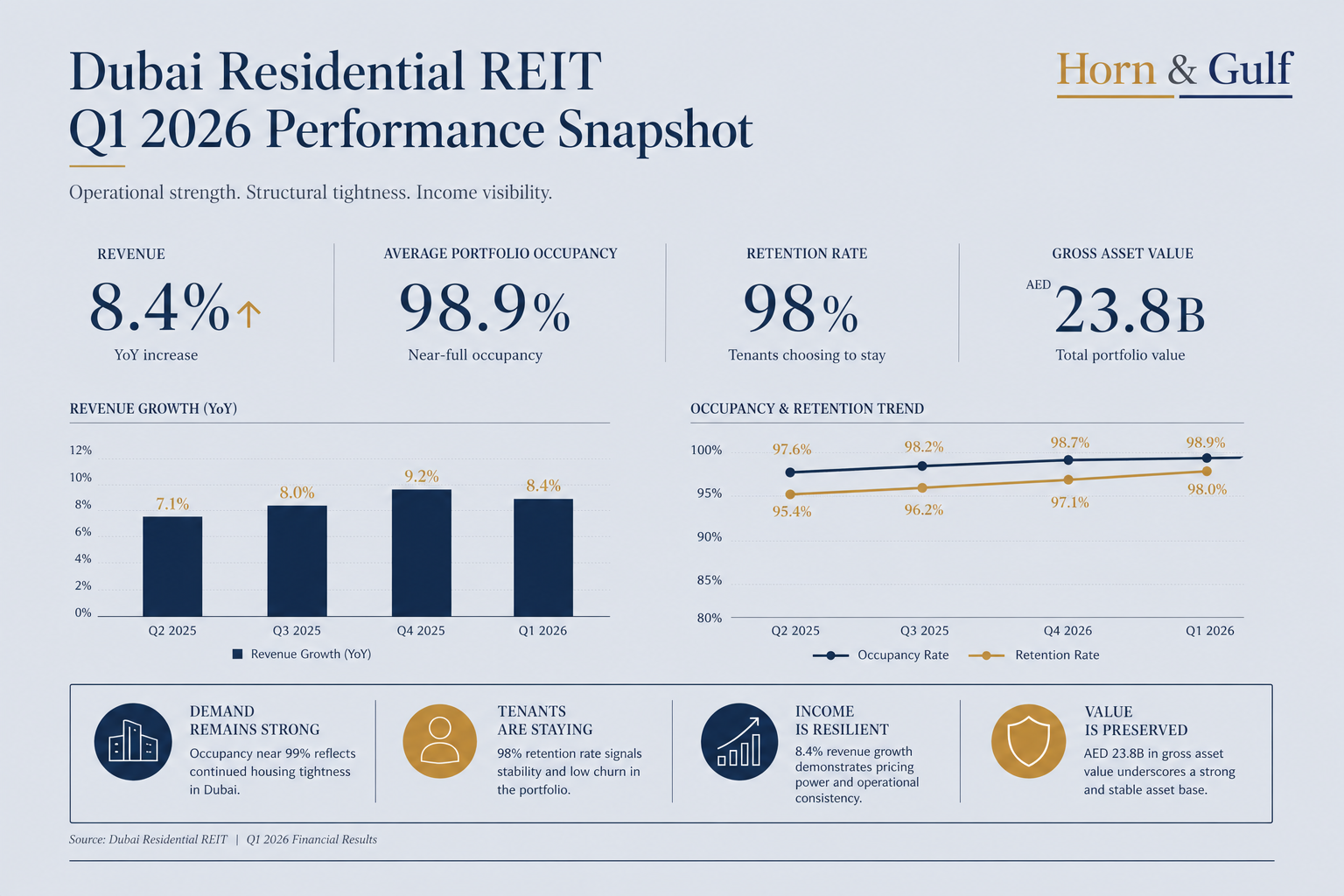
Revenue is up 8.4% year-on-year. Occupancy sits at 98.9%. Retention is at 98%. Gross asset value holds above AED 23 billion.
None of these numbers are extreme. That is precisely the point. This is not acceleration. This is stability under pressure.
High Occupancy Is No Longer Growth — It Is Structural Tightness
A market operating at nearly 99% occupancy is not expanding. It is constrained. At this level, vacancy stops being a variable. It becomes irrelevant. The system has no slack. In most global cities, occupancy fluctuates with cycles. In Dubai, it is holding at the ceiling.
That tells us something simple: Demand is not chasing opportunity. Demand is chasing availability. And availability is limited.
Retention at 98% Means Movement Has Stopped
A 98% retention rate is not just strong. It is abnormal. It suggests tenants are not rotating. They are staying. Not because they prefer to stay — but because moving has become inefficient:
- rents are higher elsewhere
- supply is fragmented
- transaction friction is real
In other words, the market is no longer fluid. It is locked.
Revenue Growth Is Slowing — But That Is the Signal
An 8.4% increase in revenue would have looked modest two years ago. Today, it is meaningful. Because it comes after a cycle where prices moved aggressively. What we are seeing now is not a slowdown driven by weakness. It is normalization driven by saturation.
The system is no longer repricing. It is absorbing.
Asset Values Holding Is the Real Anchor
With gross asset value above AED 23 billion, the REIT is not just generating income. It is preserving valuation. That matters more than growth. In volatile environments, assets either reprice or hold. Holding is strength. Especially when external conditions — rates, geopolitics, liquidity — are not neutral.
This Is Not a Boom Market Anymore — It Is an Income System
Put together, these metrics describe a transition. Dubai residential real estate is no longer in a discovery phase.
It is in a yield phase. The characteristics are clear:
- high occupancy
- low tenant churn
- steady income growth
- stable asset base
This is what institutional capital looks for. Not upside. Predictability.
The System Is Tight, Not Fragile
There is a tendency to read high occupancy and high retention as signs of overheating. That would be a misread. Overheated markets show volatility — sharp price moves, rising vacancies, forced turnover. This system shows none of that. It is tight, but it is not breaking.
Implication: Dubai Is Moving From Expansion to Control
This is the real takeaway. Dubai’s residential market is no longer expanding outward. It is consolidating inward. Control is shifting:
- from developers to operators
- from pricing to occupancy
- from speculation to income
That shift is subtle, but structural.
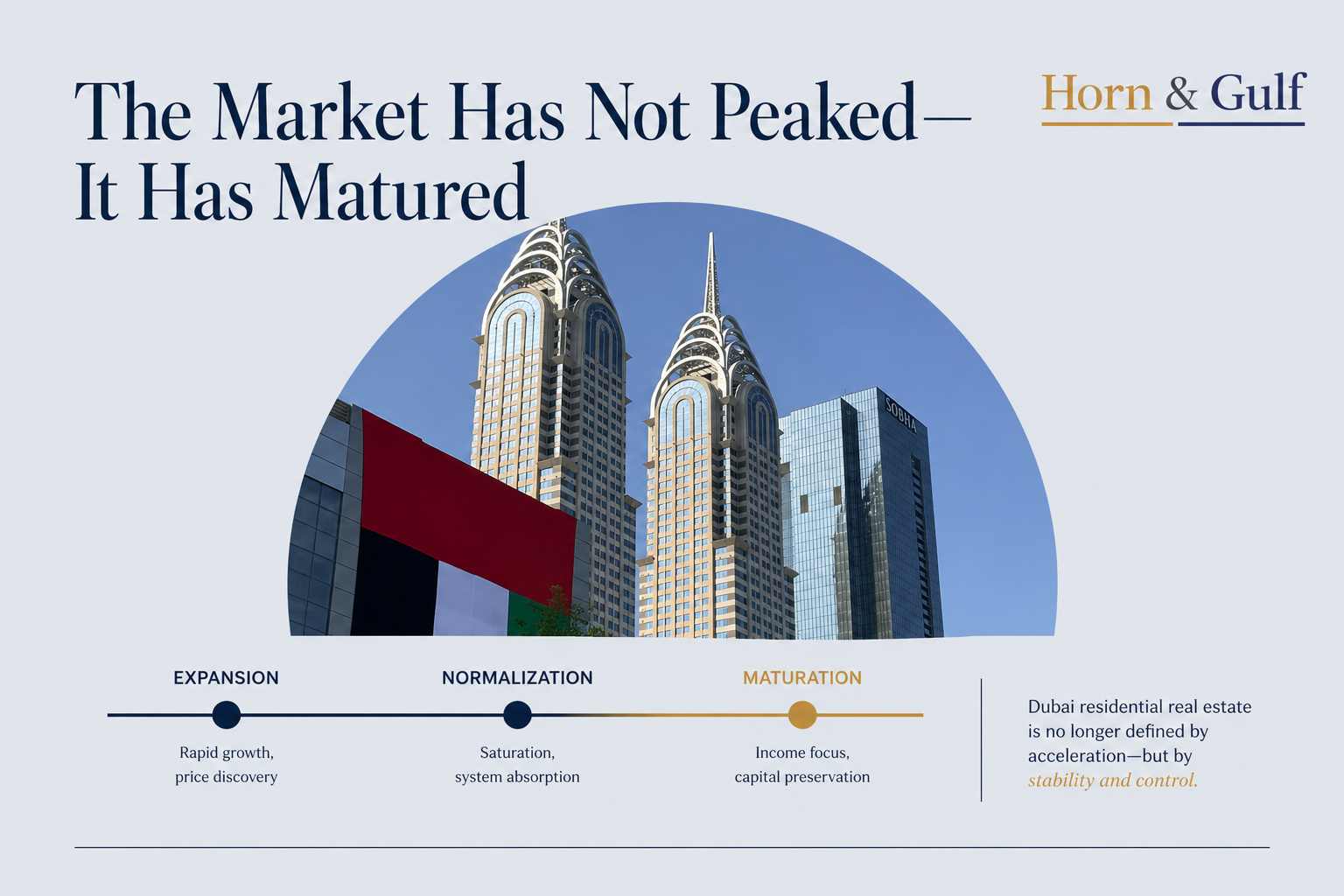
The Market Has Not Peaked — It Has Matured
The REIT data does not signal a top. It signals a phase change. The easy gains of rapid appreciation are behind. What remains is a system designed to hold value and generate cash flow. For investors, that changes the question.
Not “How fast can this grow?”
But “How reliably can this perform?”
And in Q1 2026, the answer is clear. It performs.