
Yemen red sea control layer dynamics are no longer theoretical. Yemen is becoming the strategic hinge between Hormuz and the Red Sea, reshaping Gulf rivalry, maritime logistics and global trade flows.
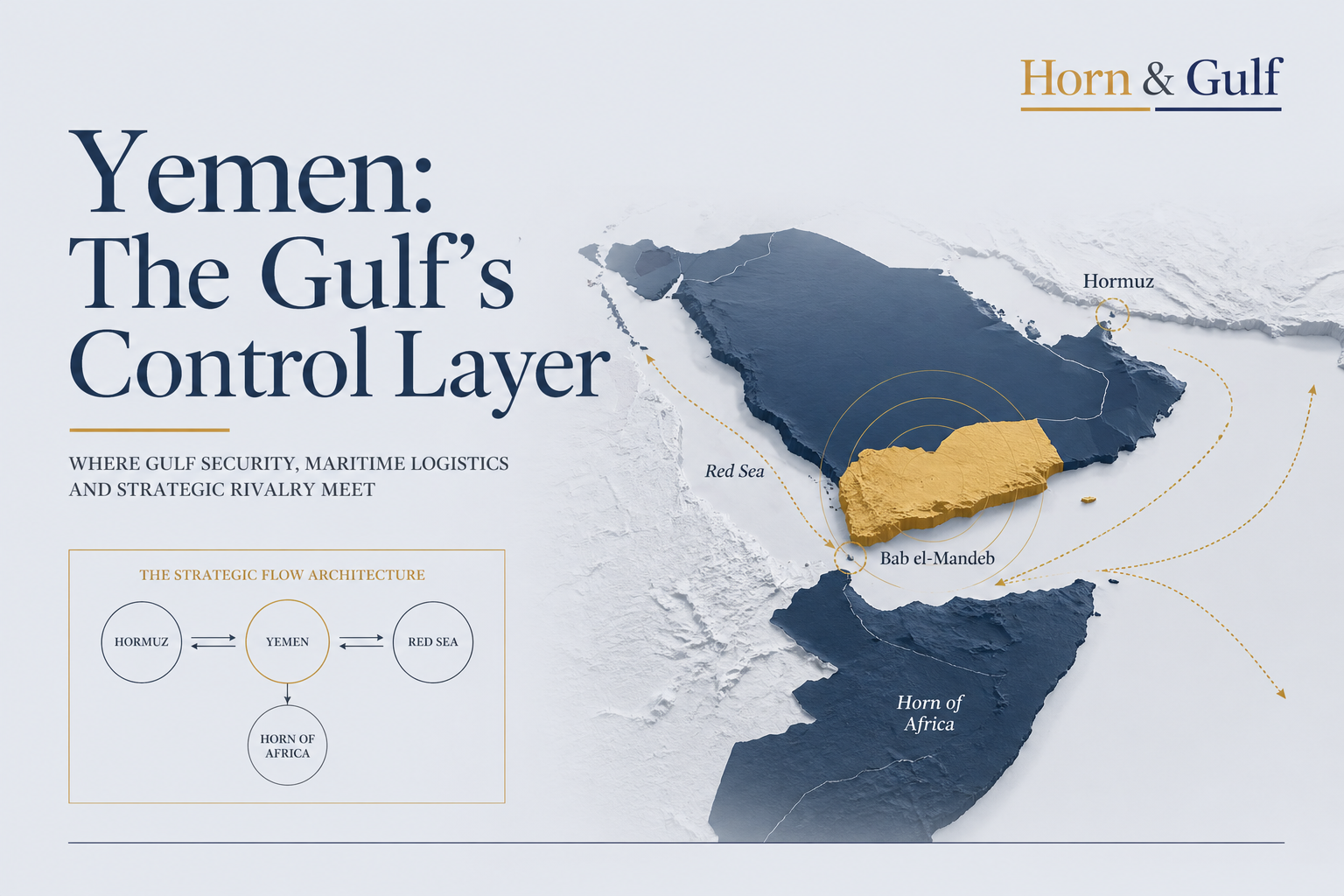
There was a time when Yemen was treated as the southern edge of Gulf politics — unstable, distant, and largely reactive. That frame no longer holds.
Yemen is not the periphery of Gulf politics anymore. It is the place where Gulf security, maritime logistics and strategic rivalry now meet.
What appears on the surface as a fragmented civil war is, underneath, a structural contest over how flows — of oil, goods, security and influence — are organized between the Strait of Hormuz, the Bab el-Mandeb, and the wider Red Sea system. This is no longer about territory. It is about control.
From Buffer Zone to System Node
For decades, Saudi Arabia approached Yemen as a security problem. The objective was straightforward: prevent instability from spilling north. Borders, militias, insurgencies — Yemen was a shield to be stabilized. But the regional system has shifted.
The vulnerability of Hormuz — where a significant share of global energy flows — has forced a strategic rethink. Reliance on a single chokepoint is no longer viable in a world of recurring disruption, proxy escalation and maritime risk. Yemen, in this context, is no longer just a borderland. It sits at the hinge of an alternative geography:
- South of Saudi territory
- Adjacent to Bab el-Mandeb
- Connected to Red Sea routes
- Facing the Horn of Africa
It has become a system node — a place where alternative corridors can be enabled or blocked.
Two Gulf Strategies, One Geography
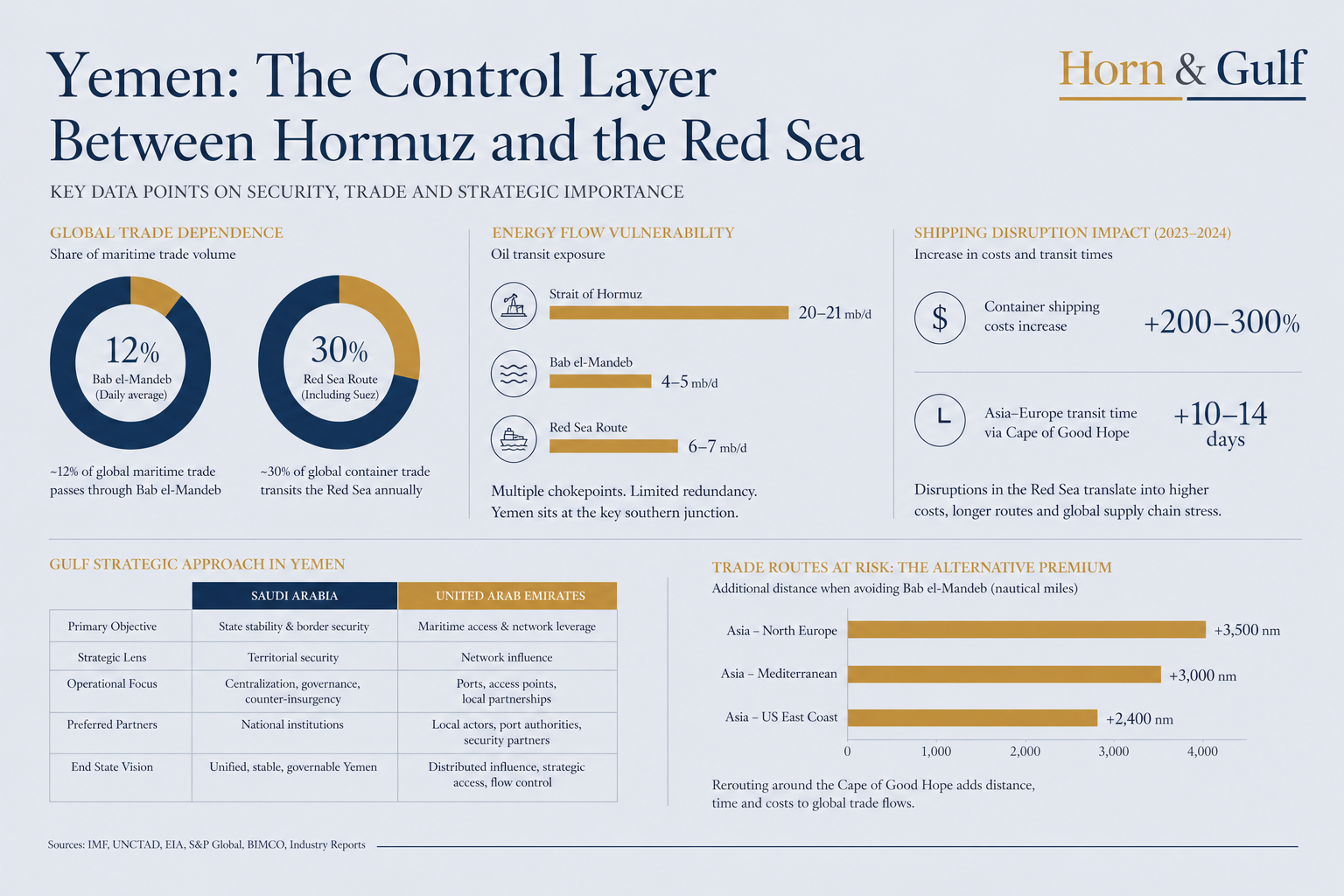
The divergence between United Arab Emirates and Saudi Arabia becomes clear when seen through this lens. Saudi Arabia still leans toward state consolidation. Its priority is a governable Yemen — predictable, centralized, and aligned with its security needs. Stability is the objective, because instability carries direct cost.
The UAE operates differently. Abu Dhabi needs functional access points — ports, local partners, coastal influence. Its strategy is not territorial; it is network-based.
From southern Yemen to the Horn of Africa, the UAE has spent years building a maritime influence architecture. Not through formal control, but through connectivity, logistics, and security partnerships.
This is the key distinction:
- Saudi Arabia seeks order within borders
- The UAE builds control across flows
Yemen is where these models collide.
The Red Sea Is No Longer a Route
The Red Sea is often described as a trade corridor. That description is now outdated. It has become a control layer — a system where access, timing and security are actively managed.
Disruptions in recent years have made this clear. Shipping reroutes, insurance premiums, naval deployments — all signal a shift from passive transit to active control. The Red Sea is no longer just a passage; it is a space where power is exercised.
Yemen sits at its southern gate. Control of that gate does not require full sovereignty. It requires presence, partnerships and positioning. That is why southern Yemen — ports, coastlines, local authorities — matters disproportionately.
Hormuz, Contingency and Optionality
The strategic logic extends further. As risks around Hormuz fluctuate, Gulf states are quietly building optionality. Pipelines, inland corridors, Red Sea access points — all serve the same purpose: reduce dependency on a single chokepoint.
In this system, Yemen is not an isolated theater. It is part of a contingency architecture. If Hormuz is constrained, flows must adjust. If flows adjust, routes matter. If routes matter, control points become strategic assets. Yemen is one of those points.
Beyond Proxy War: A System-Level Rivalry
It is tempting to describe the Saudi–UAE dynamic in Yemen as a proxy competition. That misses the scale. This is not simply about influence over local actors. It is about how the Gulf organizes its external environment.
- Will security be built through centralized states?
- Or through distributed networks of ports, partners and corridors?
- Will control rely on borders?
- Or on access to flows?
Yemen is where these questions are no longer theoretical. They are being tested in real time.
The Horn of Africa Connection
Across the water, the Horn of Africa completes the picture. Ports in Eritrea, Somaliland, Djibouti — these are not peripheral assets. They are extensions of the same system. The Red Sea is not a line; it is a network.
The UAE has understood this early, linking both sides of the sea into a coherent maritime strategy. Saudi Arabia, historically more land-focused, is adapting. Yemen sits between them — not as a battlefield, but as a bridge.
A New Map of Gulf Power
The map of the region is changing, but not in ways that are immediately visible. Borders remain the same. States remain intact. But beneath that surface, a different structure is forming — one defined by flows, corridors and control layers.
In that structure:
- Hormuz is no longer sufficient
- The Red Sea is no longer passive
- Yemen is no longer peripheral
It is central.
Conclusion
What is unfolding in Yemen is not the end of a war. It is the emergence of a new system. A system where Gulf power is no longer measured by territory alone, but by the ability to shape movement — of energy, goods, and security — across interconnected corridors.
And in that system, Yemen is no longer the edge. It is the point where everything meets.