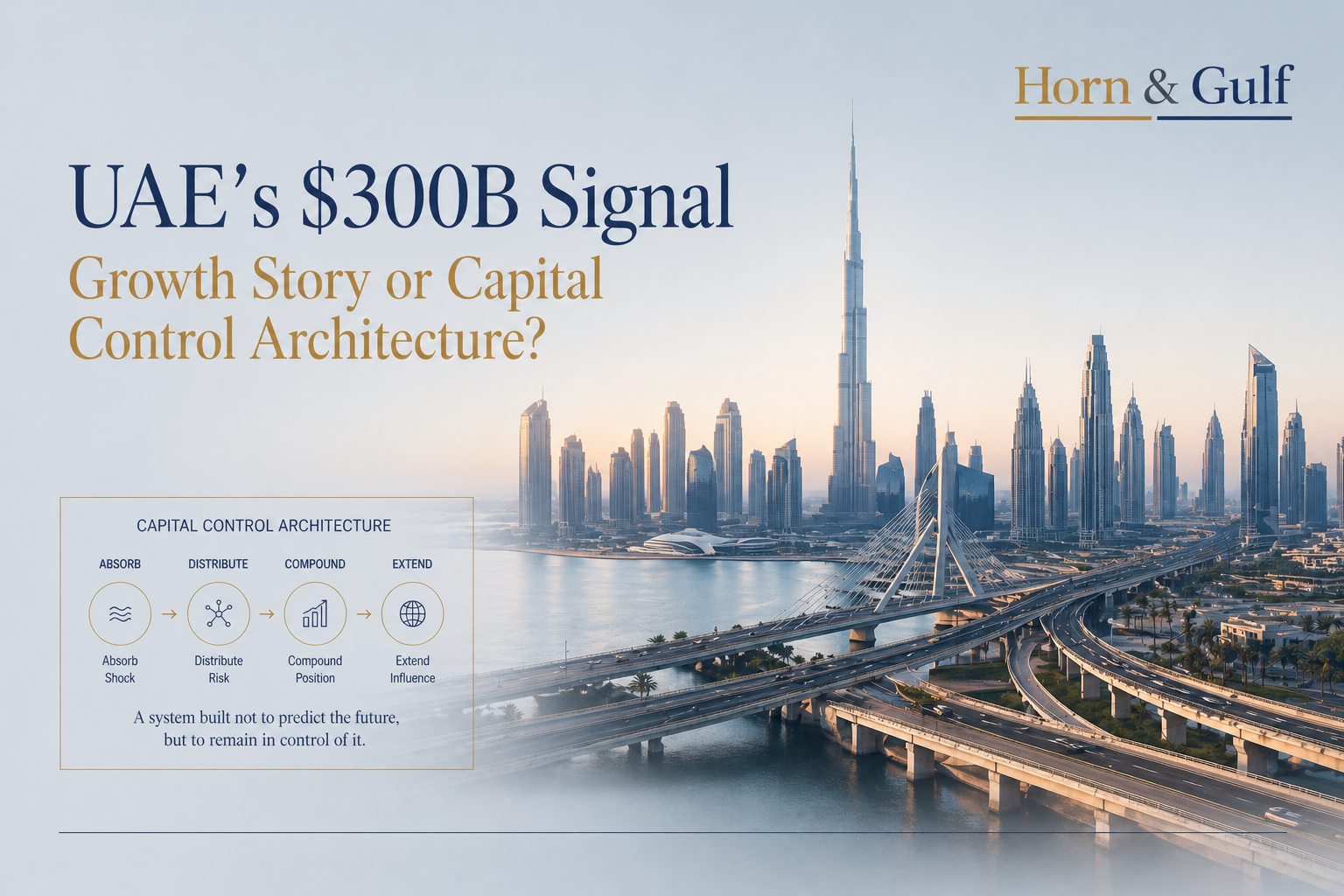
UAE capital architecture is no longer defined only by growth headlines. The country’s recent $300B project wave shows how infrastructure, sovereign capital, energy and technology are being used to build confidence under pressure.
The UAE Is Not Slowing Down — It Is Signaling Through Scale
In March and April 2026 alone, the United Arab Emirates announced projects exceeding AED 300 billion. The figures are striking: a major metro expansion in Dubai, a multi-billion AI ecosystem initiative, and continued global energy scaling through Masdar. At first glance, this reads like a familiar Gulf growth story — another cycle of expansion driven by capital and ambition.
But this is not a typical growth cycle.
These announcements are not simply about economic activity. They are signals — directed not inward, but outward — to global capital, to markets under stress, and to investors recalibrating risk across regions.
The question is no longer whether the UAE is growing. The question is what kind of system produces this kind of signal, especially under pressure.
Project Announcements Are Not Output — They Are Confidence Infrastructure
It is tempting to read AED 300 billion as immediate economic output. It is not. These are not cash flows deployed overnight, nor do they reflect short-term demand surges. They represent something more strategic: intent, direction, and credibility.
In uncertain environments, capital does not move toward growth — it moves toward clarity.
What the UAE is building, through these announcements, is a form of confidence infrastructure. A system where large-scale commitments — across transport, energy, and technology — create predictability in an otherwise volatile landscape.
This is why the composition of these projects matters more than their size. Infrastructure anchors internal stability. Energy secures long-term positioning. AI signals participation in future value chains. Together, they form a layered narrative: not expansion for its own sake, but structured continuity.
Diversification Is Not the Story — Risk Distribution Is
The standard narrative describes the UAE as diversifying beyond oil. That framing is outdated. What we are observing now is not diversification, but distribution.
Each sector being developed plays a role within a broader system of risk management. Infrastructure projects deepen domestic resilience. Sovereign investments extend influence across borders. Energy capacity ensures relevance across transition cycles. Technology initiatives position the country within future capital flows.
This is not a portfolio. It is an architecture. And architecture behaves differently from growth. It is not reactive to cycles — it absorbs them.
The Budget Does Not Define the System — The System Extends Beyond It
A federal budget in the range of AED 90 billion may appear modest relative to the scale of announcements. But focusing on the budget alone misses the structure entirely.
The UAE does not operate within a single balance sheet. Its economic system extends across sovereign wealth funds, government-linked entities, and a highly active developer ecosystem. Capital is not centralized — it is distributed across multiple channels that can move independently yet act in coordination.
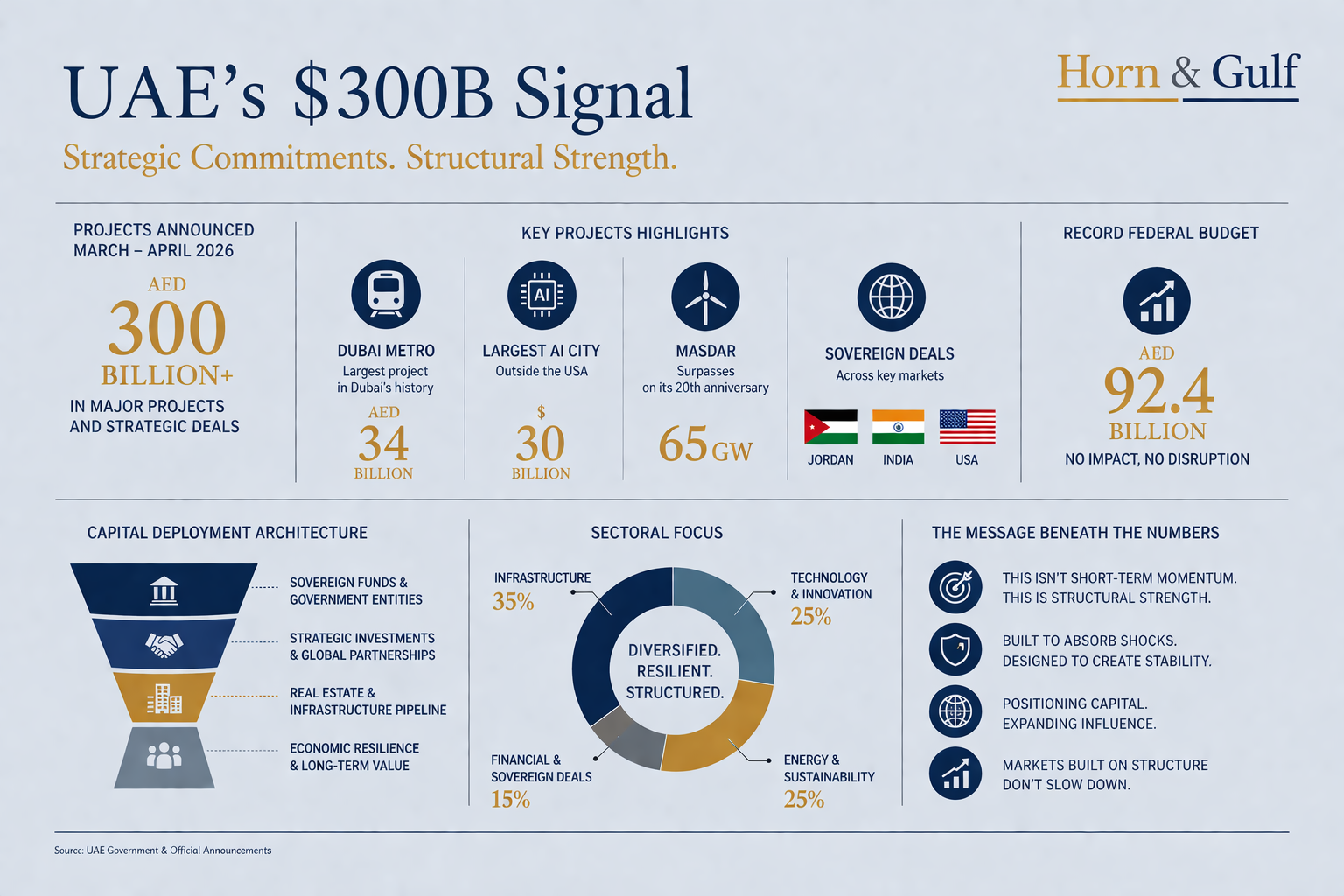
This creates a unique advantage. While traditional economies are constrained by fiscal cycles, the UAE operates with layered capital pools that can be activated selectively.
The result is not just flexibility. It is strategic timing.
In Times of Stress, Most Systems Contract — This One Accelerates
Global conditions remain uncertain. Supply chains are under pressure. Regional tensions persist. In such an environment, most economies slow down, reassess, and conserve.
The UAE does the opposite. It accelerates visibility. Project announcements increase. Strategic partnerships expand. Capital commitments become more public, not less. This is not accidental. It is a deliberate response to uncertainty.
When markets lose clarity, the system that provides it gains relative strength. This is not resilience in the traditional sense. It is controlled amplification.
Capital Does Not Flee Instability — It Reprices Toward Systems That Absorb It
The implications for capital flows are significant. Investors are no longer choosing between “growth markets” and “safe havens” in the traditional sense. They are looking for systems that can operate through instability without breaking structure.
The UAE increasingly fits that definition. This does not eliminate risk. But it reshapes it. Volatility is not removed — it is absorbed, managed, and redistributed across layers of the system.
In this context, large-scale project announcements are not about immediate returns. They are about long-term positioning within a global repricing of risk.
This Is Not a Growth Story — It Is a System Defining Its Role
The AED 300 billion figure is not the story. It is the surface.
Beneath it lies a system that is redefining how capital interacts with uncertainty. One that does not wait for stability to expand, but uses instability as a moment to reinforce its position. The UAE is no longer simply a fast-growing market.
It is becoming a platform — one designed to absorb shocks, maintain continuity, and attract capital not despite uncertainty, but because of how it manages it. And in a world where instability is no longer the exception but the baseline, that distinction matters more than growth itself.