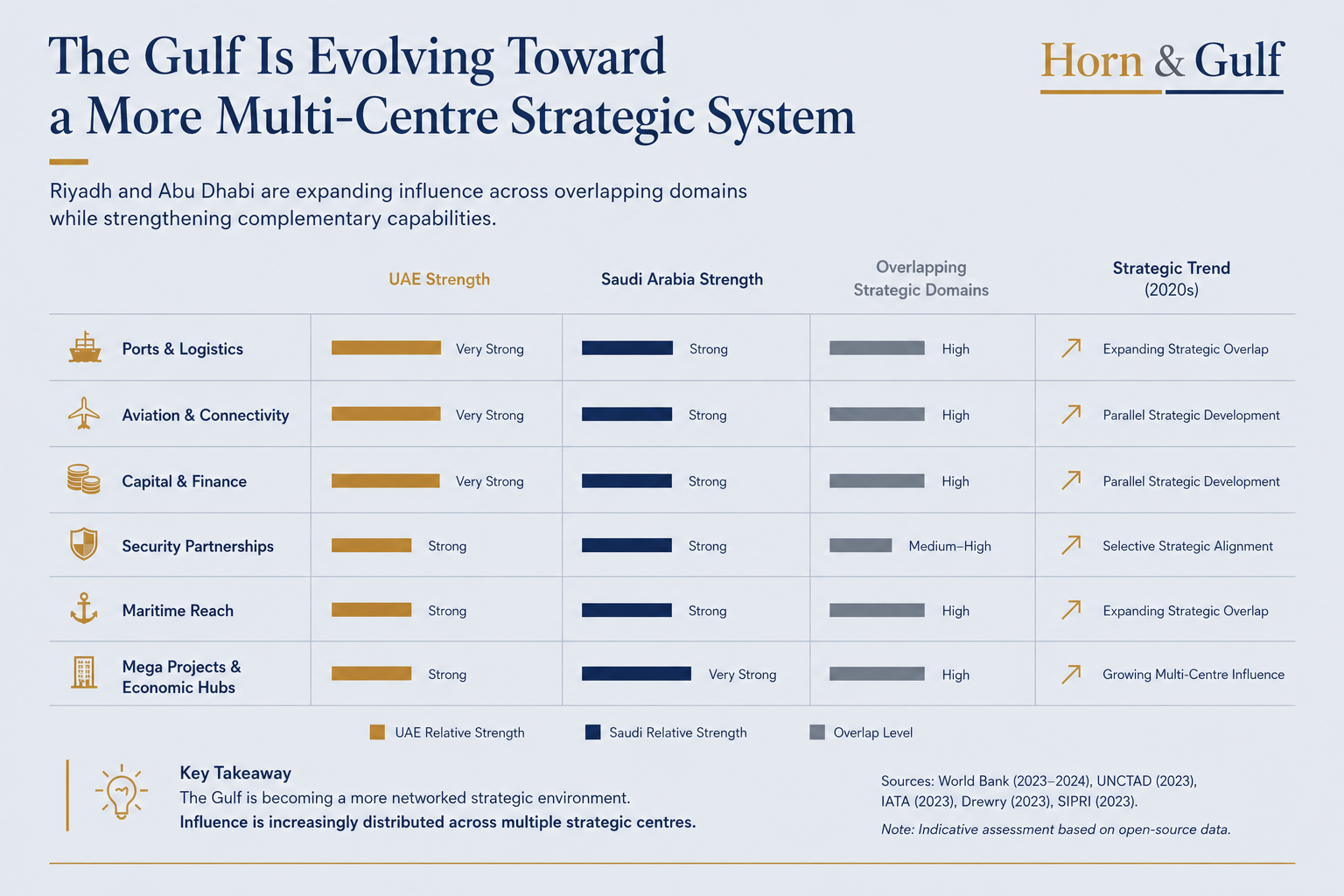
Saudi–UAE strategic competition is becoming one of the defining structural shifts inside the Gulf. While Riyadh and Abu Dhabi remain closely interconnected through security, trade and energy coordination, their strategic priorities are increasingly evolving toward a more multi-centre regional system.
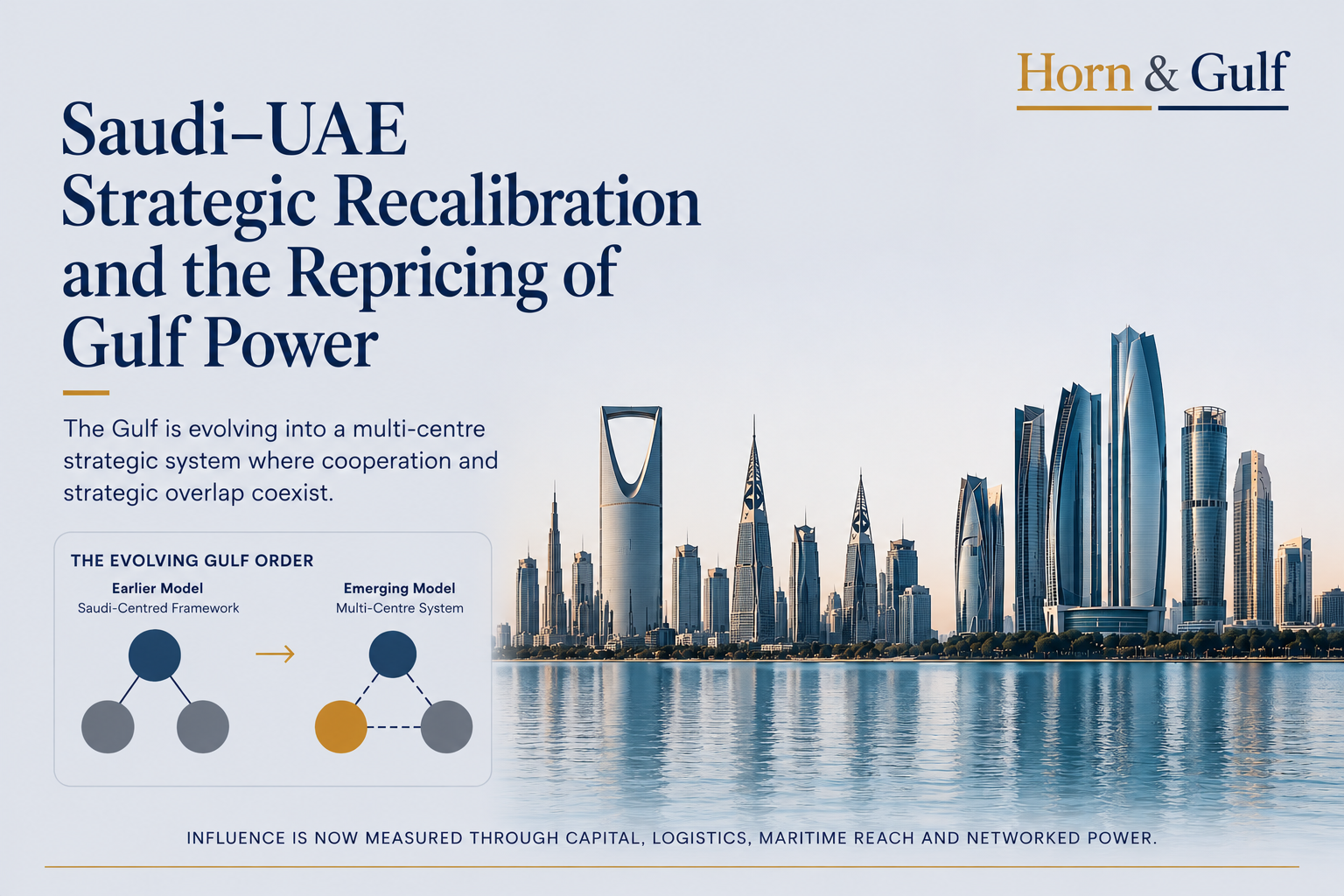
The visible signal is not a rupture between Riyadh and Abu Dhabi, but a more complex phase of strategic differentiation within the Gulf system.
Saudi Arabia continues to operate from a position of scale, religious geography, economic weight and historical centrality.
The UAE operates through a somewhat different model. Despite its smaller size and population, it has expanded influence through ports, finance, logistics, aviation, security partnerships, technology and global capital connectivity.
Abu Dhabi has developed a highly networked model of regional and global influence through finance, logistics, ports, aviation and technology.
That is where strategic divergence becomes more visible.
Historical Memory Still Shapes Gulf Politics
Several historical developments continue to influence how both states perceive regional order and sovereignty.
The Buraimi dispute in the 1950s left a lasting political memory involving territory, tribal loyalties and suspected oil reserves. For parts of the Emirati strategic outlook, the episode reinforced the importance of autonomy, institutional resilience and cautious balancing among larger regional actors.
In 2009, the UAE withdrew from the proposed Gulf monetary union project following disagreement over the location of the planned central bank headquarters in Riyadh rather than Abu Dhabi. The episode reflected broader sensitivities surrounding regional institutional balance and sovereignty inside the Gulf system.
These moments remain relevant because Gulf politics is shaped not only by formal institutions, but also by dynastic memory, prestige, sovereignty and long-term strategic perception.
This Is Larger Than Personal Diplomacy
Reducing Saudi–UAE divergence solely to the relationship between individual leaders risks oversimplifying a broader structural transition underway inside the Gulf.
Saudi Arabia is pursuing a major repositioning effort aimed at strengthening economic diversification, investment attraction, logistics integration, tourism development and technological transformation.
The UAE is simultaneously focused on preserving strategic flexibility and maintaining its role as a globally connected commercial, financial and logistical platform. This naturally creates areas of overlap.
Dubai and Abu Dhabi already function as major hubs connecting trade routes, aviation systems, capital flows, wealth management, arbitration services and maritime logistics networks. Saudi Arabia’s ongoing transformation increasingly places Riyadh in similar strategic sectors.
The earlier Gulf framework was more Saudi-centred politically, with the UAE functioning as a highly agile commercial and logistical partner inside that wider regional structure.
The emerging environment is more competitive and more complex. Both states are now investing heavily in capital attraction, logistics systems, strategic infrastructure, maritime connectivity and long-term economic influence.
Signal → Structure → Implication
Signal: Differences in strategic priorities periodically emerge across Yemen, OPEC coordination, regional diplomacy, Red Sea security and wider Gulf institutional discussions.
Structure: The Gulf is gradually evolving toward a more multi-centre system where Riyadh, Abu Dhabi and Doha increasingly pursue parallel but independent strategic priorities.
Implication: The Gulf should no longer be analysed exclusively as a fully unified geopolitical bloc. It increasingly operates as a competitive strategic ecosystem where cooperation and divergence exist simultaneously.
Yemen Highlighted the Strategic Difference
Yemen highlighted differences in strategic priorities more clearly than formal diplomatic language often suggests.
Saudi Arabia has generally approached Yemen primarily through border security, state continuity and the prevention of long-term instability along its southern frontier.
The UAE’s Yemen approach has often placed greater emphasis on maritime security, southern political dynamics, port infrastructure and anti-Islamist security priorities. Both approaches contained their own strategic logic, but they pointed toward somewhat different regional priorities.
For Riyadh, fragmentation risks prolonged instability near critical border areas. For Abu Dhabi, coastal security, maritime access and local security partnerships have remained especially important components of regional strategy.
The divergence was not simply tactical. It reflected different understandings of how regional stability should be preserved.
The Red Sea Is Expanding the Strategic Competition
The Red Sea, Gulf of Aden and Horn of Africa are no longer peripheral theatres for Gulf powers. They are increasingly connected to Gulf strategic depth, trade continuity and long-term economic security.
Ports, logistics corridors, food security, maritime chokepoints, naval access and infrastructure connectivity are becoming more central to Gulf strategic planning.
The UAE expanded early into this geography through port operations, commercial investments and regional security partnerships extending from the Horn of Africa toward parts of the eastern Mediterranean.
Saudi Arabia is also repositioning the Red Sea as a major strategic frontier linked to NEOM, energy transition routes, tourism development and long-term regional connectivity.
This creates simultaneous cooperation and competition. Both countries continue to prioritise regional stability, although their strategic approaches and operational priorities do not always fully align.
Ideology and Governance Models Also Matter
The divergence is not purely economic or geopolitical. The UAE increasingly positions itself around technocratic governance, controlled modernisation, commercial pragmatism and strong opposition to transnational Islamist movements.
Saudi Arabia’s recent reform agenda has also accelerated modernisation, while still operating within the broader context of Saudi Arabia’s religious, political and regional leadership responsibilities.
These differences can produce varying sensitivities regarding public opinion, regional diplomacy and political Islam across the wider Middle East.
Some of these distinctions became more visible after the Arab Spring and continue to influence regional alignments today.
Final Assessment
The Saudi–UAE relationship is not collapsing, and framing it as a crisis would likely exaggerate the current reality.
The two states remain deeply interconnected through security cooperation, economic coordination, energy markets and long-standing relationships with major global powers.
However, the relationship is evolving. The earlier model was closer to partnership within a more Saudi-centred regional framework.
The emerging model is increasingly characterised by parallel influence-building, strategic competition and selective cooperation. That is one of the most important geopolitical transformations currently underway in the Gulf. The most important conclusion is not that Riyadh and Abu Dhabi occasionally diverge. Major regional powers often do.
The more important signal is that the Gulf itself is evolving into a more networked and multi-centre strategic system where influence is increasingly measured through capital attraction, logistics integration, maritime reach and long-term economic connectivity rather than traditional hierarchy alone.