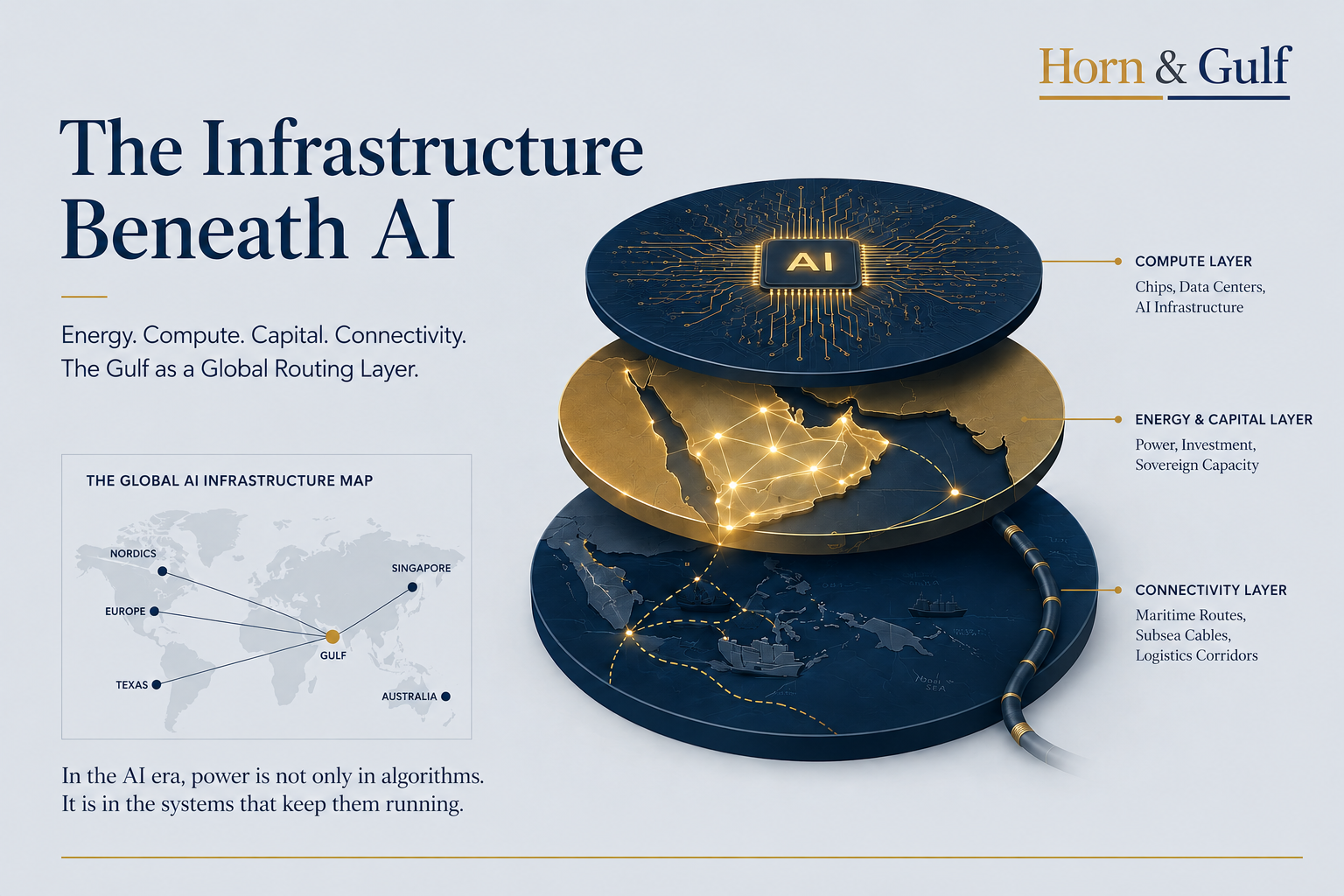
Gulf AI infrastructure is becoming increasingly important as artificial intelligence shifts from a software industry toward a physical infrastructure system. Compute capacity now depends not only on advanced chips, but also on electricity availability, logistics continuity and geopolitical access across interconnected global networks.
For much of the past decade, artificial intelligence was discussed primarily as a software competition shaped by models, venture capital and engineering talent. The assumption was that AI would evolve like previous digital industries: asset-light, globally distributed and concentrated around traditional technology hubs.
That assumption is beginning to weaken.
The AI economy is becoming increasingly physical. Compute infrastructure requires enormous electricity capacity, advanced cooling systems, long-term financing and politically trusted semiconductor supply chains. In that environment, geography starts to matter again.
This is where the Gulf’s strategic position becomes increasingly important.
Over the past fifteen years, several Gulf states — particularly the UAE — quietly accumulated overlapping layers of energy capacity, sovereign capital, logistical connectivity and diplomatic flexibility that now align with the structural requirements of the AI era. Nuclear energy investments, semiconductor partnerships, renewable infrastructure, normalization with Israel, deeper ties with India and calibrated engagement with both Washington and Beijing increasingly resemble components of a long-term state architecture rather than isolated policies.
The more important point is not whether the Gulf becomes “the next Silicon Valley.” The more important point is that the region is positioning itself as part of the physical operating system beneath the AI economy.
That is a different form of power.
AI Is Reconnecting Technology With Energy Geography
Most public discussion still treats artificial intelligence primarily as a software industry. Increasingly, it resembles strategic infrastructure.
The critical constraints are no longer limited to innovation itself. They now include:
- compute density
- electricity availability
- trusted semiconductor access
- regulatory continuity
- geopolitical alignment
This changes the geography of technological competition.
Large-scale AI systems require states capable of combining energy abundance, capital depth, infrastructure execution and political reliability. The countries best positioned for this environment are not necessarily those with the strongest startup ecosystems. They are the ones capable of sustaining infrastructure at sovereign scale.
The Gulf increasingly fits that profile. Electricity is re-entering geopolitics through AI.
In the industrial era, Gulf energy powered manufacturing systems. In the AI era, Gulf energy may increasingly support compute systems.
That shift is larger than technology itself. It represents a gradual convergence between digital infrastructure and energy geography.
Strategic Interoperability Is Becoming a Form of Power
The Gulf’s emerging advantage is often misunderstood as neutrality. The reality is more calibrated.
Several regional states are attempting to position themselves inside multiple geopolitical systems simultaneously while avoiding total dependency on any single bloc. That balancing mechanism matters because the AI economy is emerging inside an increasingly fragmented geopolitical environment.
Washington seeks trusted semiconductor ecosystems and controlled technology transfer. China seeks continuity despite export restrictions. India seeks large-scale compute capacity for its expanding digital economy. Israel contributes technological integration and venture depth. Europe faces growing energy and regulatory constraints around hyperscale infrastructure expansion.
The UAE increasingly positions itself between these systems.
Not outside them.
Not above them.
Between them.
Its long-term value may depend less on technological leadership itself and more on its ability to operate as an interoperable platform across rival geopolitical architectures. That distinction matters.
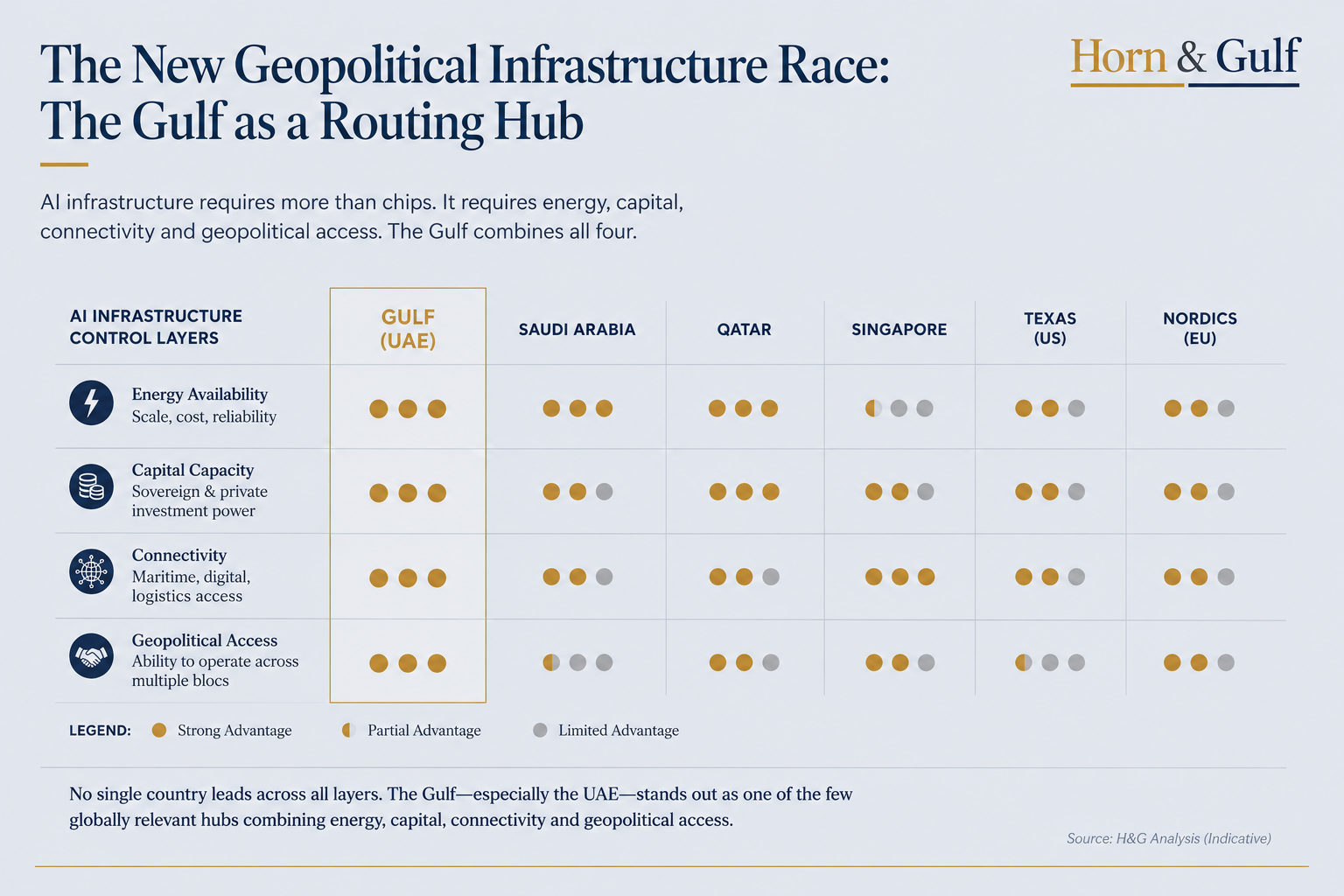
The UAE is not the only state pursuing this strategy. Saudi Arabia is expanding aggressively into AI infrastructure and compute capacity. Qatar retains significant sovereign-capital influence, while Singapore, Texas and parts of Northern Europe continue to hold structural advantages in regulation, energy integration or hyperscale infrastructure.
The more accurate interpretation is not that the UAE stands alone, but that it is emerging as one of a small number of globally relevant routing and continuity hubs within the evolving AI economy.
The Maritime Layer Beneath AI
One of the least discussed dimensions of artificial intelligence is that the system remains deeply dependent on physical continuity.
Semiconductors move through maritime trade corridors. Energy exports move through strategic chokepoints. Data infrastructure depends on subsea cable systems, stable ports, insurance markets and uninterrupted logistics networks.
This reconnects AI directly to the Gulf, the Red Sea and the Horn of Africa. The same maritime system already under pressure from Red Sea insecurity, insurance repricing and Hormuz risk is increasingly becoming part of the infrastructure backbone supporting future compute economies.
That creates a second-order geopolitical effect. The Gulf is no longer only exporting hydrocarbons through maritime chokepoints. It is increasingly supporting computational continuity.
This changes how strategic corridors are understood. Hormuz is no longer solely an oil transit route. The Red Sea is no longer solely a shipping corridor. Both are gradually becoming infrastructure arteries within a larger system linking energy, logistics, compute and capital flows.
That also means AI infrastructure inherits the vulnerabilities of physical infrastructure. Future disruption scenarios involving Hormuz, subsea cable systems, shipping insurance markets or regional escalation would affect not only energy pricing but potentially compute reliability and infrastructure confidence.
The AI economy may appear digital at the surface level. Structurally, it remains highly physical.
Capital Is Already Repricing the Shift
Global capital increasingly rewards continuity rather than narrative optimism.
Infrastructure funds, sovereign investors and hyperscale operators are searching for environments capable of providing:
- energy availability
- regulatory predictability
- sovereign financing capacity
- geopolitical access
- operational continuity
The Gulf increasingly markets itself within exactly that framework.
This helps explain why Gulf jurisdictions continue attracting capital despite broader regional volatility. The logic is not based on the absence of risk. It is based on relative system resilience.
The region is gradually being repriced from:
- energy exporter to
- infrastructure stabilizer
That repricing remains incomplete.
The Underestimated Transformation
The Gulf’s growing relevance in artificial intelligence is not primarily about software innovation. It is about the return of physical systems to the center of global economics.
For years, globalization encouraged the assumption that digital systems operated independently from physical infrastructure. The AI era is reversing that assumption.
Compute requires electricity.
Electricity requires continuity.
Continuity requires infrastructure.
And infrastructure eventually becomes geopolitics.
This is why the Gulf’s role in artificial intelligence may ultimately matter less as a technology story and more as a systems story.
The Emerging Control Layer
The next phase of the AI economy is unlikely to be determined solely by which country produces the most advanced models. The more important question may be which states become indispensable infrastructure layers beneath the system itself.
That appears to be the direction in which parts of the Gulf are positioning.
Not as replacements for Silicon Valley.
Not as neutral actors detached from geopolitical competition.
But as components of the trusted infrastructure architecture through which energy, compute, logistics and capital increasingly flow.
The Gulf is not replacing the digital economy. It is becoming part of the physical foundation beneath it.