Turkey’s Blue Homeland strategy is increasingly expanding beyond the Eastern Mediterranean into the Red Sea and Gulf security environment. Recent regional reactions to Ankara’s maritime posture suggest that Turkey is becoming a more influential actor across interconnected shipping corridors, energy routes and maritime-security systems.
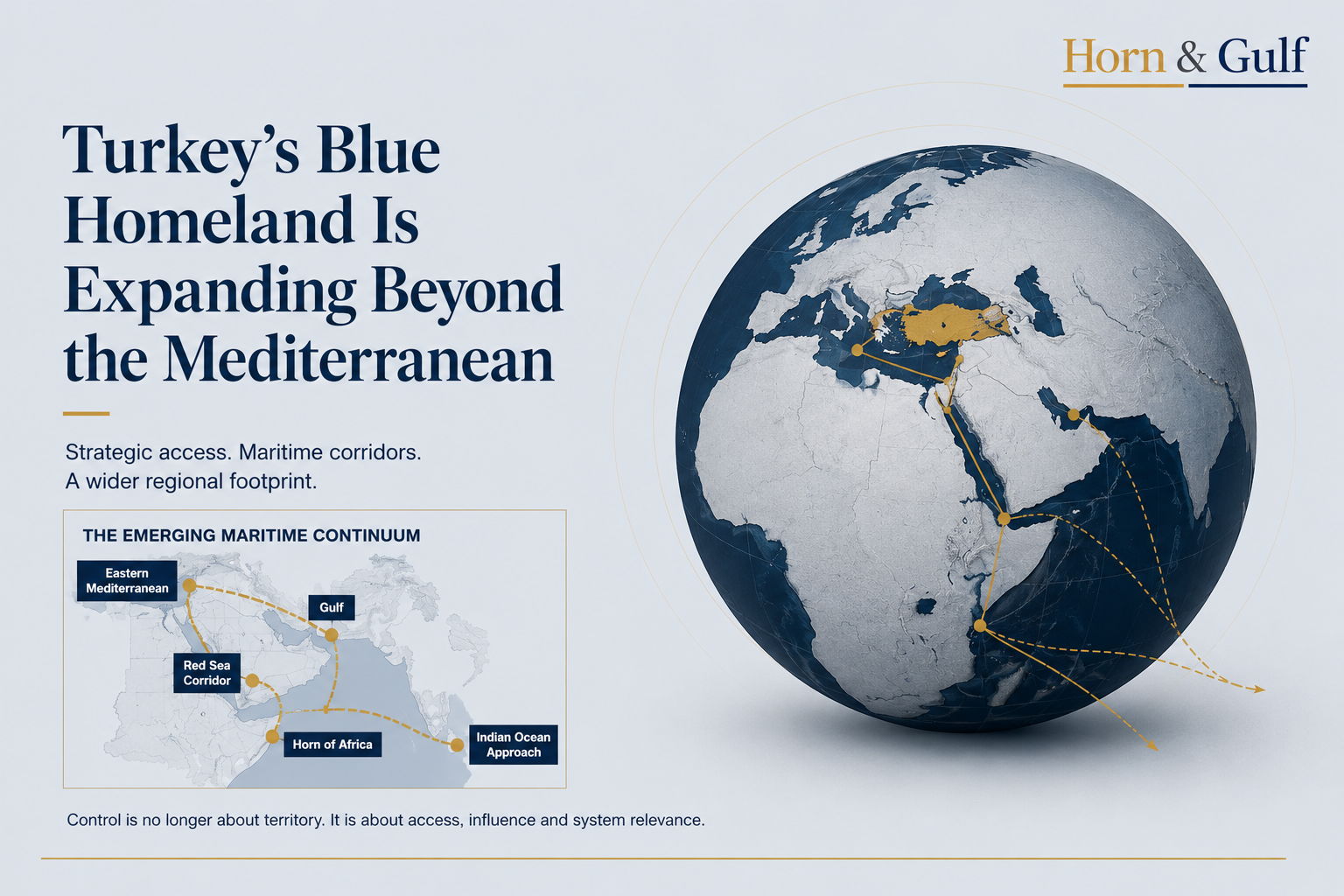
The signal was not Turkey’s naval posture itself. It was the growing regional reaction to it.
Recent Israeli media commentary describing a Turkish strategic arc stretching “from Greece to Yemen” reflects a broader shift now taking place across the Eastern Mediterranean and Red Sea system. The language may be exaggerated, but the underlying concern points to an important regional transition: Turkey is no longer being viewed solely as a Mediterranean power. Increasingly, it is being read as a maritime-system actor operating across interconnected chokepoints linking Europe, the Gulf and the Indian Ocean.
That distinction matters because the region itself is changing.
For decades, the Eastern Mediterranean, the Gulf and the Red Sea were often treated as largely separate strategic theatres. Today, those theatres are becoming increasingly interconnected through shipping routes, energy infrastructure, naval positioning, insurance exposure and logistical resilience. Developments near Cyprus increasingly influence calculations around the Bab el-Mandeb, while maritime developments in the Horn of Africa are becoming more relevant to Gulf security and trade discussions.
Turkey appears to be positioning itself within this evolving environment.
For years, the Blue Homeland doctrine was primarily associated with maritime boundaries, offshore energy disputes and naval positioning in the Eastern Mediterranean. Greece, Cyprus and Libya formed the visible geography of the discussion. Over time, however, the doctrine has expanded beyond maritime demarcation debates. It is increasingly connected to a broader effort to establish strategic access points across major maritime corridors.
That effort does not resemble a traditional territorial expansion project. Turkey is not establishing direct control across the region, nor is there clear evidence of a unified anti-Israel or anti-Gulf alignment extending from the Mediterranean to Yemen. Such claims remain interpretive and require careful qualification. Nevertheless, Ankara has expanded its regional presence through naval diplomacy, military cooperation agreements, defence partnerships and maritime-security engagement.
The Somalia dimension is particularly important.
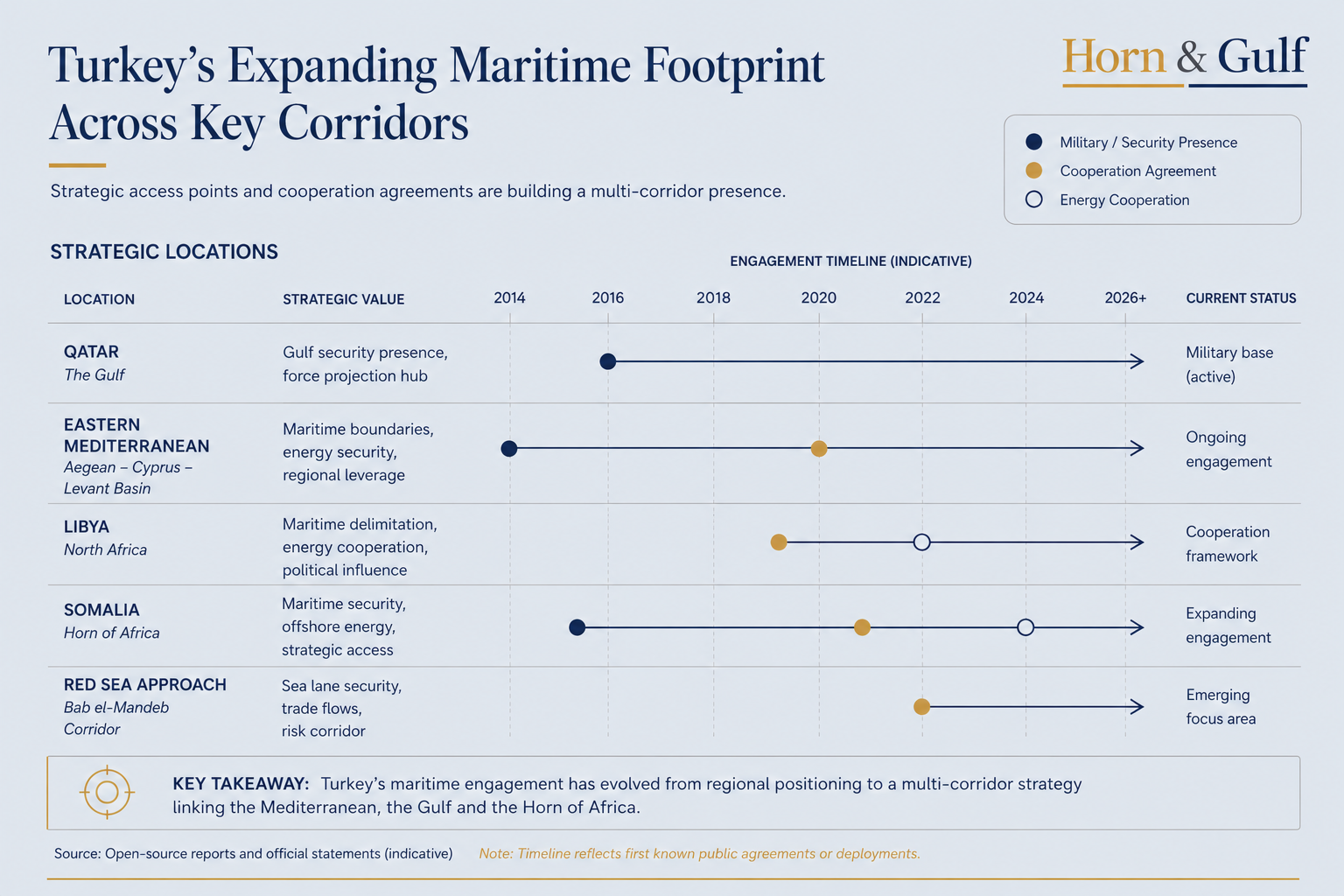
Turkey’s growing role in Somali maritime security and offshore energy cooperation places Ankara near one of the world’s most strategically sensitive maritime approaches: the Bab el-Mandeb corridor linking the Red Sea to the Gulf of Aden. This does not mean Turkey controls the chokepoint, nor does it imply direct Turkish influence over Yemen itself. But it does suggest that Turkey is seeking a more visible role within the wider maritime-security architecture surrounding Red Sea trade flows.
That positioning carries implications beyond military presence alone.
The Red Sea is no longer functioning simply as a shipping route. It is increasingly becoming a political and financial risk corridor where insurance exposure, naval protection, logistical continuity and route reliability are continuously reassessed. Escalations involving Yemen, maritime attacks or regional tensions can rapidly affect shipping premiums, rerouting decisions, delivery timelines and port competitiveness across the Gulf system.
This is where Turkey’s expanding maritime posture becomes strategically relevant.
The issue is not whether Ankara can “control” sea lanes in a traditional sense. The more important question is whether Turkey can shape negotiations, increase diplomatic leverage and establish itself as a relevant actor within the political architecture surrounding these routes. Current regional developments suggest its influence is expanding in that direction.
The Gulf layer deepens this dynamic further.
Turkey’s long-standing military presence in Qatar gives Ankara a durable position within the Gulf security environment. Combined with its Eastern Mediterranean posture and Horn of Africa engagement, this creates continuity across maritime theatres that were previously discussed more independently.
This continuity matters because the Gulf is entering a more multi-centred strategic phase in which regional states are pursuing increasingly differentiated security and economic priorities.
The region is also operating through multiple overlapping security arrangements rather than a single clearly dominant framework. Saudi Arabia, the UAE, Qatar, Iran and external powers continue to pursue distinct but interconnected approaches to regional security, trade and maritime positioning. At the same time, the Red Sea system is becoming increasingly crowded with competing port networks, naval actors, logistics corridors and energy-security calculations.
In such an environment, influence is measured less through territorial expansion and more through access, flexibility and system integration.
Turkey’s position is becoming increasingly relevant within that framework.
Unlike actors whose regional influence may be constrained by sanctions, isolation or limited institutional access, Ankara combines NATO connectivity, regional military reach, defence-industrial capacity and diplomatic flexibility. This allows Turkey to operate simultaneously within Western security structures while also pursuing autonomous regional engagement across the Mediterranean, Gulf and Horn of Africa.
This creates a more complex strategic environment for several regional actors, including Israel.
From an Israeli perspective, Turkey’s posture complicates multiple strategic calculations simultaneously: Eastern Mediterranean energy planning, Red Sea security considerations and broader maritime-alignment structures. The concern is not immediate military confrontation. Rather, the broader implication is that Turkey is becoming increasingly relevant to the region’s evolving maritime order.
That represents a different category of power. It is not direct domination. It is strategic insertion into the systems through which trade, energy and security increasingly flow. The longer-term implications may ultimately prove more important than the immediate headlines.
The Mediterranean and Red Sea are gradually evolving into a more integrated strategic operating environment shaped by insurance markets, naval presence, logistics resilience, energy corridors and capital behaviour. Ports, shipping routes and maritime partnerships are increasingly being evaluated not only through geography, but through resilience, policy continuity and crisis-management capacity.
This trend is already becoming visible across the Gulf.
Capital flows continue moving toward systems perceived as stable, flexible and operationally resilient. Shipping firms increasingly assess political exposure alongside distance and fuel costs. Insurance pricing is becoming more sensitive to regional military signalling and maritime disruption risks. Port competition is no longer purely commercial; it is increasingly shaped by geopolitics and strategic connectivity.
In that environment, maritime influence becomes an increasingly important factor in how commercial risk and capital allocation are assessed.
Turkey’s evolving Blue Homeland posture should therefore not be understood merely as a nationalist naval doctrine. It is increasingly part of a broader regional competition over who can shape the control layers governing movement across the Eastern Mediterranean, the Red Sea and the Gulf.
That competition remains in its early stages.
But the growing regional reaction to Turkey’s maritime posture suggests that many actors already recognise the direction in which the system may be evolving.