The “managed damage” framework now circulating in Gulf risk analysis reasonably describes what Iran has been doing. It explains less about why this week. Tehran has used limited coercion as a negotiating instrument before; this is not new. But something specific changed on Thursday, June 26 — the day before the Ever Lovely was struck — and almost no analysis has caught it. That is where this piece begins.
Four Tankers, One Corridor, One Thursday
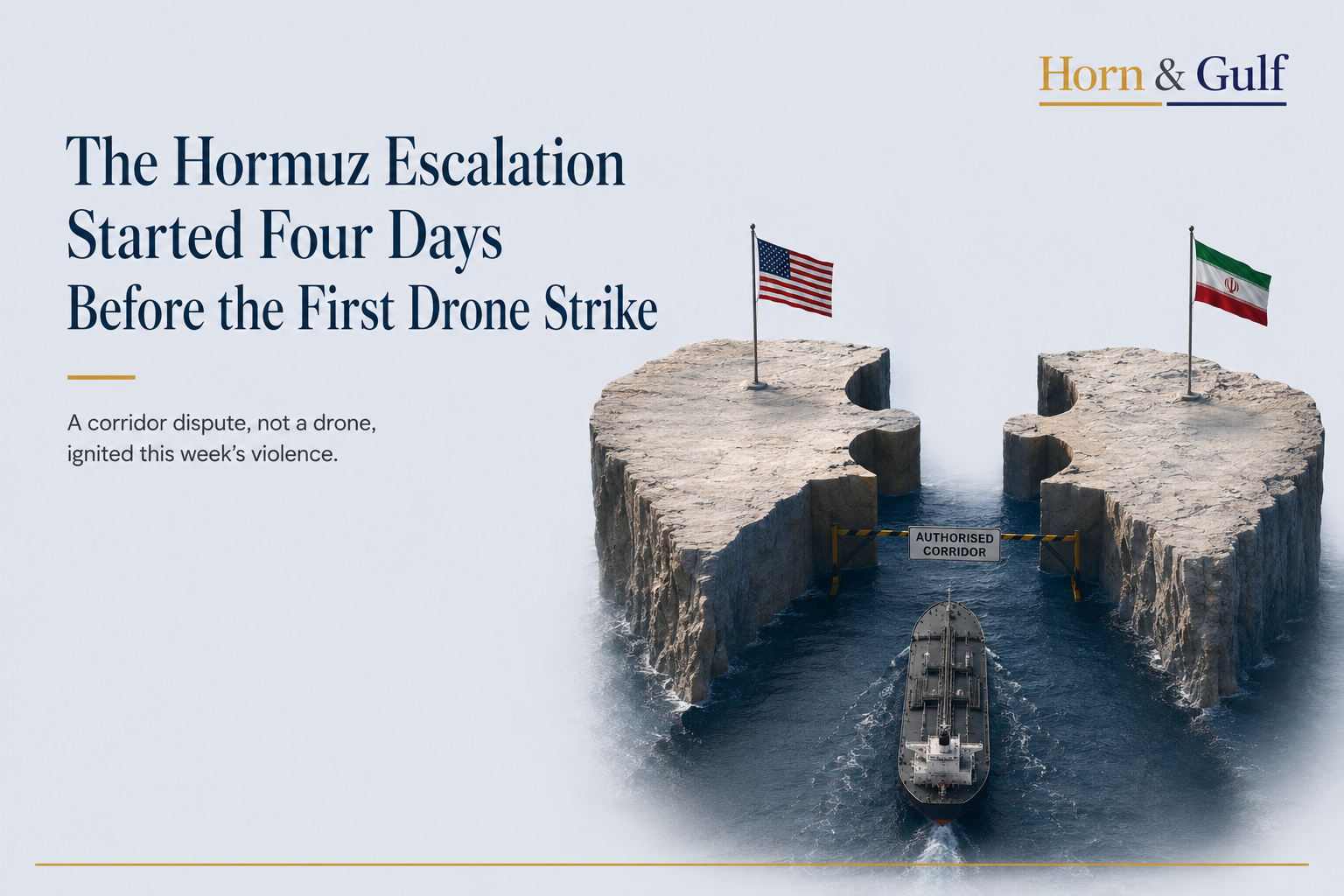
On the afternoon of June 26, the IRGC Navy stopped four tankers transiting the Strait of Hormuz and ordered them to reverse course. The vessels were not carrying sanctioned cargo. They had not violated any international maritime convention. They were simply moving through the southern corridor — the passage running closer to Omani territorial waters — without first notifying Iranian naval authorities.
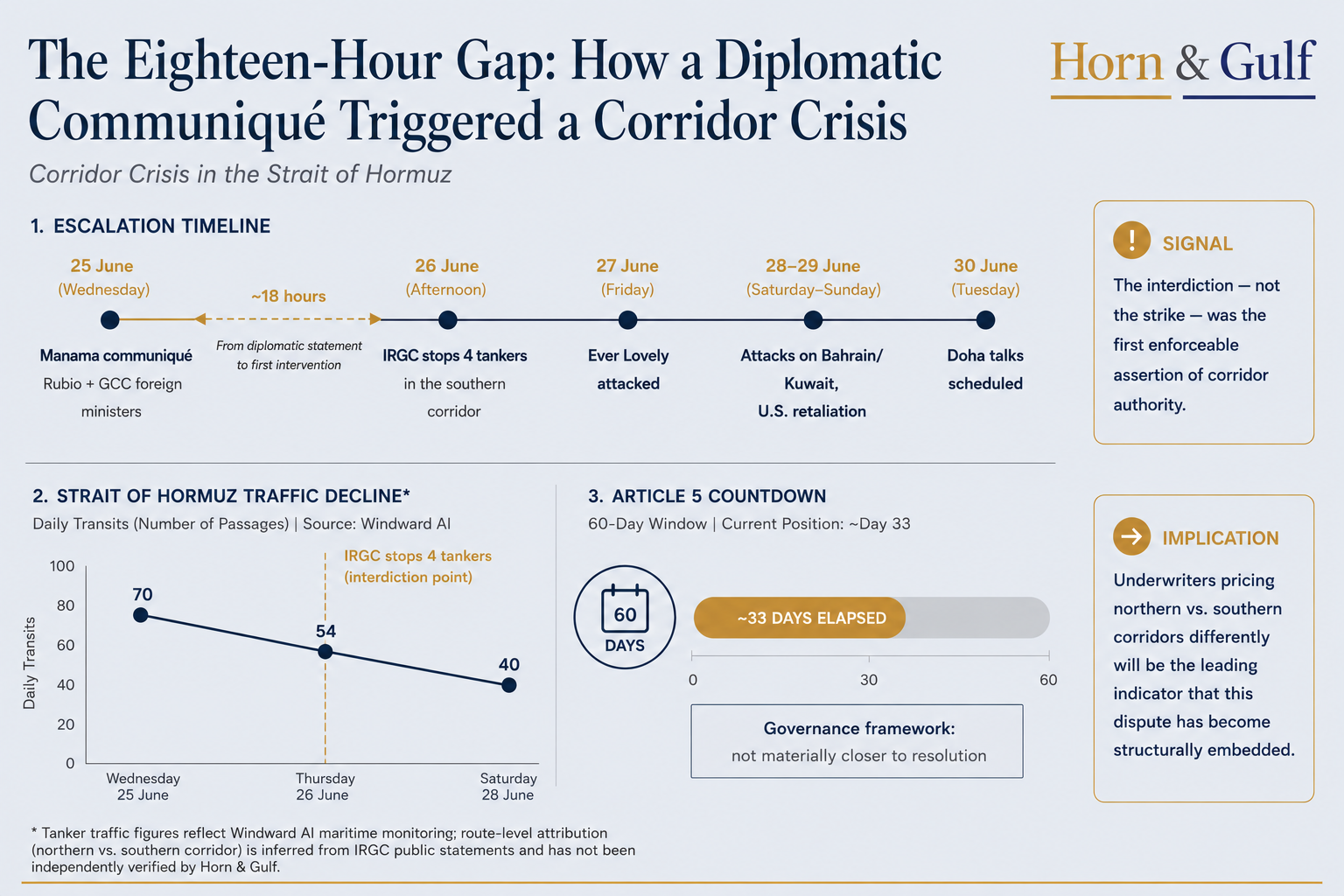
The IRGC called this “illegal, unacceptable and highly dangerous.” Three tankers switched to the northern corridor, through Iranian territorial waters, and completed their transit. One turned back entirely. Windward AI’s maritime traffic data shows daily transits through the Strait falling from seventy on Wednesday to fifty-four on Thursday. By Saturday, after strikes hit the Ever Lovely and Kiku, the number had dropped to forty.
Media coverage routinely compresses this into a single escalation arc: tanker interdiction Thursday, drone strike Friday, US retaliation Friday night, further Iranian strikes on Bahrain and Kuwait through the weekend, ceasefire announcement Monday. Reading the tanker interdictions separately produces a sharper picture, because they were not a military action. They were a legal assertion.
The IRGC was not testing the ceasefire. It was enforcing its own interpretation of it.
One Agreement, Two Incompatible Readings
What Article 5 Leaves Unanswered
Article 5 of the Islamabad MoU commits Iran to facilitating safe commercial passage through the Strait for sixty days. It calls on Tehran to open dialogue with Oman on “future administration and maritime services,” in coordination with other Persian Gulf littoral states. The text also invokes Iran’s “sovereign rights” as a coastal state and frames Iranian arrangements as operating within “applicable international law.”
On the question that matters most operationally — which corridor counts as authorised during the interim sixty-day period — the agreement says nothing.
Washington’s Reading vs. Tehran’s Reading
Washington reads the MoU’s passage provisions as corridor-neutral. Commercial vessels, in this reading, may use either the northern or southern route as an expression of restored transit. Gulf partners backed this interpretation, and traffic patterns reflected it: the southern corridor, where IRGC enforcement capacity is weaker, became the operationally preferred option for most commercial operators.
Tehran’s reading runs the opposite direction. Iranian officials have stated consistently — including through formal Foreign Ministry channels — that routing authority during the interim period belongs to Iran as a sovereign coastal state. In this view, the northern corridor is the designated route, and any vessel transiting south without IRGC coordination operates outside the agreement’s framework. Foreign Minister Araghchi warned this week that bypassing Iran’s preferred route would produce “tension and escalation.” He issued that warning before the strikes, not after. It described the legal framework the IRGC was already applying when it turned back the four tankers on Thursday.
Neither reading is unreasonable as textual interpretation. The MoU was built to secure a political agreement, and it deferred the corridor question rather than resolving it. Both parties signed the same sentence and read different operational permissions into it. Thursday’s interdictions marked the first moment that incompatibility turned into a physical event rather than a diplomatic disagreement.
This distinction reshapes how the subsequent violence should be read. Washington called the Ever Lovely strike a ceasefire violation. Tehran called the US retaliatory strike the violation, arguing the vessel had entered a route Iran already considered off-limits. Neither side broke the same agreement the other side thought it had signed. Each enforced a different one.
The Internal Dimension: Tehran Is Not One Actor
External analysis consistently underweights one factor: IRGC operational decisions and Foreign Ministry diplomatic channels run on parallel tracks, not synchronised ones.
This week supplied an unusually visible indicator of that gap. Iran’s Assembly of Experts — the body constitutionally responsible for overseeing the Supreme Leader — experienced a rare public rupture. A majority of its members issued a statement on the MoU; the body’s own leadership rebuked that statement publicly within hours. The exchange exposed live disagreement at the highest levels of the Islamic Republic over the terms of engagement with Washington.
This does not mean Iran’s political system is in crisis. It means that modelling Iranian behaviour as a single unified calculation will produce systematically wrong predictions. The IRGC turned back tankers on the same day Iran’s diplomatic team prepared to travel to Doha. Those two actions may not reflect one decision. They more plausibly reflect different institutional actors, operating under different mandates, applying different readings of the same agreement.
For institutional actors building risk models on Hormuz, the practical implication is this: de-escalation conditions are harder to identify than a bilateral US-Iran framework suggests. Iranian compliance is not a single variable. It results from IRGC institutional interests, domestic political competition, and Foreign Ministry positioning — three forces that can pull in different directions at once.
What Happened in Manama on June 25
A sequencing question remains unaddressed by the managed-damage framing: why did a corridor dispute that had been building for weeks convert into drone strikes and retaliatory airstrikes specifically in this window?
Part of the answer lies in a joint communiqué Secretary of State Rubio issued after meeting Gulf Cooperation Council foreign ministers in Manama on June 25 — the day before the tanker interdictions began.
How Tehran Read the Communiqué
The communiqué addressed Iran’s nuclear programme, its missile capabilities, and the governance of the Strait of Hormuz. Iran’s Foreign Ministry condemned it within hours, calling it “interventionist, irresponsible and provocative.” Tehran specifically objected to language it read as an attempt to build a regional security architecture that excludes Iranian participation. Deputy Foreign Minister Gharibabadi issued an explicit operational warning: any Hormuz governance framework not grounded in coordination with Iran and Article 5 of the MoU would trigger suspension of the designated parallel route.
The IRGC turned back four tankers the following afternoon. Forces struck the Ever Lovely the day after that.
Why the Timing Matters
The communiqué did not cause the escalation outright — the corridor dispute and the underlying governance contest predate it. But it functioned as an accelerant. Washington and its Gulf partners had signalled publicly that they were prepared to build a post-conflict maritime governance framework on terms Tehran found unacceptable. That signal narrowed Iran’s window for asserting corridor authority through lower-intensity means. The IRGC’s Thursday interdictions and Friday strike responded, in part, to a deadline Gulf-US coordination had created — not only to the corridor traffic itself.
This carries a specific lesson for Gulf policy planners, one mostly absent from current analysis: coordination with Washington on Hormuz governance language does not occur in a vacuum. Statements of principle that lack an enforcement mechanism, and that Tehran reads as structurally exclusionary, can accelerate Iran’s operational timeline for coercion. Measured in time between publication and the first tanker interdiction, the Manama communiqué’s cost ran to roughly eighteen hours.
What Doha Is Actually Negotiating
Commentary routinely frames the Tuesday Doha meeting as a return to diplomacy. It functions more precisely as a continuation of the corridor dispute by other means.
Good-faith gestures cannot resolve the questions that produced this week’s violence. They require a formal governance determination across several specific issues. Does commercial transit need advance IRGC notification or authorisation? Which corridor becomes the default route once the sixty-day interim period closes? What inspection or reporting requirements, if any, apply to vessels in Iranian territorial waters? Does Iran retain the right to charge service fees for transit? And how will any future multilateral maritime governance body be constituted, with which parties holding effective veto?
Each question produces a different answer depending on whether one accepts Washington’s reading of the MoU or Tehran’s. A ceasefire reaffirmation resolves none of them. The sixty-day Article 5 window — designed to create space for a governance framework — has now passed its halfway point, and the framework question stands no closer to resolution than when the parties signed the agreement.
Iran’s incentive in Doha is straightforward. Reaching the window’s expiry with no governance framework agreed preserves Iranian discretionary authority over the corridor. Accepting a framework that institutionalises the southern route as the operational norm does the opposite. Washington’s incentive runs in reverse. Doha, then, looks less like a negotiation toward agreement and more like a holding action in which both sides manage the clock.
Implications for Institutional Actors
Shipping operators and maritime insurers should treat the tanker interdictions, not the drone strikes, as the operative signal. The IRGC has shown it will enforce corridor authority physically, not just rhetorically — and it will do so against vessels carrying no sanctioned cargo under any legal framework except its own reading of an ambiguous MoU. Doha is unlikely to resolve the corridor question formally. Until it does, the southern route carries a risk premium that routing decisions alone cannot hedge. Watch for underwriters pricing the two corridors differently on a sustained basis: that will mark the point where the governance dispute becomes structurally embedded in regional logistics costs.
Gulf sovereign wealth funds and infrastructure investors with Hormuz-adjacent exposure should track the governance outcome, not the ceasefire status. A post-conflict regime that formally or operationally validates Iranian corridor authority creates a conditional-access environment, where transit certainty remains periodically renegotiable. That risk profile differs structurally from one governed by international maritime law with multilateral enforcement. The distinction carries real weight for energy export pricing assumptions, project finance parameters in the eastern Gulf, and the long-term value of alternative routing infrastructure that several Gulf states have built over the past decade. Saudi Arabia’s Yanbu redundancy hedges against Hormuz closure. It does not hedge against Hormuz operating as a managed-access corridor with episodic coercive enforcement.
Gulf policy planners can draw a lesson from the Manama sequencing that extends past this episode. The communiqué was diplomatically necessary as a statement of principle. Its operational consequence was an accelerated Iranian enforcement timeline. Future coordination with Washington on Hormuz governance language needs to account for this dynamic explicitly — not by avoiding principled positions, but by timing them against the Iranian escalation cycle rather than in ignorance of it. Statements issued at the wrong point in that cycle do more than fail to deter. They can actively compress the window in which lower-intensity outcomes remain available.
Verdict
This week’s strikes on Bahrain, Kuwait, and commercial shipping in the Strait of Hormuz did not begin with a drone. They began with a legal claim: four tankers turned back on a Thursday afternoon, because Iran and the United States had signed the same agreement and read different operational authorities into it.
Doha will not resolve that disagreement. It will manage it for another cycle. The corridor question, the IRGC’s enforcement authority, and the post-conflict governance architecture of the world’s most consequential maritime chokepoint all remain structurally open. The sixty-day Article 5 window was meant to bridge toward a governance framework. Instead, it has become the arena where the governance contest plays out.
Institutional actors should model accordingly. The real risk is not the next drone strike. It is that the current ambiguity resolves into a managed-access regime rather than a rules-based one — and that by the time that outcome becomes visible in diplomatic language, markets will have already priced it into insurance, capital behavior, and the operational assumptions of every logistics operator moving energy through the eastern Gulf.
Horn & Gulf produces independent strategic analysis for institutional audiences across the Gulf, Red Sea, and Horn of Africa. This brief does not constitute investment advice.