The Bahrain strikes ceasefire dynamic is revealing a different phase of Gulf security rather than a simple return to stability. Recent attacks and the subsequent resumption of technical talks suggest that limited military pressure and continued negotiations are increasingly operating in parallel, creating a new framework for pricing geopolitical risk across Hormuz.
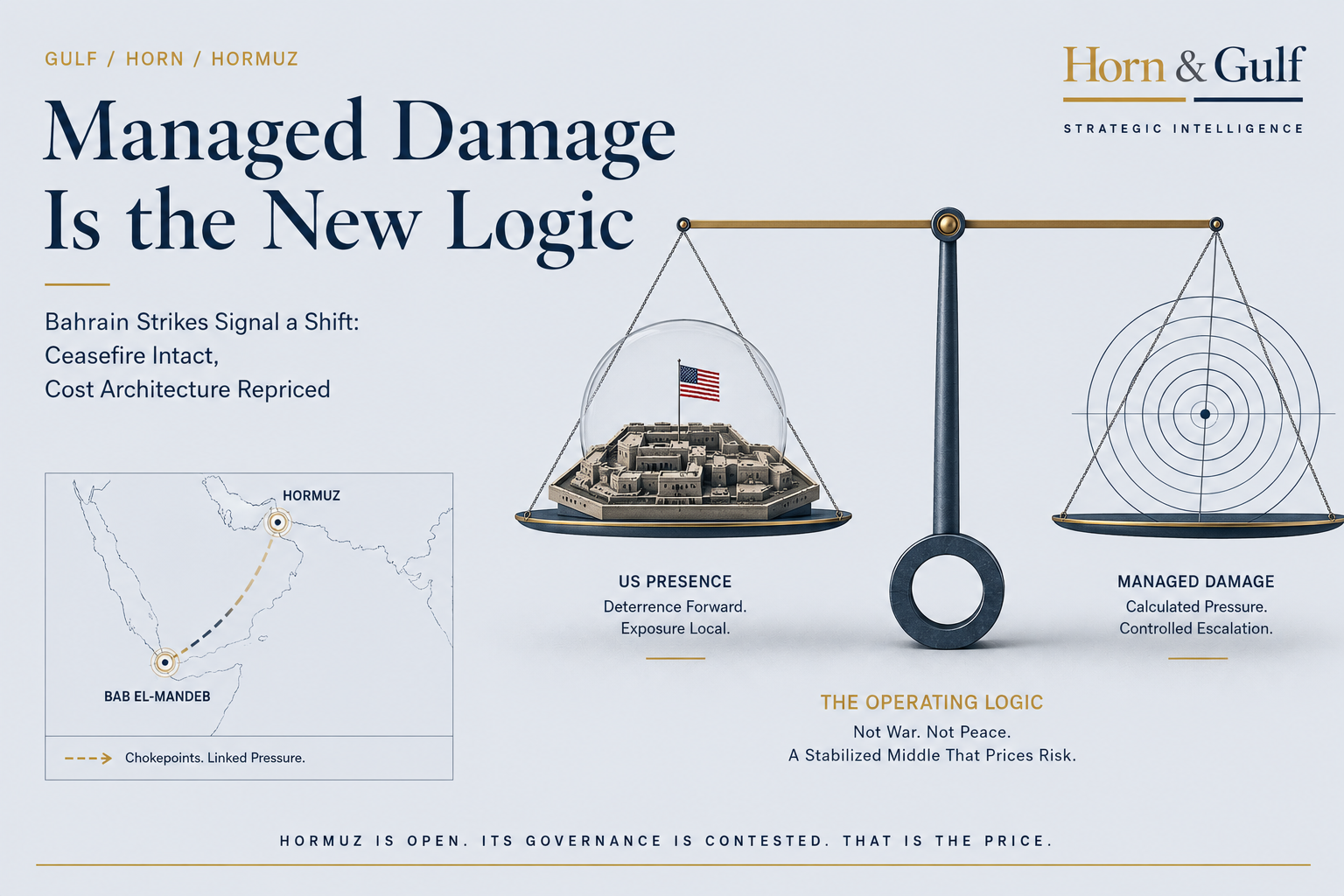
The missile that struck a residential building in Muharraq did not hit a military target. Whether that was precision failure or deliberate ambiguity almost does not matter — because in either case, Tehran produced the same strategic outcome: a demonstration that hosting American military infrastructure carries a cost that extends beyond the base perimeter.
That is the signal worth reading carefully. Not the fact of the strikes, which Reuters confirmed and most analysts have now processed. But the geometry of them.
Bahrain, Kuwait, and Qatar were all affected within the same operational window. Bahrain took structural damage to a civilian building near the Muharraq air base. Kuwait intercepted two ballistic missiles. Qatar reported a shrapnel death from regional operations. No American casualties. No major military infrastructure destroyed. And within hours, Washington and Tehran agreed to halt attacks and return to technical talks on Hormuz.
The pattern is not escalation toward war. It is something more difficult to price: the institutionalization of manageable damage as a negotiating instrument.
What the MOU’s Fifth Article Actually Does
Most commentary on the Pakistan-brokered memorandum has focused on the Hormuz passage provisions. The more consequential clause is Article Five.
Under its terms, Iran commits to “best efforts” for safe commercial passage through the Strait for sixty days. After that window, Iran, Oman, and other Gulf states are scheduled to negotiate the future governance of the passage itself.
The distinction is not technical. It is structural. A sixty-day best-efforts commitment does not reopen Hormuz — it timetables a dispute over who controls the transit regime. Insurance actuaries and shipping operators are not pricing those two things identically. Passage restored and passage under managed contestation are different risk environments, and the Article Five formulation delivers the second while allowing both parties to claim the first.
Fertiliser shipments have begun moving through the Strait again, Reuters reported on June 26. Over five hundred vessels remain trapped inside the Gulf. Traffic remains well below pre-conflict levels. The physical channel is technically open. The governance question is explicitly unresolved.
The Architecture of Coercive Hosting
Iran’s strike pattern reflects a logic that Chatham House identified in its June analysis: Tehran’s deterrence architecture, weakened across the Levant as Hezbollah’s capacity has degraded, is being rebuilt through a different pressure point — the vulnerability of Gulf host states.
The mechanism operates as follows. American forward deployment in Bahrain, Kuwait, and Qatar transforms those states’ territory into legitimate targeting environments under Iran’s declared doctrine. Striking adjacent to — rather than directly at — military infrastructure achieves two things simultaneously: it maintains plausible operational deniability around precision failure while signaling to Gulf governments that their exposure is not theoretical.
Riyadh has watched this carefully. Saudi Arabia’s own de-escalation posture, which Chatham House has characterized as economic infrastructure rather than diplomatic concession, depends on the Gulf not becoming a managed-damage theater. The Yanbu export route and the Red Sea corridor provide genuine redundancy against Hormuz disruption. They do not provide redundancy against the broader insurance and capital behavior effects that low-intensity strikes generate even when the Strait remains technically navigable.
This is the structural pressure that matters most for institutional readers. Disruption does not require closure. The perception of contested passage is sufficient to alter shipping confidence, insurance calculations, and contingency planning by regional operators.
The Condition That Is Not in the Agreement
One element of the current situation receives less analytical attention than it warrants: Iran has made clear, through channels Reuters has reported, that it views resolution of the Lebanon conflict as a condition for sustained MOU compliance.
That framing does not appear in the agreement’s text. It operates as an implementation constraint — a political ceiling below which the ceasefire’s operational credibility cannot descend regardless of what Bahrain or Hormuz provisions specify.
The implication is significant. The MOU is being priced not primarily as a Gulf-American bilateral arrangement, but as one element in a much wider Axis of Resistance geometry. If Hezbollah’s situation deteriorates further, the Hormuz technical talks may continue on schedule while Iran’s incentive to honor Article Five’s spirit quietly erodes.
Gulf policy planners cannot resolve this tension. But they can account for it.
What Institutional Actors Should Price Differently
For infrastructure investors and development finance institutions with Hormuz-adjacent exposure, the relevant question is no longer whether the Strait reopens fully. It is how long the current ambiguity lasts, and what that ambiguity costs.
The attack-negotiation-attack cycle that emerged over the past seventy-two hours is not a sign of breakdown. It is beginning to look like a stabilized pattern — which is, in some respects, worse. Breakdowns resolve. Stabilized low-intensity contestation generates persistent pricing effects on insurance, shipping confidence, and capital behavior without triggering the decisive de-escalation response that a full breakdown would demand.
For logistics operators still routing around the Strait, the return of fertiliser shipments is a data point, not a signal. Passage capacity at a fraction of pre-conflict levels, with five hundred vessels still waiting, and a governance dispute explicitly scheduled for renegotiation, does not constitute a restored corridor.
For the Horn of Africa, the exposure is downstream and indirect but real. Chatham House’s multiplier analysis on simultaneous Hormuz and Bab el-Mandeb pressure applies here: if the Red Sea–Bab el-Mandeb–Horn axis absorbs sustained spillover from continued Gulf instability, food price and fertiliser supply risk for East African markets remains structurally elevated regardless of short-term shipping resumptions.
The Bahrain strikes will likely recede from headlines quickly. No American deaths. A ceasefire nominally intact. Talks resuming on schedule.
That is precisely the condition Iran has calibrated for. The managed damage threshold — high enough to signal coercive capacity to Gulf host states, low enough to avoid triggering American military response — is not a miscalculation. It is the policy.
For institutional actors in the region, the operating question has shifted. It is no longer whether the next escalation will cross a threshold. It is whether the current threshold produces structural costs that compound quietly — in insurance markets, in capital behavior, in the governance of the world’s most consequential maritime chokepoint — before any single dramatic event forces a reappraisal.